Agentic AI for WordPress – The Complete 2026 Guide
What Is Agentic AI for WordPress?
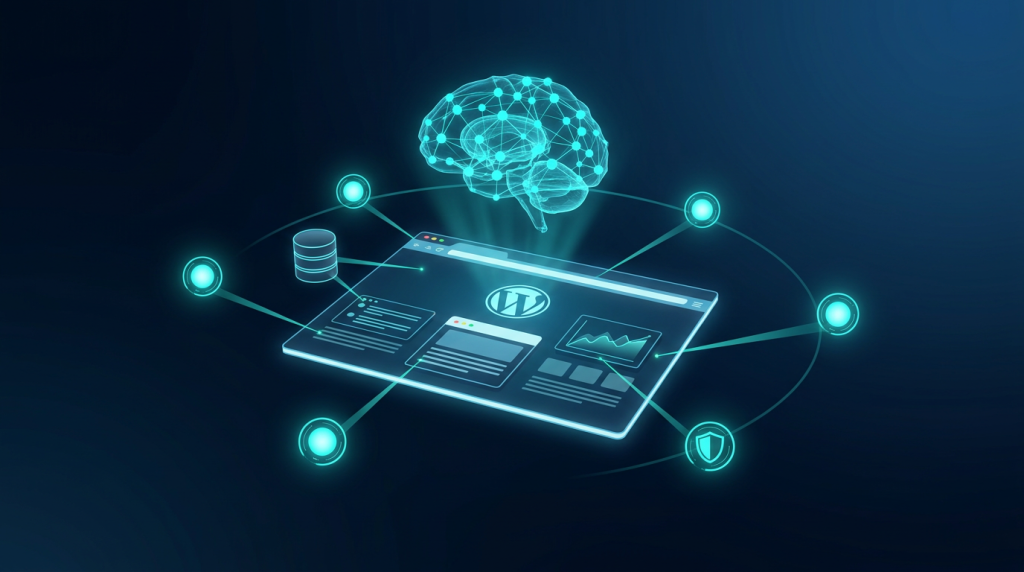
Agentic AI for WordPress is a system of autonomous, goal-oriented software agents. These agents plan, execute, and self-correct multi-step tasks inside your WordPress environment. They use shared memory, real-time tool access via the Abilities API, and Model Context Protocol (MCP) to pursue business outcomes. No human micro-management is needed.
The Paradigm Shift: From “Tool” to “Digital Employee”
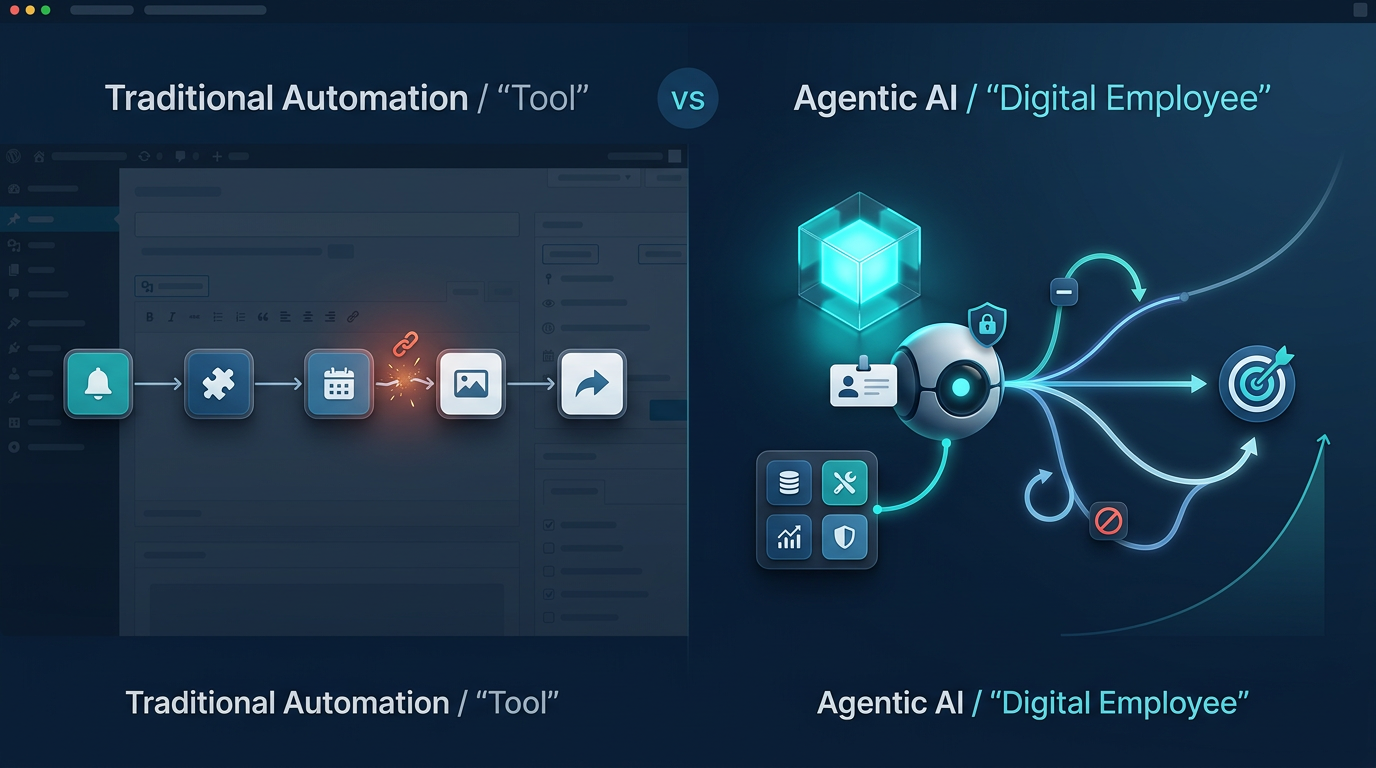
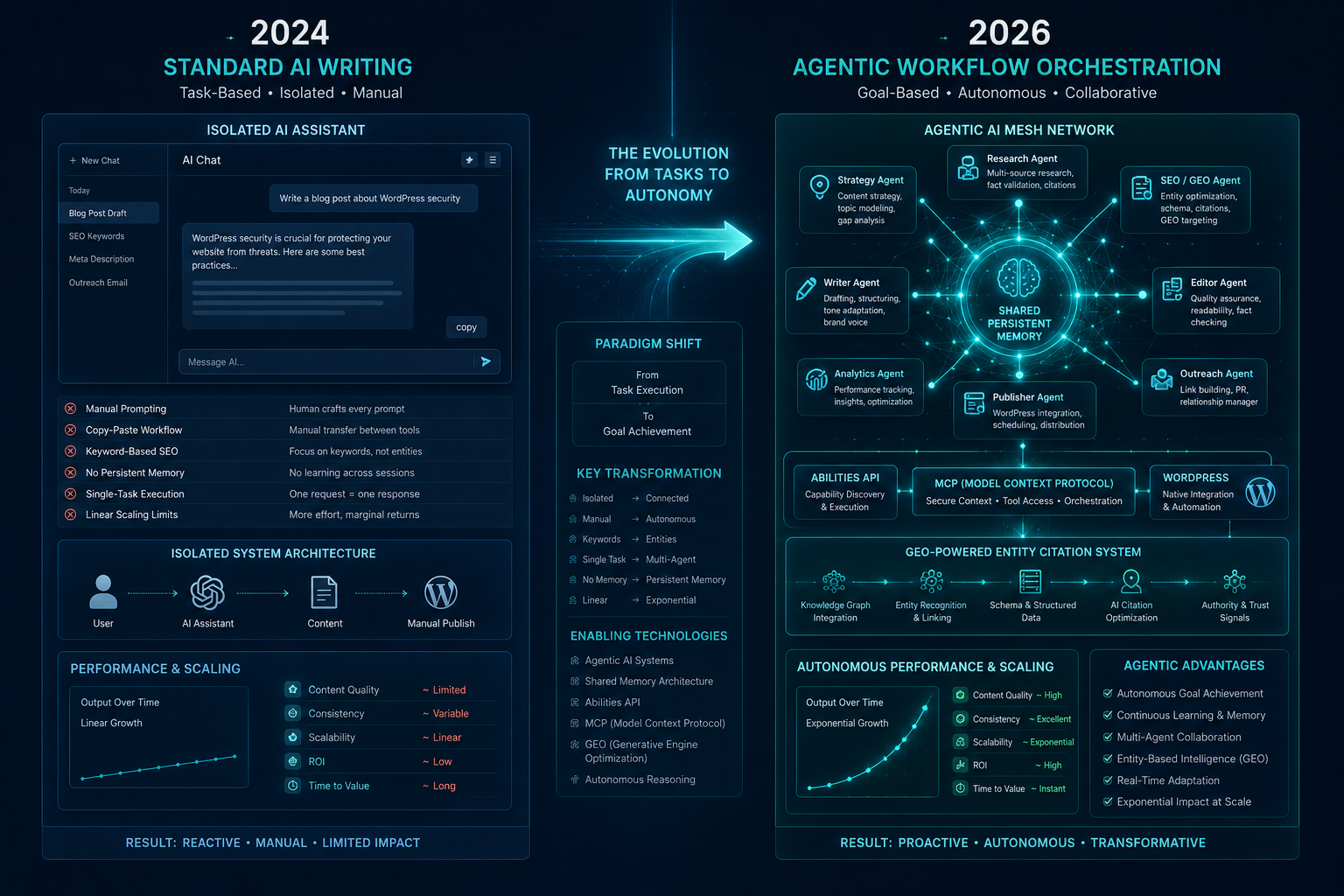
The transition happening in 2026 is not incremental. It is a complete shift in how humans interact with software. For two decades, WordPress automation relied on linear, rule-based logic. Plugins worked as tools. A human had to provide the trigger and the exact instructions. This is the “Traditional Automation” model (IFTTT). While it served its purpose, it was brittle. When the digital environment changed even slightly, the automation broke. It had no ability to reason.
Agentic AI for WordPress works differently. It operates on the principle of Goal-Based Reasoning. Instead of giving instructions, you give the system a desired outcome. For example, instead of manually scheduling a post, you task an agent with “Enhancing the topical authority of our technical blog category.” As a result, the agent analyzes current content, finds gaps through live market data, and fills them. More importantly, it picks its own tools, checks its own work, and adapts when it hits an obstacle.
At WPscaleops.com, we call this the shift from a “Tool” to a “Digital Employee.” A digital employee understands context. It holds memory of your brand guidelines. Furthermore, it has direct authority to interact with WordPress core through secure protocols. This autonomy allows organizations to scale content and operations at a non-linear rate.
The Technical Backbone: WordPress 6.9+ and the AI Building Blocks
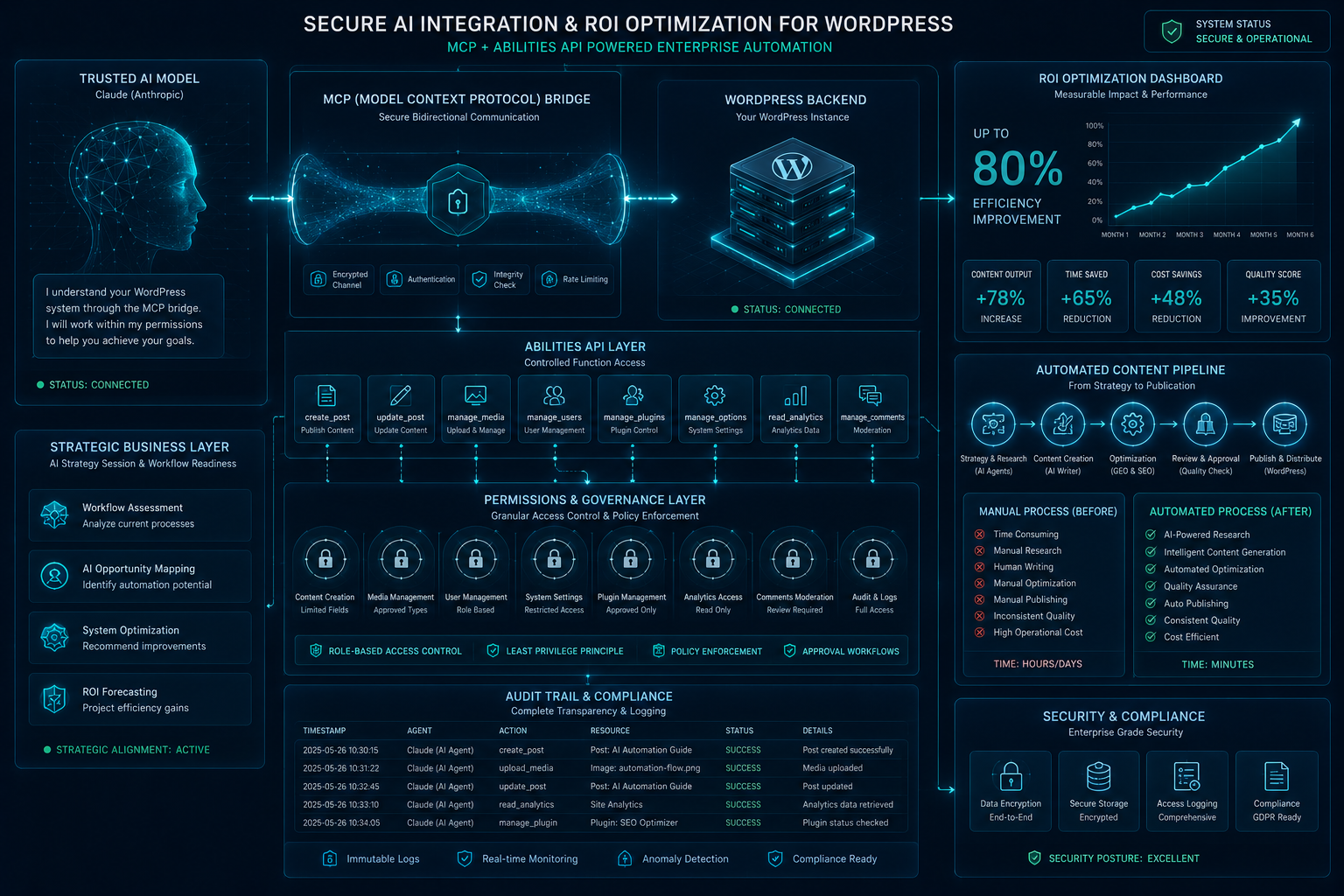
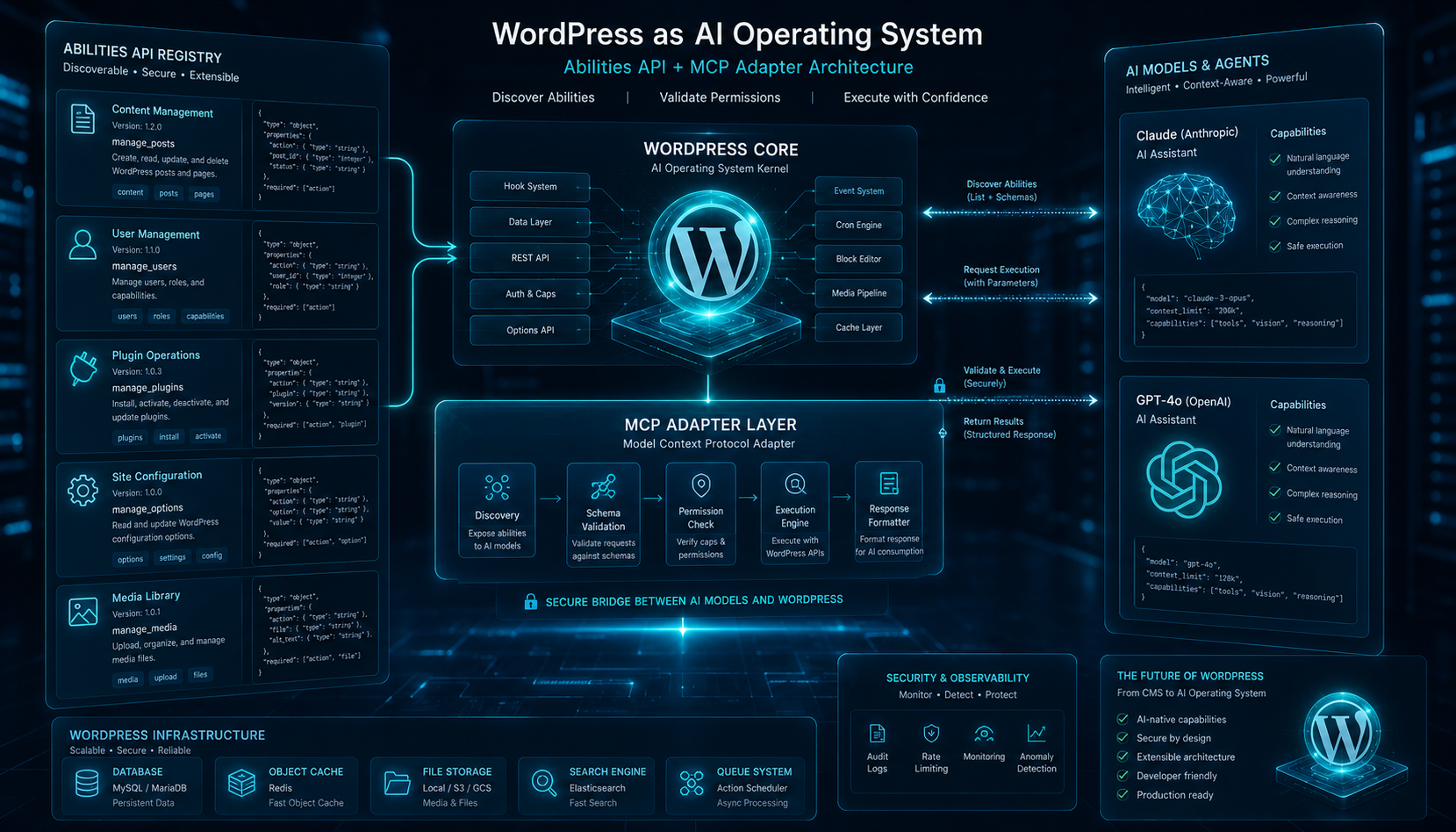
The maturity of Agentic AI for WordPress in 2026 comes from one key change. WordPress evolved from a simple CMS into a robust operating system for AI. This evolution rests on two core technologies: the WordPress Abilities API and the Model Context Protocol (MCP).
The WordPress Abilities API: Making Your Site Discoverable
Introduced in WordPress 6.9, the Abilities API serves as the nervous system for AI agents. Before this API existed, an AI agent had to guess REST API endpoints. It had to navigate a chaotic landscape of hooks and filters. In contrast, the Abilities API gives agents a clean, machine-readable registry of every capability your site has.
Every “Ability” in the system follows a strict schema. This includes:
- Namespace and Name: A unique identifier for the action (e.g.,
wpscaleops/security-scan). - JSON Schema Definitions: Defined input and output parameters that ensure the AI sends the correct data types.
- Permission Callbacks: A security layer that checks whether the agent has authority to execute the action.
As a result, this API turns your website into a set of “skills” an agent can browse and use. It removes the hallucination problem found in older AI integrations. The agent must stay within the strict boundaries of your site’s code.
Engineer’s Note: The key advantage of the Abilities API is “discoverability.” When an agent starts up, it queries the site for all available abilities. This gives it a full map of what it can do — from updating WooCommerce stock levels to regenerating CSS files — with no hard-coded developer instructions required.
The MCP Adapter: A Native Terminal for Claude and ChatGPT
The Abilities API defines what the system can do. The Model Context Protocol (MCP) Adapter defines how the agent gets access. MCP is an open standard. It allows Large Language Models (LLMs) like Claude 4, GPT-5, and Llama 4 to “mount” a WordPress site as a secure resource. For a deeper technical reference, see the official MCP specification.
The MCP Adapter creates a live connection between the model and the server. Using HttpTransport, agents read WordPress data as “Resources.” They also execute site functions as “Tools.” In other words, your AI agent doesn’t just talk about your site — it works inside it. It browses the media library, audits user permissions, and edits the wp_options table. All of this happens within a sandboxed, permission-aware environment.
The Multi-Agent Swarm: Agentic AI for WordPress Content Workflows
In high-performance WordPress environments, one AI instance is not enough. Therefore, we deploy a “Swarm” — a group of specialized agents that work together within a shared memory layer. This approach delivers higher accuracy and deeper optimization than any human-led process can achieve at scale.
1. The Researcher Agent
The Researcher finds high-value content gaps. It uses Firecrawl to deep-crawl competitor sites. It also connects to live Search APIs to see what AI Overviews (SGE) currently cite. Then, it cross-references this data with your internal content graph via the MCP Adapter. The output is a structured “Opportunity Manifest.” This is a clear list of the entities and topics your brand needs to cover.
2. The Creator Agent
The Creator receives the manifest and starts drafting. It draws from Shared Memory, which holds your brand voice, style rules, and restricted vocabulary. Because it has native WordPress access via the Abilities API, it pulls in internal data — like related products or past blog posts. As a result, the draft feels like it was written by a senior team member, not a generic AI tool.
3. The GEO Specialist Agent
In 2026, optimization has moved beyond keywords. It now focuses on Generative Engine Optimization (GEO). This agent makes content “AI-readable.” It injects specific JSON-LD schema types — including Article, FAQ, and Entity schemas from Schema.org. It also maps key terms to their Wikidata entries. Furthermore, it formats content in the “Direct-Answer” style that AI search engines like Gemini and Perplexity prefer for citations.
4. The Social Distribution Agent
Once the post goes live, the Distribution Agent activates via a webhook. It reads the published version and understands the core arguments. Then, it creates native content for LinkedIn, X, and Threads. It doesn’t just share links — it builds platform-specific “Engagement Loops.” It also monitors comments and alerts a human only when a high-value interaction needs a personal response.
Autonomous Maintenance: How Agentic AI for WordPress Heals Itself
The biggest operational ROI in Agentic AI for WordPress comes from Resolution-Based Maintenance. We have moved away from reactive troubleshooting. Instead, we use a proactive, self-healing model. Agents work toward one standing goal: 99.9% uptime and zero critical security vulnerabilities.
When a plugin update is released, a maintenance agent acts on its own:
- Staging Deployment: It creates a mirror of the live site in a staging environment.
- Regression Testing: It applies the update and runs visual and functional tests. It checks whether the header, footer, or checkout process has changed.
- Diagnostic Repair: If a conflict is found, the agent reads the PHP error logs and the site’s hook registry. It often applies a “Compatibility Patch.” If not, it rolls back the update and sends a full technical report to a human engineer.
Because of this system, your site stays updated and secure. The risk of a “White Screen of Death” hitting your live audience is eliminated.
GEO: Structured Data as Competitive Infrastructure
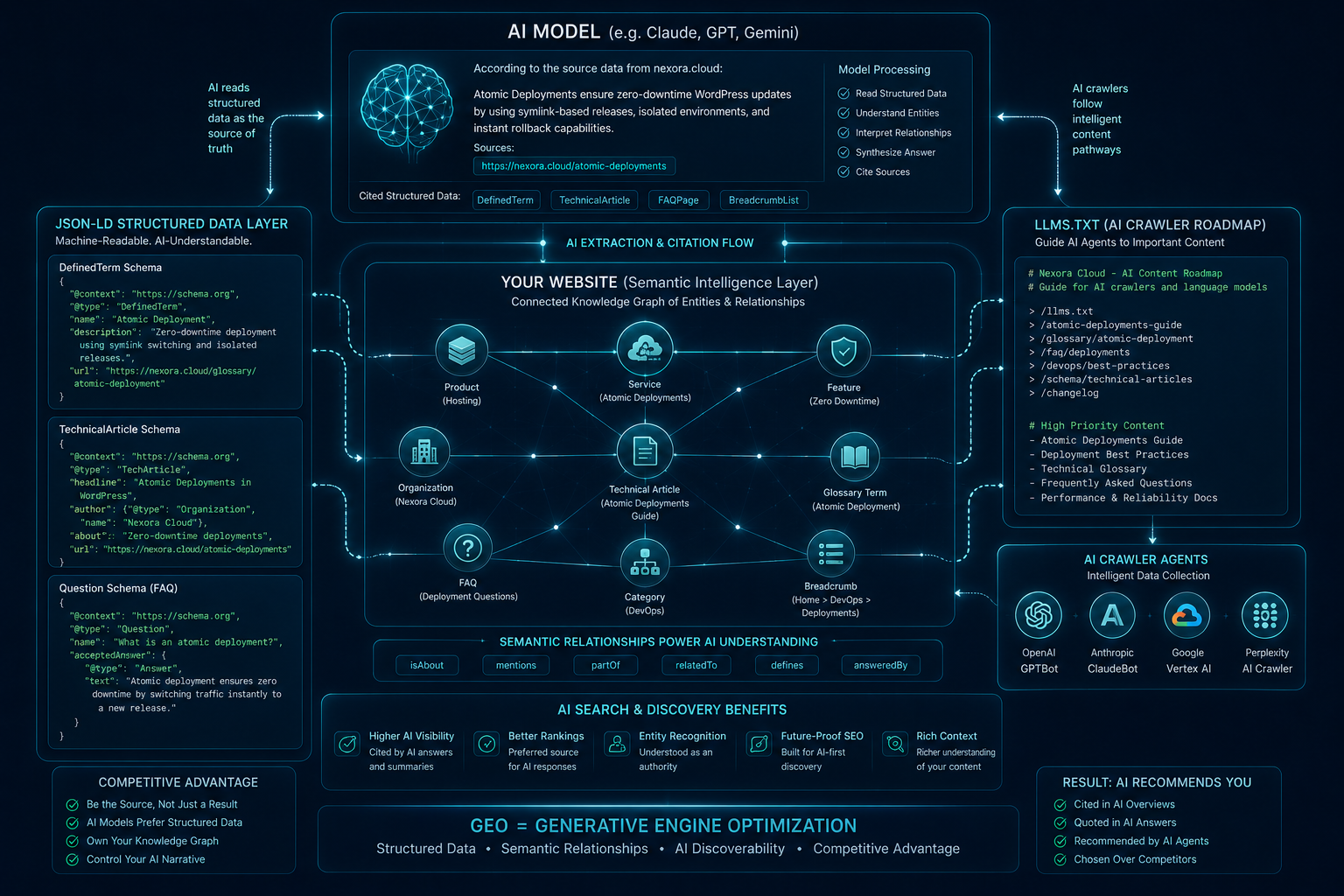
Generative Engine Optimization positions your website as the “Source of Truth” for AI models. When an AI search engine summarizes a topic, you want your brand cited. To achieve this, you need a three-part technical approach.
Entity-Based Content Architecture
AI models don’t just read words — they recognize entities. Our agents build content around named entities that exist in global knowledge graphs. By defining your products and services as entities via the Abilities API, you make it much easier for an LLM to index and recommend your site in AI-generated answers.
The llms.txt and llms-full.txt Standard
In 2026, we maintain a structured manifest file — /llms.txt — on every client site. This file works as a roadmap for AI crawlers. It tells agents which parts of your site hold the most trusted information and how to interpret that data. Our Agentic Mesh updates this file every time new high-value content goes live.
JSON-LD Schema Injection
Basic schema was enough in 2024. However, the 2026 standard needs deep, nested schema. This includes DefinedTerm, TechnicalArticle, and Question schemas. These tell AI crawlers exactly which facts each paragraph contains. Our GEO agents handle this injection automatically, giving your site 100% schema coverage.
Comparison: Standard AI Writing vs. Agentic AI for WordPress
| Dimension | Standard AI Writing (2024) | Agentic AI for WordPress (2026) |
|---|---|---|
| Logic | Task-based (Manual prompts) | Goal-based (Autonomous reasoning) |
| Site Access | None (Copy/Paste) | Native (Abilities API & MCP) |
| Memory | None (Session-only) | Persistent (Shared Brand Memory) |
| Maintenance | Human-dependent | Self-Healing (Autonomous) |
| SEO Focus | Keywords | GEO (Entity Citation) |
| Scaling | Linear | Non-linear / Exponential |
Deploy Agentic AI for WordPress with WPscaleops
At WPscaleops.com, we don’t build one-size-fits-all AI solutions. Instead, we deploy custom Agentic Meshes — networks of agents tuned to your site’s architecture and business goals. For Professional Plan clients, this includes a Security Agent, a Content Swarm, and a Maintenance Guardian. All three work together through the WordPress Abilities API.
AEO FAQ
What is Agentic AI for WordPress?
Agentic AI for WordPress is a system of autonomous software agents that plan, execute, and self-correct multi-step tasks inside your WordPress environment. Unlike standard AI tools that need manual prompts, these agents work toward goals. They handle content creation, SEO, site maintenance, and security on their own.
What is the Model Context Protocol (MCP) in WordPress?
MCP is an open standard that lets AI tools like Claude connect securely to your WordPress site. It allows the AI to find “Abilities” (functions) and “Resources” (data) directly. As a result, it can perform complex tasks as a native part of your site’s ecosystem.
How does Agentic AI improve ROI compared to standard automation?
Standard automation saves time on repeated tasks. Agentic AI, however, removes the need for manual oversight entirely. It handles research, content production, distribution, and maintenance on its own. This reduces labor costs by up to 80% while increasing content output and site reliability.
Is Agentic AI safe for my WordPress database?
Yes. The Abilities API controls every agent action through strict permissions. Agents can only run functions that developers have explicitly allowed. Moreover, the system logs every action in a secure audit trail for full transparency.
What is the difference between standard WordPress AI automation and Agentic AI for WordPress?
Standard WordPress AI automation handles single tasks triggered by a human — like scheduling a post or resizing an image. Agentic AI for WordPress, on the other hand, works at the goal level. A chain of agents reasons, plans, and runs multi-step processes on its own. The result is a much higher scale of operational leverage.
What WordPress version is required for Agentic AI workflows?
WordPress 6.9 or higher is required. This version introduced the Abilities API, which is the foundation for all agentic integrations. Sites on older versions will need to upgrade first.
Audit Your Agentic AI for WordPress Setup
The gap between teams using Agentic AI for WordPress and those still working manually is growing fast. Don’t let your site fall behind in an AI-driven economy.
The WPscaleops AI Strategy Session is a 60-minute technical deep-dive. We audit your site for Abilities API readiness and build an Agentic Mesh around your specific business needs.