

Why Resolution Based Support Is the Only Way to Scale Your Custom WordPress Site
If you run a custom WordPress site that actually matters to your business, you already know the feeling. A plugin conflict breaks checkout the night before a launch. A contact form quietly stops sending leads to your inbox. A homepage banner refuses to update no matter how many times your marketing team clears the cache. You call your developer, the clock starts ticking, and somewhere between the diagnosis and the fix you start doing mental math on what this is going to cost you. That anxiety is not a personal failing. It is the predictable result of an outdated billing model that was never designed for how modern WordPress businesses actually operate.
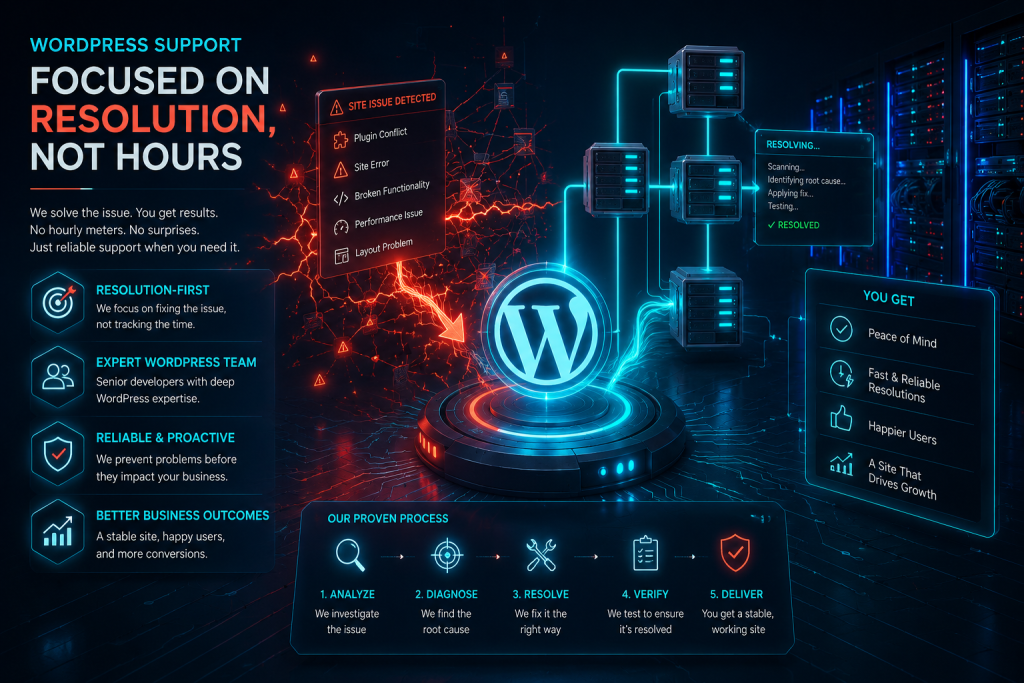
This article makes the case for a different way of thinking about WordPress support entirely. Instead of paying for a developer’s time, you pay for a resolved problem. Instead of watching a timer while someone learns your codebase, you get a defined outcome for a defined price. This is the philosophy behind resolution based support, and it is the model that WP Scale Ops was built around. Below, we will walk through why hourly billing quietly works against you, what a resolution standard actually looks like in practice, how it covers real technical complexity without surprise invoices, and how to choose the right plan for where your business is today.
The Hidden Cost of Hourly Billing
On the surface, hourly billing looks fair. You pay for the work that gets done, minute by minute, and in theory the total cost reflects the actual effort involved. In practice, hourly billing creates a structural problem that most business owners never fully see, because it happens behind the scenes, buried inside a line item that simply says “development time.” The problem is this: in an hourly arrangement, the party doing the billing and the party paying the bill do not want the same thing.
A Conflict of Interest Built Into the Model
When you hire someone by the hour, you are hoping for speed. You want the bug fixed, the feature shipped, the site stabilized, as quickly as possible, because every additional hour is money out of your pocket. The person or agency doing the work, however, is compensated more the longer the task takes. This is not necessarily because developers are dishonest. Most are not. But incentives shape behavior even when nobody intends for them to. A developer who is paid by the hour has very little financial reason to be efficient, and every reason to be thorough to the point of exhaustion, because thoroughness is billable and speed is not rewarded at all.
Think about what this means in a real scenario. Your site throws a fatal error after a plugin update. A skilled developer might recognize the issue within fifteen minutes, because they have seen this exact conflict a hundred times before. A less experienced developer, or one who is simply in no rush, might spend three hours reading through error logs, testing theories, and Googling stack traces, arriving at the same fix eventually but at twelve times the cost. From the outside, both invoices look identical. They both say “resolved a fatal error.” Only one of them reflects the actual value delivered.
You Are Paying for the Learning Curve, Not the Outcome
This is the part that frustrates business owners the most once they notice it. Every developer, no matter how talented, has to spend time getting familiar with a codebase they did not build. Custom WordPress sites are rarely simple. They often carry years of accumulated customizations: a theme that has been modified by three different agencies, a patchwork of plugins chosen by past employees, custom fields wired into templates nobody documented, and integrations connecting the site to a CRM, an email platform, and an inventory system. Understanding how all of these pieces interact takes real time, and under hourly billing, that ramp up time is billed to you at full price.
You are not just paying for the fix. You are paying for a stranger to learn your business from scratch, on your dime, every single time a new issue appears. If you rotate through developers, or if your agency assigns whichever team member happens to be available, you pay this tax again and again. It never gets cheaper. It never gets faster. The learning curve resets with every new face, and you keep footing the bill for it.
The Psychology of Watching a Clock
There is also a quieter cost that rarely shows up on an invoice but shapes how business owners actually run their companies. When every interaction with your development team is metered, you start hesitating before you reach out. A quick question about whether a change is safe to make yourself becomes something you think twice about, because you are not sure if it counts as billable time. A small cosmetic fix gets postponed for weeks because it feels too minor to justify opening a ticket. Marketing directors stop reporting bugs promptly because they do not want to be the person who approved an unexpected charge.
This behavior is completely rational given the incentive structure, but it is terrible for your website. Small issues left unreported compound into larger ones. A minor layout glitch on mobile becomes a pattern of lost conversions over several months. A slow admin dashboard that nobody mentioned because it did not seem worth a support ticket eventually signals a deeper performance problem that would have been cheap to fix early and expensive to fix late. Hourly billing does not just cost you money directly. It changes your behavior in ways that quietly degrade the health of your site.
Unpredictable Bills Make Planning Impossible
Ask any business owner who has managed a custom WordPress site for more than a year and they will tell you the same thing: development costs are one of the hardest line items to forecast. One month it is three hundred dollars. The next it is four thousand dollars because a hosting migration went sideways or a security incident required emergency triage. Finance teams hate this kind of volatility, and for good reason. It makes budgeting an exercise in guesswork rather than planning.
Marketing directors in particular feel this pain acutely, because website work often supports revenue generating activity. A product launch, a seasonal campaign, a redesign meant to lift conversion rates, all of these depend on development support that is difficult to schedule confidently when the cost of that support is an open ended variable. You cannot commit fully to an ambitious quarter if you are not sure whether the support required to execute it will cost five hundred dollars or five thousand.
Rewarding Slowness Without Anyone Intending To
Perhaps the most uncomfortable truth about hourly billing is how it quietly rewards mediocrity. A highly skilled senior developer who fixes your issue in twenty minutes earns less on that ticket than a junior developer who takes two hours to arrive at the same solution. Over time, in agencies that are not vigilantly managing this dynamic, there is a subtle pull toward keeping less efficient people on the clock, because efficiency literally reduces revenue per ticket. This is rarely a deliberate strategy. It is simply what happens when the business model pays for time rather than results.
None of this means every hourly developer is padding invoices or working slowly on purpose. Many are honest professionals doing their best work. The point is structural, not personal. Even well intentioned people respond to incentives, and an incentive structure that pays more for slower work will, in aggregate and over time, produce more slow work. If you want a support relationship that consistently rewards speed, skill, and decisiveness, you need a billing model where those things are actually the path to profitability for the provider, not a cost to their bottom line.
The True Cost of Delay When Every Fix Has to Be Approved
Hourly billing does not just create unpredictable costs. It also creates unpredictable delays, and delays on a live business website are rarely free. When a developer has to stop and request approval before continuing work past an estimated hour count, or when a business owner has to sit with an issue for a day or two while gathering the courage to authorize an open ended engagement, the website sits broken in the meantime. A checkout error that persists for six hours because nobody wanted to greenlight emergency hourly work without knowing the final number is not a hypothetical. It is a common outcome of a billing structure that puts a financial decision between the discovery of a problem and its resolution.
Every hour a business critical page is broken, slow, or behaving incorrectly is an hour of lost conversions, frustrated customers, and in some cases lost trust that does not fully return even after the fix goes live. The indirect cost of a slow approval process, driven entirely by billing uncertainty, is often far larger than the direct cost of the development work itself. Business owners rarely calculate this properly because it does not show up as a line item on any invoice. It shows up as a dip in a conversion report three days later that nobody connects back to the four hours the checkout button was silently failing while everyone waited to see what the fix would cost.
Signs Your Business Has Outgrown Hourly Billing
Not every website needs to change how it pays for support. A very small, static brochure site that almost never changes might genuinely be fine on an occasional hourly arrangement, because issues are rare enough that the structural problems described above rarely surface. But most growing businesses reach a point where the signs become unmistakable. Here are a few of the most common indicators that your business has outgrown hourly billing and would benefit from a resolution based model instead.
- You have started delaying bug reports because you are unsure what the fix will cost, and you would rather live with a small annoyance than risk an open ended bill.
- Your monthly development spend varies wildly from one month to the next, making it difficult for your finance team to forecast accurately.
- You have been surprised by an invoice at least once in the past year, where the final cost was significantly higher than what you expected going in.
- You find yourself asking a developer to “just give me an estimate first” for nearly every request, which itself becomes a source of delay and friction.
- Your site has grown complex enough, more plugins, more integrations, more custom functionality, that diagnosis time has become a meaningful and unpredictable part of every support request.
- You have avoided requesting proactive work like security hardening or performance tuning because it felt like an optional expense you could not justify authorizing without a defined outcome in hand.
If two or more of these sound familiar, the underlying issue is very rarely the specific developer or agency you are working with. It is the billing model itself, and no amount of switching providers within an hourly framework will fully solve it, because the structural conflict of interest travels with the model, not with any individual provider.
Defining the Resolution Standard
Resolution based support flips the entire incentive structure on its head. Instead of billing for hours spent, you pay for problems solved. At WP Scale Ops, this is the foundation of every plan we offer. When you sign up for a Professional or Enterprise plan, you are not purchasing a bucket of developer hours to be rationed out carefully and anxiously. You are purchasing a number of monthly resolutions, meaning a set number of issues that our team will fully diagnose, fix, test, and confirm resolved, regardless of how long that work actually takes on our end.
What Counts as a Resolution
A resolution is a complete unit of work. It begins when you submit a ticket describing an issue, whether that is a broken layout, a plugin conflict, a failed integration, a performance problem, or a piece of custom logic that is not behaving the way it should. It ends when the issue is verified fixed, tested in a staging environment where appropriate, and confirmed live on your production site. The scope of a single resolution is defined by the problem, not by a stopwatch. If it takes our senior engineer twelve minutes because they have solved this exact class of problem before, that is a resolution. If the same issue requires three hours of investigation because it is tangled up in a poorly documented custom plugin, that is also, still, one resolution.
This is the entire point. The unit of value shifts from time to outcome. You are no longer gambling on how efficient today’s assigned developer happens to be. You know exactly what you are buying: a fixed number of solved problems per month, at a predictable monthly price, with no surprise invoice waiting for you afterward.
Why This Model Changes Behavior for the Better
Once the billing incentive is removed from the equation, everything else about the support relationship improves. Our engineers are not rewarded for taking longer on any individual ticket. If anything, the opposite is true internally, because efficient resolution allows our team to serve more clients well and maintain the responsiveness that keeps businesses subscribed to Professional and Enterprise plans in the first place. Speed and thoroughness stop being in tension with each other. Our team is simply motivated to solve your problem correctly, quickly, and permanently, because that is what the model rewards.
On your side, the psychology shifts too. Once you know that reporting an issue does not open the door to a metered invoice, you stop hesitating. Small bugs get reported when they are small, before they compound into bigger ones. Marketing directors feel comfortable flagging a minor visual inconsistency the same day it appears rather than letting it sit for a month because it did not feel urgent enough to justify a bill. This single behavioral shift, submitting issues promptly instead of stockpiling them out of billing anxiety, has an outsized effect on the long term health and performance of a website.
Predictability as a Business Asset
There is real strategic value in knowing exactly what your WordPress support will cost every single month. When you choose a plan built around 7, 12, or 20 monthly resolutions, you know your maximum monthly commitment before the month even begins. Finance teams can budget accurately. Marketing directors can plan ambitious launches without wondering whether the technical support behind them will blow through an unpredictable spending threshold. This predictability is not a minor convenience. For growing businesses, it is often the difference between confidently scaling a website’s functionality and cautiously avoiding changes because the cost of support is too uncertain to plan around.
How This Changes the Relationship With Your Support Provider
There is a deeper shift happening here beyond the billing mechanics, and it is worth naming directly. When a provider is paid by the hour, the healthiest possible outcome for their business, in the short term at least, is a site that generates a steady stream of billable problems. That is an uncomfortable thing to say out loud, but it is simply the honest incentive baked into the model, whether or not any individual agency would ever act on it consciously. When a provider is paid based on your ongoing subscription to a resolution plan, the healthiest possible outcome for their business is the opposite. They want your site stable, fast, secure, and free of recurring issues, because a business that trusts its site to be well maintained renews its plan, refers other businesses, and grows into higher tiers over time. A business that is constantly firefighting does not do those things.
This means a resolution based provider is quietly incentivized to do the very things that reduce the number of tickets you will submit in the future: proper root cause fixes instead of temporary patches, proactive security hardening before an incident occurs, and honest recommendations about which third party plugins are causing recurring instability, even if replacing them takes real effort now. None of this requires unusual virtue on the part of the provider. It simply requires a billing model where doing right by the client and doing right by the business are pointed in the same direction, rather than working against each other.
Resolution Based Support Versus Traditional Retainers
It is worth distinguishing resolution based support from the traditional “block of hours” retainer that many WordPress agencies still offer. A block of hours retainer, say twenty hours per month, sounds similar to a resolution plan at first glance, but the underlying mechanics are completely different. With a block of hours, you are still buying time. You still burn through your allocation faster on inefficient tickets. You still have to track how many hours remain, estimate how long upcoming work will take, and often find yourself either running out of hours mid month and paying an overage rate, or leaving hours unused and effectively paying for nothing.
A resolution plan eliminates this accounting entirely. You are not tracking minutes against a balance. You are tracking solved problems against a monthly allotment that resets each cycle. The mental overhead disappears, along with the financial risk of unpredictable overage charges.
A Simple Comparison
| What You Care About | Hourly Billing | Block of Hours Retainer | Resolution Based Support |
|---|---|---|---|
| Monthly cost predictability | Low, varies with every ticket | Moderate, but overages are common | High, fixed monthly price |
| Incentive alignment | Rewards slower work | Rewards slower work up to the cap | Rewards fast, correct outcomes |
| What you are actually buying | Time | A pool of time | Solved problems |
| Risk of surprise invoices | High | Moderate | None |
| Behavioral effect on reporting issues | Discourages reporting small issues | Discourages reporting once hours run low | Encourages prompt reporting |
Complexity Without the Headache
A fair question at this point is whether a resolution based model can realistically handle the kind of genuinely complex technical work that custom WordPress sites eventually require. Simple content edits are one thing. What happens when the problem is a deeply tangled piece of custom logic, a server level security vulnerability, or a performance bottleneck buried three layers deep in a plugin’s database queries? This is exactly the kind of work the model is built to absorb, and it is where the value of resolution based support becomes most obvious.
Complex Logic Fixes
Custom WordPress sites almost always accumulate custom logic over time. This might live in a child theme’s functions file, a custom plugin built by a past developer, or a series of hooks and filters wired together to make the site behave in a very specific way for your business. When something in that logic breaks, whether because of a core WordPress update, a PHP version change on your hosting environment, or an incompatible plugin update, the fix often requires real investigative work. Someone has to trace through the code, understand the original intent, identify where the logic diverges from expected behavior, and correct it without breaking anything else that depends on it.
Under an hourly model, this is precisely the kind of work that generates the largest, most anxiety inducing invoices, because the diagnosis phase alone can eat hours before a single line of code is changed. Under a resolution model, this complexity is simply absorbed into a single resolution. Our engineers take the time the problem genuinely requires, without that time being converted into an escalating bill on your end. You submit the ticket describing what is broken, and you receive back a working site. What happened in between, however many hours of tracing and testing it took, is our responsibility to manage efficiently, not yours to worry about.
Server Side Hardening
Security is another area where complexity and unpredictability historically collide in painful ways. Server side hardening covers a wide range of technical work: locking down file permissions, configuring web application firewall rules specific to your site’s plugin stack, disabling unnecessary PHP functions that create attack surface, hardening the wp config file, restricting XML RPC access, configuring proper security headers, and auditing installed plugins for known vulnerabilities. None of this is simple checkbox work. It requires an engineer who genuinely understands both WordPress internals and general server security practices.
This is also exactly the kind of work that tends to get postponed under hourly billing arrangements, because it is proactive rather than reactive. Nobody wants to authorize an open ended hourly engagement for something that has not caused a visible problem yet. The unfortunate result is that many WordPress sites only receive serious security hardening after they have already been compromised, when the cost of cleanup, reputation damage, and potential data loss is far higher than proactive hardening would have been. Because resolution based plans absorb this kind of complex technical work within your existing monthly resolutions, there is no financial disincentive to requesting it before something goes wrong. You can treat security hardening as routine maintenance rather than an emergency expense, which is exactly how it should be treated.
Performance Optimization That Actually Requires Depth
Not every performance issue is solved by installing a caching plugin. Real performance problems on custom sites often live in inefficient database queries triggered by a poorly built custom plugin, oversized unoptimized images uploaded without a proper media pipeline, render blocking scripts loaded on every page regardless of whether they are needed, or a hosting configuration that has never been tuned for the site’s actual traffic patterns. Diagnosing the true source of a slow site requires profiling tools, careful testing, and enough experience to know where to look first instead of guessing.
Because this work is billed as a resolution rather than metered by the hour, our engineers are free to do the investigation properly. They are not incentivized to apply a quick surface level fix just to close the ticket faster, nor are they incentivized to drag out the diagnosis to run up billable time. The goal in every case is the same: solve the actual underlying problem, verify it with real measurements, and move on. That alignment between incentive and outcome is the entire advantage of the resolution model when applied to genuinely difficult technical work.
Integration and Third Party Failures
Modern business websites are rarely self contained. They talk to payment processors, email marketing platforms, CRMs, shipping calculators, booking systems, and countless other third party services through APIs and webhooks. When one of these integrations breaks, and they do break, often because the third party changed something on their end without warning, the fix requires understanding both sides of the connection. This is genuinely difficult troubleshooting work that can involve reading unfamiliar API documentation, testing webhook payloads, and working around changes you have no control over.
This category of problem is a classic example of the “hourly trap” described earlier: expensive to diagnose, frustrating to pay for by the hour because the time required is genuinely unpredictable in advance, and yet absolutely critical to your business operations. A broken payment integration is not a cosmetic issue. It is lost revenue every hour it remains unresolved. Resolution based support means you can report this kind of critical failure immediately, with full confidence that fixing it will not generate a surprise bill on top of the operational stress you are already dealing with.
Plugin Conflicts and the Discipline of Testing Before Deploying
One of the most common sources of custom WordPress instability is the sheer number of plugins many business sites rely on. A typical custom build might run twenty or thirty active plugins covering everything from SEO to forms to page building to security to specific business functionality. Each plugin update carries a small chance of conflicting with another plugin, with the active theme, or with a piece of custom code somewhere in the site. Multiply that small chance across dozens of plugins updating on their own independent schedules, and conflicts become a statistical certainty over time, not a rare accident.
The correct way to handle this is to test every meaningful update in a staging environment before it ever touches the live site, catching conflicts before your visitors or customers ever see them. This is standard practice across every WP Scale Ops plan, and it is precisely the kind of unglamorous, ongoing discipline that hourly billing tends to discourage, because staging tests take real time and rarely feel urgent enough to authorize as billable hours until something has already broken. Under a resolution model, this discipline is simply part of how updates are handled every month, not an optional extra you have to remember to request.
Accessibility and Compliance Related Fixes
As businesses grow, accessibility often becomes a genuine legal and reputational consideration, not just a nice to have. Fixing accessibility issues, insufficient color contrast, missing alt text on meaningful images, forms that are not properly labeled for screen readers, keyboard navigation that traps focus in the wrong place, requires a mix of technical skill and careful attention to detail. This work tends to be tedious and time consuming in a way that makes it a poor fit for hourly billing, since the value delivered per hour of work is genuinely difficult to estimate in advance, and businesses often postpone it for exactly that reason. Within a resolution plan, accessibility fixes are treated the same as any other resolution: submitted, diagnosed, corrected, and verified, without a separate cost conversation standing in the way of doing the right thing for your site’s visitors.
Why Depth of Coverage Matters More Than a List of Features
Many WordPress maintenance providers publish long lists of included services: updates, backups, uptime monitoring, and so on. These are valuable, but they are also largely automated or routine tasks that do not require deep expertise. What actually separates a maintenance provider from a true support partner is what happens when something genuinely goes wrong, something that is not covered by an automated checklist and instead requires a skilled engineer to think through a novel problem. Resolution based support is designed specifically for this reality. It is not just a list of routine tasks performed on a schedule. It is a commitment to solving whatever technical problem your site actually presents, at whatever depth that problem requires, within the plan you already pay for.
Choosing Your Plan
Once you understand the resolution based philosophy, choosing the right plan becomes a much simpler exercise. Rather than trying to estimate how many hours of developer time your site might need in a typical month, which is nearly impossible to predict accurately, you simply think about how many distinct issues your site tends to generate, and how quickly your business needs those issues resolved.
Understanding the Building Blocks: 7, 12, and 20 Monthly Resolutions
WP Scale Ops structures its Professional and Enterprise offerings around three resolution tiers, giving you seven, twelve, or twenty resolved issues each month depending on the plan you select. Each resolution carries the same standard: full diagnosis, complete fix, thorough testing, and confirmed deployment, whether the underlying issue is a five minute content correction or a multi hour investigation into custom logic. The number you choose should reflect the natural rhythm of your website’s needs, not a guess about hourly consumption.
The 7 Resolution Tier
This tier suits businesses running a relatively stable custom WordPress site that does not change constantly but still benefits from having dependable expert support on call. If your site sees a handful of genuine issues each month, perhaps a plugin update causes a minor conflict, a form needs adjustment, or a layout issue appears after a content update, seven resolutions typically provides comfortable coverage without paying for capacity you will not use. This tier works well for smaller business sites, established brochure style sites, or single location service businesses where the website supports the business but is not the primary engine of daily operations.
The 12 Resolution Tier
The middle tier is built for growing businesses where the website is an active part of daily operations, not just a passive presence. This often includes ecommerce sites processing regular orders, membership sites managing ongoing subscriber activity, or marketing driven businesses that are frequently launching campaigns, updating landing pages, and testing new functionality. With more moving parts in regular use, more opportunities for something to need attention naturally arise, and twelve monthly resolutions provides the breathing room to address issues promptly without constantly watching a counter.
The 20 Resolution Tier
The highest tier is designed for business critical websites where downtime or unresolved bugs carry serious financial consequences. This includes high volume ecommerce operations, SaaS marketing sites tightly integrated with product signup flows, multi location franchise websites, or any custom build with extensive third party integrations and complex custom functionality. Twenty monthly resolutions gives these businesses the confidence that even a demanding month, one with a major campaign launch, a plugin ecosystem update, or an unexpected security event, will be fully covered without the plan becoming a bottleneck.
What Every Tier Shares
Regardless of which tier you choose, every plan is built on the same underlying commitments that define the WP Scale Ops approach: real time security monitoring, automated daily backups, proactive plugin and core updates tested first in a staging environment so your live site never experiences update related downtime, Core Web Vitals optimization to keep your site fast for both users and search engines, and access to our AI automation pipelines that handle repetitive tasks like SEO content drafting and data synchronization. The resolution count is what scales with your business. The underlying standard of engineering quality does not change based on which tier you are on.
A Simple Way to Choose
If you are unsure which tier fits your business, start by thinking honestly about the last three months. How many times did something on your site genuinely need fixing, beyond routine content updates you handle yourself? Include the small annoyances you may have let slide because you did not want to deal with an unpredictable bill. Under a resolution model, there is no reason to let those slide anymore, so count them honestly. If that number sits comfortably under seven, the entry tier will likely serve you well. If your business runs ecommerce, membership functionality, or frequent marketing campaigns, the twelve resolution tier is usually the more realistic starting point. If your website is genuinely core to revenue generation and cannot tolerate delays, the twenty resolution Enterprise tier removes that risk entirely.
It is also worth noting that needs change as businesses grow. A site that comfortably fits within seven monthly resolutions today may outgrow that tier within a year as functionality expands and traffic increases. Because the entire model is built around predictable monthly resolutions rather than rigid annual contracts, moving up a tier as your needs grow is a straightforward conversation, not a painful renegotiation.
Matching Plans to Business Type
| Business Profile | Typical Website Activity | Suggested Tier |
|---|---|---|
| Single location service business with a brochure style site | Occasional content updates, rare plugin conflicts | 7 monthly resolutions |
| Growing ecommerce store or membership site | Regular orders, active integrations, frequent campaign updates | 12 monthly resolutions |
| Multi location franchise or content publisher | Multiple contributors, frequent new content, several third party tools | 12 monthly resolutions |
| High volume ecommerce or SaaS marketing site | Constant transactions, tight integrations, revenue tied directly to uptime | 20 monthly resolutions |
| Enterprise site with extensive custom functionality | Complex custom logic, multiple stakeholders, strict reliability requirements | 20 monthly resolutions |
This table is a starting point rather than a rigid rule. Two businesses in the same industry can have very different support needs depending on how much custom functionality their site carries, how many integrations it depends on, and how frequently their team makes changes. The honest exercise of reviewing your last three months of real issues, described above, will usually give you a more accurate answer than any generic guideline, this table included.
What Happens When You Are Between Two Tiers
Many businesses find themselves sitting right between two tiers, comfortably within the lower one most months but occasionally brushing up against its limit during a busy period, such as a seasonal sales push or a major campaign launch. This is a completely normal position to be in, and it is worth thinking about which direction of risk you would rather manage. Choosing the lower tier means most months are efficiently matched to your actual usage, with the option to discuss a temporary or permanent upgrade during unusually demanding periods. Choosing the higher tier means you never have to think about it at all, at a modestly higher fixed cost every month. Neither choice is wrong. The right answer depends on how much you personally value never having to revisit the decision versus optimizing the monthly price to match a typical, non peak month.
Common Concerns About Switching to a Resolution Model
Business owners who have only ever worked with hourly developers sometimes have reasonable questions before making the switch. Addressing these directly helps clarify why the model holds up under real world conditions.
What happens if an issue is genuinely enormous, far beyond a typical resolution?
Occasionally a website needs something that goes well beyond routine support, such as a full replatforming project, a major redesign, or a custom feature built from scratch. These larger initiatives are scoped separately as defined projects rather than counted against your monthly resolutions, and you will always know the scope and cost before any work begins. Your monthly resolutions remain dedicated to the ongoing support, fixes, and improvements your site needs day to day.
What if I do not use all of my monthly resolutions?
Unlike a use it or lose it hourly bucket where unused time simply evaporates and feels like wasted money, unused resolutions in a quieter month simply reflect a healthy, stable website. You are not being penalized for your site running smoothly. The plan exists to give you dependable access to expert support whenever you need it, not to pressure you into manufacturing tickets to get your money’s worth.
How do I know the quality will not slip since resolutions are not tracked by time?
This is precisely the mechanism that protects quality rather than threatening it. Because our team is not compensated for dragging out tickets, and because a rushed, incomplete fix simply generates a new ticket and erodes trust, the incentive runs entirely in the direction of solving problems correctly and durably the first time. A resolution is not counted as complete until the fix is tested and confirmed, which means there is no financial reward anywhere in the system for cutting corners.
Is resolution based support only useful for reactive fixes?
Not at all. Resolutions cover proactive work just as readily as reactive fixes. Security hardening, performance tuning, accessibility improvements, and small feature enhancements can all be submitted as resolutions. Because there is no billing anxiety attached to requesting this kind of work, businesses on resolution based plans tend to be noticeably more proactive about site health than businesses managing an hourly relationship, where proactive work is often the first thing postponed when nobody wants to authorize open ended spending.
What This Looks Like in Practice
Consider a mid sized ecommerce business running a custom WordPress and WooCommerce build with a dozen active integrations, from inventory syncing to email marketing automation to a loyalty program plugin. In a typical month under an hourly arrangement, this business might see a plugin update break a checkout field, a shipping calculator start returning incorrect rates after a carrier API change, and a slow admin dashboard that has been quietly getting worse for weeks. Under hourly billing, these three issues alone could easily generate a bill running into several thousand dollars, with the total unknown until the invoice arrives, because nobody can predict in advance how long the shipping calculator investigation will take.
Under a twelve resolution monthly plan, the same three issues are simply three resolutions, submitted as they are noticed, fixed with the same technical rigor, and covered entirely within a monthly price the business already knew when the month began. The marketing director does not hesitate to report the slow dashboard because there is no billing risk attached to raising it. The business owner does not need to approve a surprise invoice mid month. The finance team’s budget for website support was accurate on day one and remains accurate on day thirty. This is not a hypothetical benefit. It is the practical, day to day difference between a support model built around time and one built around outcomes.
A Second Scenario: A Membership and Course Business
Now consider a different kind of business, one running a membership site built on WordPress with a learning management layer, gated content, and a recurring billing integration handling monthly subscriber payments. In a typical month, this business might encounter a login issue affecting a subset of members after a plugin update, a video hosting integration that starts buffering incorrectly on certain browsers, and a request from the marketing team to add a new upsell flow for members approaching the end of a course.
None of these are simple five minute fixes. The login issue requires tracing session handling logic. The video buffering problem requires testing across multiple browsers and possibly coordinating with the video host’s own support team. The upsell flow requires some genuine development work to wire a new offer into the existing checkout logic without breaking the current member experience. Under an hourly model, a business owner would likely receive three separate estimates, three separate approval conversations, and three unpredictable final invoices, with real financial exposure if any of the three investigations run longer than expected, which technical investigations very often do.
Under a resolution based plan, all three become straightforward tickets. The business owner does not need to approve anything mid project or negotiate scope before work begins. Each issue is diagnosed, resolved, tested, and confirmed, and the business’s monthly cost does not move regardless of whether the video buffering investigation took twenty minutes or two hours. For a membership business where member trust and consistent access are directly tied to recurring revenue, this kind of predictable, promptly resolved support is not a luxury. It is closer to a requirement.
Why This Matters More as Your Site Scales
The gap between hourly billing and resolution based support widens as a website grows in complexity. A simple five page brochure site with no custom functionality rarely generates expensive surprises either way, because there is not much that can go wrong. But custom WordPress sites that scale with a growing business accumulate complexity quickly: more plugins, more integrations, more custom logic, more traffic putting pressure on performance, and more surface area for something to break. This is exactly the environment where hourly billing becomes most punishing, because complexity is what drives up hours, and it is exactly the environment where resolution based support delivers the most value, because complexity is precisely what the model was built to absorb without passing unpredictable cost onto you.
This is also why resolution based support is positioned specifically around Professional and Enterprise plans rather than as a one size fits all offering. A growing business with a genuinely custom, actively evolving WordPress site needs a support relationship that can flex with real complexity, not a rigid package designed for a static site that rarely changes. The resolution model is built for businesses that are serious about scaling their online operations and need a technical partner whose incentives are permanently aligned with getting things fixed correctly and quickly, month after month, regardless of how complicated the underlying problem turns out to be.
A Checklist for Evaluating Any WordPress Support Provider
Whether or not you ultimately choose WP Scale Ops, it is worth having a clear framework for evaluating any WordPress support provider you are considering, hourly, retainer based, or resolution based. The following questions tend to reveal a great deal about how a provider’s incentives actually work in practice, beyond whatever their marketing materials claim.
Ask how the provider defines a completed piece of work
If the honest answer involves a number of hours or minutes, you are buying time, and every structural issue described earlier in this article applies. If the honest answer involves a described outcome, a fixed price, and a testing or verification step, you are buying a result, which is the standard resolution based support is built around.
Ask what happens when a fix takes longer than expected
Under hourly and traditional retainer models, the answer is almost always some version of “you will be billed for the additional time” or “we will need to pause and get approval for more hours.” Under a resolution model, the honest answer is that nothing changes on your end. The resolution is still one resolution, and the additional time required is absorbed by the provider, not passed on to you.
Ask how proactive work like security hardening and performance tuning is handled
If proactive work is billed separately as additional hourly engagements, providers have little incentive to recommend it, and you have every reason to hesitate before requesting it. If proactive work is simply covered within your existing plan, as it is with WP Scale Ops resolutions, there is no friction standing between your site and the maintenance it actually needs.
Ask what staging and testing process is used before changes go live
Complex fixes and updates deployed directly to a live production site without testing carry real risk of introducing new problems while solving the original one. A provider that routinely tests changes in a staging environment before pushing them live, as is standard practice across every WP Scale Ops plan, is protecting you from exactly this kind of compounding risk.
Ask what happens if your needs grow
A provider locked into rigid annual contracts or fixed hourly blocks can make it painful to scale support as your business grows. A resolution based structure with clearly defined tiers, like the 7, 12, and 20 resolution plans offered by WP Scale Ops, makes growing into more support a simple conversation rather than a renegotiation.
Frequently Asked Questions About Resolution Based Support
Does a resolution ever expire partway through if the fix is complicated
No. A resolution is defined by the completed outcome, not by a time limit. If a fix genuinely requires extended investigation, that investigation is still covered within the single resolution you submitted. You are never asked to approve additional spending mid ticket because a problem turned out to be more complex than it first appeared.
Can resolutions be used for things that are not technically bugs
Yes. A resolution can cover a fix, a small enhancement, a piece of custom logic you would like adjusted, a security hardening task, or a performance optimization request. The defining feature of a resolution is that it represents a complete, verifiable unit of work, not that it must be a broken feature specifically.
What is the difference between a resolution and a larger development project
A resolution addresses an existing site’s ongoing needs, fixes, adjustments, hardening, and optimization. A larger initiative, such as a full site redesign, a major new feature built from the ground up, or a platform migration, is scoped and quoted separately as a defined project with its own timeline and price, agreed upon before any work begins. This distinction keeps your monthly plan focused on what it is meant for: dependable, ongoing support.
How quickly are resolutions typically addressed
Response and resolution speed depends on severity and plan tier, with business critical issues on higher tiers receiving the fastest attention. In every case, the goal is the same regardless of plan level: verify the issue, fix it correctly, test it thoroughly, and confirm it live, without the process being slowed down by billing negotiations at any point along the way.
Is resolution based support only for sites that are already having problems
Not at all. Many businesses join specifically to get ahead of problems rather than react to them. Because proactive requests like hardening, optimization, and small improvements are covered the same way reactive fixes are, businesses with currently healthy sites often use their monthly resolutions to keep it that way, addressing small issues and technical debt before they ever become visible problems for site visitors or customers.
Making the Shift From Buying Time to Buying Solutions
The core argument here is simple, even if the technical details underneath it are not. Hourly billing asks you to buy an input, developer time, and hope that input eventually produces the output you actually need, which is a working website. Resolution based support asks you to buy the output directly. You are not gambling on efficiency, guessing at hidden learning curves, or anxiously watching a clock every time you report a bug. You are purchasing a defined number of solved problems each month, delivered by engineers whose financial incentive is permanently aligned with solving them well and solving them fast.
For business owners and marketing directors who are tired of unpredictable development bills and tired of feeling like every support request is a financial risk, this shift in thinking changes the entire relationship with your website. Maintenance stops being a source of anxiety and starts being a source of confidence. You stop asking “how much is this going to cost me” every time something breaks, and start simply reporting the issue, knowing it will be resolved, tested, and confirmed within a plan you already understand and already budgeted for.
Building a Long Term Technical Partnership Instead of a Series of Transactions
There is one more shift worth naming before closing. Hourly billing tends to produce a transactional relationship. Each ticket is its own negotiation, its own estimate, its own approval, and its own invoice. Over time, this transactional pattern makes it hard to build any real continuity, because both sides are, consciously or not, treating every interaction as a standalone event rather than part of an ongoing relationship. Developers rotate on and off projects. Businesses shop around for better hourly rates. Institutional knowledge about a site’s quirks and history gets lost every time the relationship resets.
A resolution based plan, by contrast, is built around continuity from the start. The same team gets to know your site over months and years, not just for the duration of a single billable ticket. That accumulated familiarity compounds in your favor every single month. The engineer resolving your fifteenth ticket already understands how your custom checkout flow works, already knows which plugin has caused conflicts before, and already has the context needed to diagnose a new issue faster than a stranger ever could. This is the opposite of the learning curve tax described earlier in this article. Instead of paying repeatedly for someone to get familiar with your site, you benefit from a provider who becomes genuinely, cumulatively more effective on your specific site the longer the relationship continues, at no additional cost to you.
This is ultimately what business owners and marketing directors are really looking for when they get frustrated with unpredictable development bills. It is not just the money, although the money matters. It is the desire for a technical partner they can trust to handle problems competently, communicate honestly, and charge fairly, month after month, without having to relitigate the relationship every time something breaks. Resolution based support is not a clever pricing trick. It is a structural commitment to building exactly that kind of trust.
Stop Paying for Time. Start Paying for Results.
Choose the right maintenance plan for your project and experience No Bugs, No Downtime engineering, with real time security monitoring, tested staging deployments, and a resolution standard that finally puts your incentives and your support provider’s incentives on the same side of the table.