

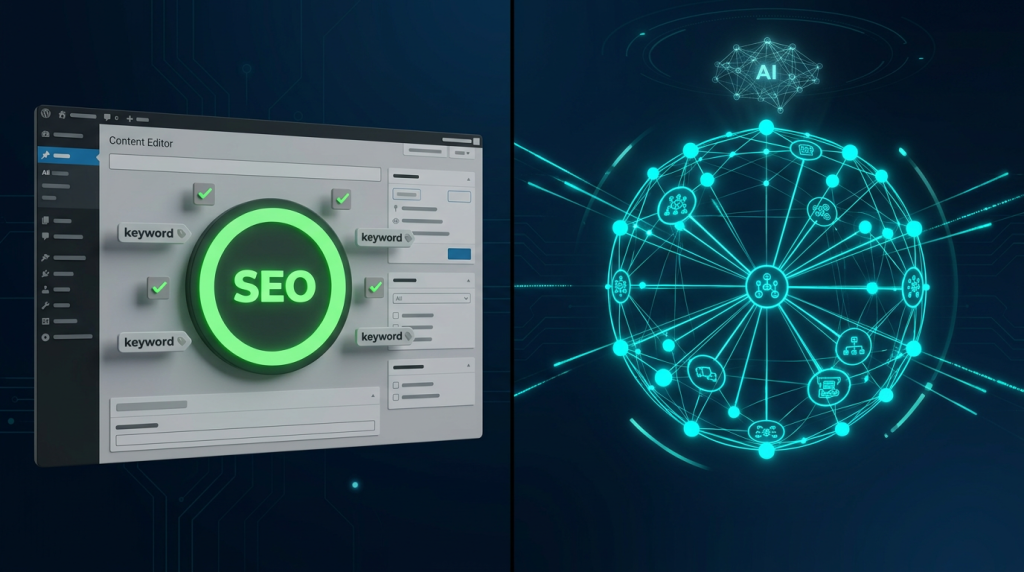
AI-Powered SEO – Beyond AI Writing Assistant for WP
AI writing assistant for WP has evolved beyond keyword density into Entity Relationships and Information Gain — satisfying both human intent and LLM citation requirements, where search engines map semantic relevance across knowledge graphs, not document surfaces.
In 2026, Google doesn’t “read” your keywords; it “maps” your intent. If you are still waiting for an ai writing assistant for WP plugin’s green light to tell you your post is optimized, you have already lost the search war.
The green circle. The readability score. The keyword density bar ticking from orange to green. These elements of Yoast, Rank Math, and every other plugin-era SEO tool were never a strategy — they were administrative scaffolding dressed in the language of performance. For years, they worked well enough. However, the gap between what they measured and what search engines actually rewarded was narrow enough to ignore.
That gap is now a canyon.
The emergence of agentic search — Google’s AI Overviews, Perplexity, ChatGPT Search, Gemini Live, and Microsoft Copilot — has fundamentally restructured the retrieval contract between publishers and search infrastructure. Consequently, the question is no longer “does this page contain the keyword?” Instead, it is: “does this page contain information that an LLM cannot generate from its training data alone, expressed in a way that satisfies the precise intent architecture of this query?”
That is a categorically different engineering problem. Any ai writing assistant for WP that ignores this shift is optimizing for a search engine that no longer exists.
The Collapse of Keyword-Centric Thinking

To understand why conventional SEO tools — including every ai writing assistant for WP — have become administrative utilities, you need to understand how modern search infrastructure processes a query. In the Yoast era, the mental model was simple: a search engine reads text, matches keywords, and ranks accordingly. Moreover, plugins were designed to grade your content against that model.
The contemporary model is vector-based retrieval operating across a knowledge graph. When a user types a query, the search system doesn’t execute a lexical match — instead, it generates a high-dimensional vector representation of the query’s intent, then scans an index of pre-computed content vectors to find the nearest neighbors in semantic space. The system is asking: “Which documents exist in approximately the same conceptual region as this query?”
Strategic Shift: The unit of search is no longer the keyword. It is the entity and the relationship between entities.
Yoast grades keyword placement. Furthermore, it has no mechanism to assess whether your content correctly represents the relationships between entities, whether your claims are structurally consistent with the knowledge graph, or whether your information exists in the semantic neighborhood of the query’s actual intent. It measures something that is no longer the primary signal. For related enterprise-level implications, see our guide on enterprise WordPress maintenance.
What Entity-Based Indexing Actually Means for AI Writing Assistant for WP
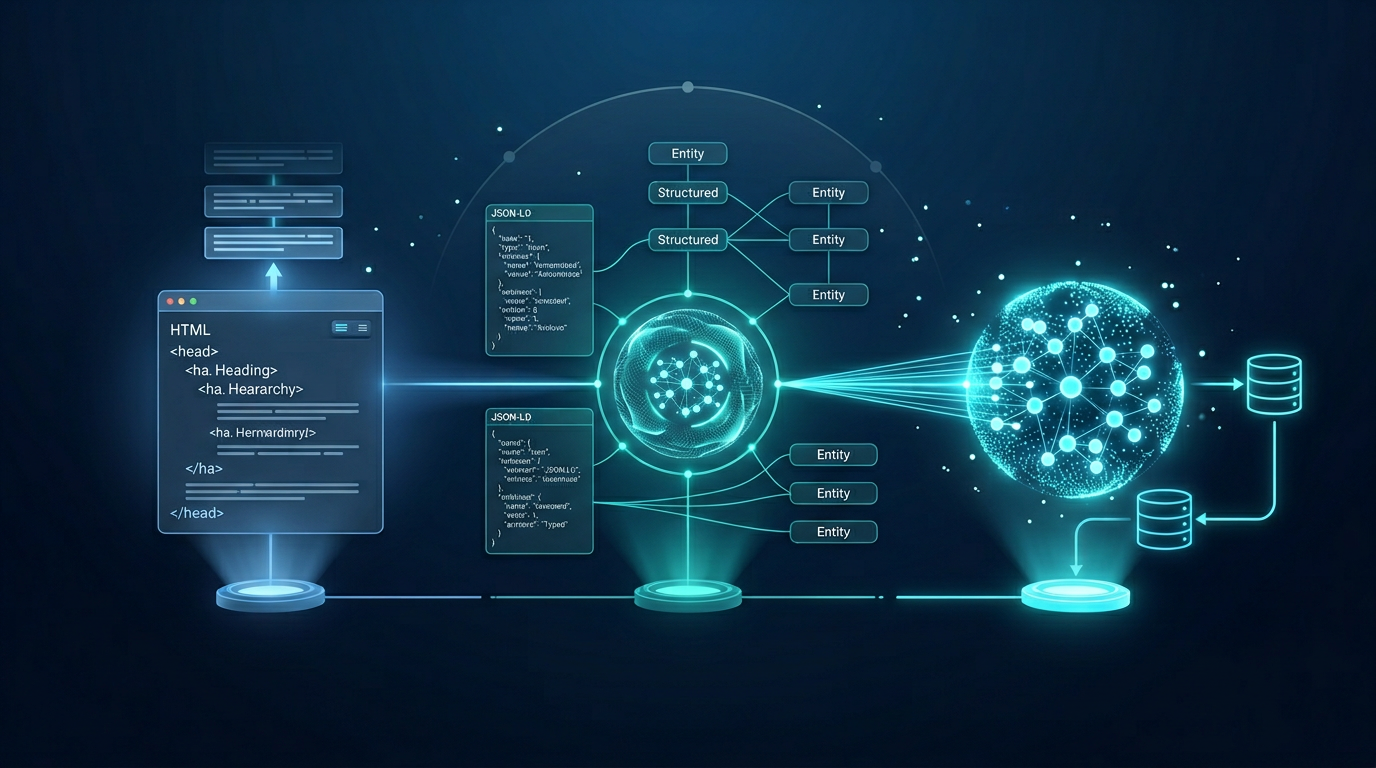
Entity-based indexing refers to Google’s practice of identifying real-world things — people, places, products, concepts, events — within content and mapping the relationships between them, not just the co-occurrence of words. Google’s Knowledge Graph contains hundreds of billions of entities and trillions of relationships. When your content is crawled, the system isn’t just reading your text; it is asking whether your expressed relationships are consistent with, and additive to, what is already in that graph.
If your article about “intermittent fasting” consistently associates the practice with entities like “autophagy,” “insulin sensitivity,” and “circadian rhythm” — and those associations are semantically accurate — the system elevates the document’s topical authority within that entity cluster. However, if your article associates “intermittent fasting” primarily with “weight loss tips” in generic language, it is placed in a crowded semantic neighborhood with thousands of near-identical documents.
Technical note: Google’s MUM (Multitask Unified Model) and Gemini-based retrieval systems process queries multimodally and cross-lingually, evaluating entity co-occurrence patterns across languages simultaneously. Therefore, a topic cluster strategy that ignores cross-lingual entity mapping is structurally incomplete by 2026 standards.
Information Gain: The Technical Requirement No AI Writing Assistant for WP Can Fake
In 2022, Google filed a patent describing a metric called “information gain score” — a measure of how much novel, non-redundant information a document contributes relative to what already exists in the index. Since then, this concept has become central to how retrieval-augmented generation (RAG) systems determine citation-worthiness.
Here is the blunt reality: if a large language model can synthesize the top 10 search results and reproduce the substance of your article, your article adds zero information gain. It will not be cited. It will be buried. Additionally, it may eventually be de-indexed as low-value content as LLM-crawling infrastructure becomes more aggressive in identifying redundant documents.
Information gain is now a technical requirement, not a content philosophy. Therefore, it must be engineered into the document’s architecture, not appended as a “unique perspective” paragraph at the end of a templated post. No ai writing assistant for WP can manufacture genuine information gain — it must come from your proprietary data and expertise.
How to Engineer Information Gain Structurally
There are four primary mechanisms for generating genuine information gain that go beyond what any ai writing assistant for WP can produce automatically:
Proprietary data: Original research, survey results, client case studies, A/B test outcomes, or platform-specific analytics that do not exist in public training data. An LLM cannot synthesize what it has never seen. Consequently, proprietary data creates a structural moat.
Expert inference: Analysis that requires domain expertise to generate — not just to validate. For example, a physician’s interpretation of a clinical trial, an engineer’s failure analysis of a system architecture, or an economist’s decomposition of a market trend. This differs from “expert quotes,” which any aggregator can replicate.
Structured synthesis across conflicting sources: When the academic literature on a topic is genuinely contested, a document that maps the conflict precisely — identifying where researchers diverge and why — provides information gain that no single summarization can replace.
Temporal specificity: LLMs have training cutoffs. Therefore, real-time data, recent case studies, and updated statistics create information gain by definition, as long as the data is embedded in analytical prose rather than simply listed.
“If your article is a well-formatted synthesis of what already exists, it is not content — it is an index entry. The index already has enough entries.”
Semantic Engineering: Vector Embeddings and the Architecture of Meaning

To understand why WPscaleops approaches WordPress database architecture differently from conventional CMS configurations, you need a working model of how vector search operates at the infrastructure level. This understanding also reframes what an ai writing assistant for WP should actually optimize for.
Vector Embeddings Explained Without Abstraction
When a machine learning model processes text, it converts words, sentences, and documents into lists of numbers — vectors — that represent the meaning of that text in high-dimensional space. Words with similar meanings end up numerically close together in this space. “Cardiologist” and “cardiac surgeon” are close vectors. “Cardiologist” and “automotive engineer,” however, are distant vectors.
Documents are converted to vectors using the same process. A search query is also converted to a vector. Subsequently, the retrieval system finds which documents are nearest to the query vector in that multidimensional space. This is vector search — and it is why two articles can rank identically well despite using completely different keywords, as long as their semantic content maps to the same conceptual region.
Strategic Shift: The implication is architectural. Your content structure must create dense, coherent semantic clusters — not keyword-saturated pages — because incoherent entity associations create dispersed, noisy vectors that land in no one’s semantic neighborhood.
How WPscaleops Structures WordPress for LLM-Friendly Retrieval
Standard WordPress installations output HTML documents with minimal machine-readable structure. The content is human-parseable but semantically thin for LLM-crawling systems. At WPscaleops, we restructure the data layer at three levels rather than relying on any single ai writing assistant for WP:
Level 1 — Advanced JSON-LD Schema Implementation: Standard Yoast schema output covers basic Article, Product, and FAQ types. We extend this to include full entity graphs — marking up not just the article’s topic but every named entity within it, with explicit relationship types. For instance, an article about SEO tools might include JSON-LD that identifies “Yoast” as a SoftwareApplication, maps its relationship to “WordPress” as a Platform, and references the author entity with verified professional credentials. This gives LLM-crawling infrastructure a pre-parsed semantic map rather than requiring inference from prose.
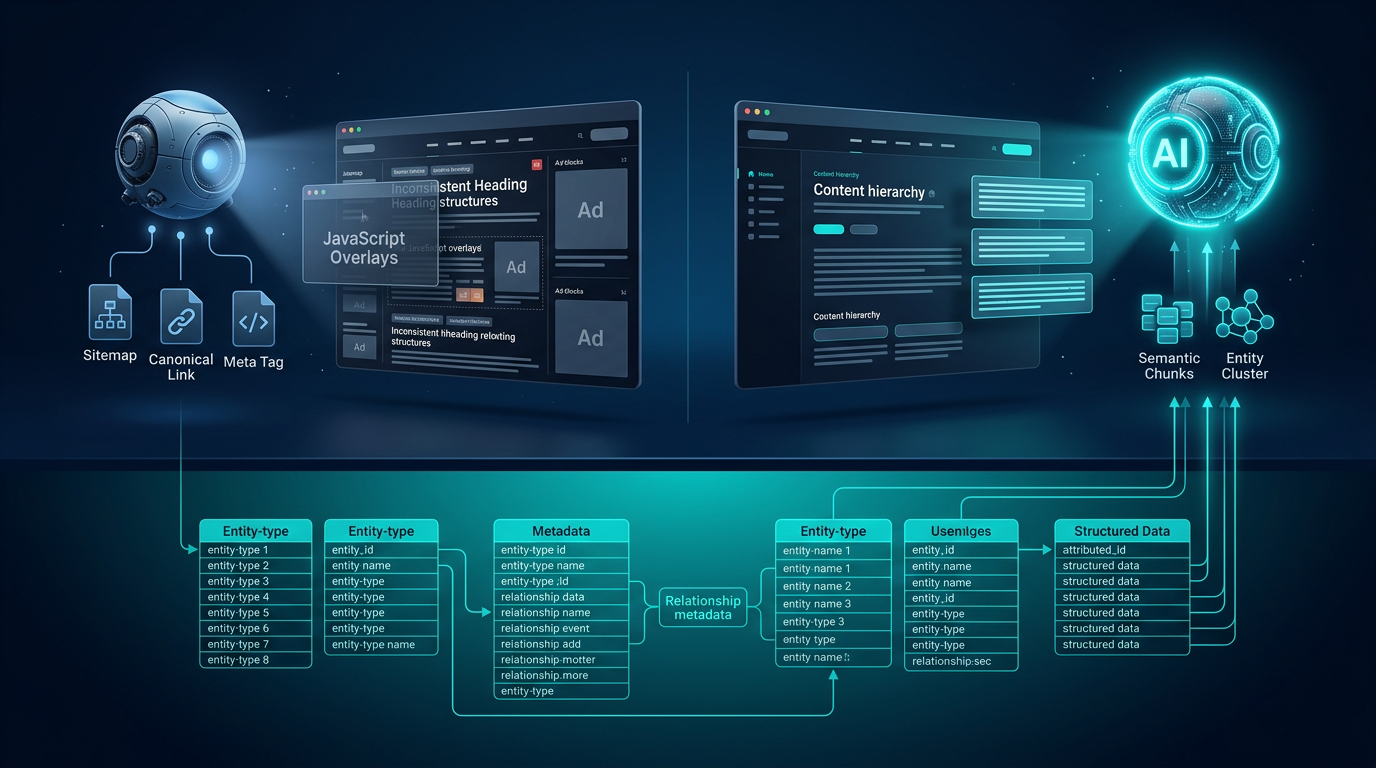
Level 2 — WordPress Database Restructuring for Knowledge Graph Compatibility: WordPress’s default post meta architecture stores content attributes as unstructured key-value pairs. We restructure this using custom table schemas that group entities by type and relationship, enabling programmatic generation of topic cluster maps, entity co-occurrence matrices, and internal link graphs that mirror the semantic architecture of a knowledge graph. This is not a plugin configuration — it is a database engineering decision.
Level 3 — Programmatic SEO at Scale: For clients with large content libraries, programmatic SEO generates entity-rich pages from structured data sources — product databases, research repositories, local entity sets — with consistent schema markup and semantic coherence. The key distinction from legacy programmatic content approaches is that each generated page must pass an information gain threshold before publication; pages that do not exceed a minimum novelty score relative to existing indexed content are held or merged.
Beyond the Plugin: Why Your AI Writing Assistant for WP Is Not Enough

Yoast, Rank Math, SEOPress, and every comparable plugin — including any ai writing assistant for WP — now occupy a specific and limited role: administrative compliance verification. They confirm that your sitemap is formatted correctly, that canonical tags are present, that title tags exist and fall within character limits. These are necessary hygiene functions. They are not strategy.
Strategic Shift: Treating a plugin’s content score as a proxy for search performance is analogous to a surgeon checking that the operating room lights are on and concluding the surgery is ready. Necessary. Utterly insufficient.
Custom AI Agents vs. Standard AI Writing Assistant for WP Tools

Search intent is not static. The semantic interpretation of a query changes as information landscapes shift — new research emerges, market conditions change, and public discourse reframes a topic. Therefore, a page optimized for the intent of a query in Q1 2025 may be misaligned with the same query’s intent in Q3 2026 without the underlying keywords changing at all.
At WPscaleops, we deploy custom AI agents — fine-tuned on domain-specific entity data and integrated with live SERP monitoring APIs — to continuously analyze intent drift across a client’s core query sets. These agents do not simply track ranking fluctuations; instead, they analyze changes in the entity co-occurrence patterns within the top-ranking documents, flagging when the semantic composition of the result set has shifted. This triggers a content review process before ranking impact becomes measurable in conventional analytics.
The agent architecture typically comprises three layers: a retrieval layer that fetches and parses live SERPs, a semantic analysis layer that computes entity distribution changes using embedding comparisons, and a reporting layer that surfaces intent drift signals to human analysts for content strategy decisions. This is not automated content production — it is automated signal detection that preserves human judgment at the strategic layer. A standard ai writing assistant for WP operates on none of these layers. For more on technical infrastructure decisions, see Google’s structured data documentation.
AEO and Citation Share: The New Metric Beyond AI Writing Assistant for WP

For the first decade of link-based SEO, the primary performance metric was backlinks — a proxy for authority derived from how many other documents referenced yours. In 2026, however, the emerging primary metric for forward-thinking publishers is citation authority: how frequently your content is cited as a source in LLM-generated responses.
When a user asks Perplexity, ChatGPT, or Gemini a question and receives a generated answer with cited sources, those citations represent retrieval decisions made by the AI system. The system evaluated all available documents in its index and determined which sources contained information precise enough, reliable enough, and structurally accessible enough to reference. This is the new link.
Strategic Shift: Citation share in AI-generated responses is becoming a measurable brand awareness metric, independent of click-through rate. A document can generate authority and brand exposure without any user clicking the link at all.
Structuring Content for Answer Boxes and Generative Summaries

To achieve consistent citation in generative responses, content must be structured to satisfy the retrieval patterns of RAG (retrieval-augmented generation) systems. These systems prioritize documents that contain:
Direct declarative answers within the first 100 words of a section. RAG systems chunk documents and retrieve the most relevant chunk — not the most relevant document. Therefore, a section that buries its core claim in the fourth paragraph after extensive context-setting will lose the retrieval race to a document that states the claim immediately. This is why we structure every major section with a direct answer in the opening sentence, followed by supporting depth.
Consistent entity naming across the document. RAG systems use entity recognition to understand what a document is about. Documents that use inconsistent terminology — “AI search,” “agentic search,” “LLM-powered retrieval” — for the same concept confuse entity resolution and weaken retrieval signal. Pick canonical entity names and use them consistently.
FAQ structures with complete question-answer pairs. The FAQ format aligns almost perfectly with how RAG systems chunk and retrieve content. A question functions as a semantic anchor for the retrieval system; consequently, the answer provides the cited content. Proper FAQ implementation using FAQPage schema is one of the highest-leverage structural interventions available within WordPress.
Numerical and factual claims with explicit attribution. LLMs are trained to prefer citable facts over unattributed assertions. Therefore, a document that contains specific, attributed data points — with source references embedded in JSON-LD or accessible anchor text — is more likely to be retrieved as a citation source than a document making the same claims without grounding.
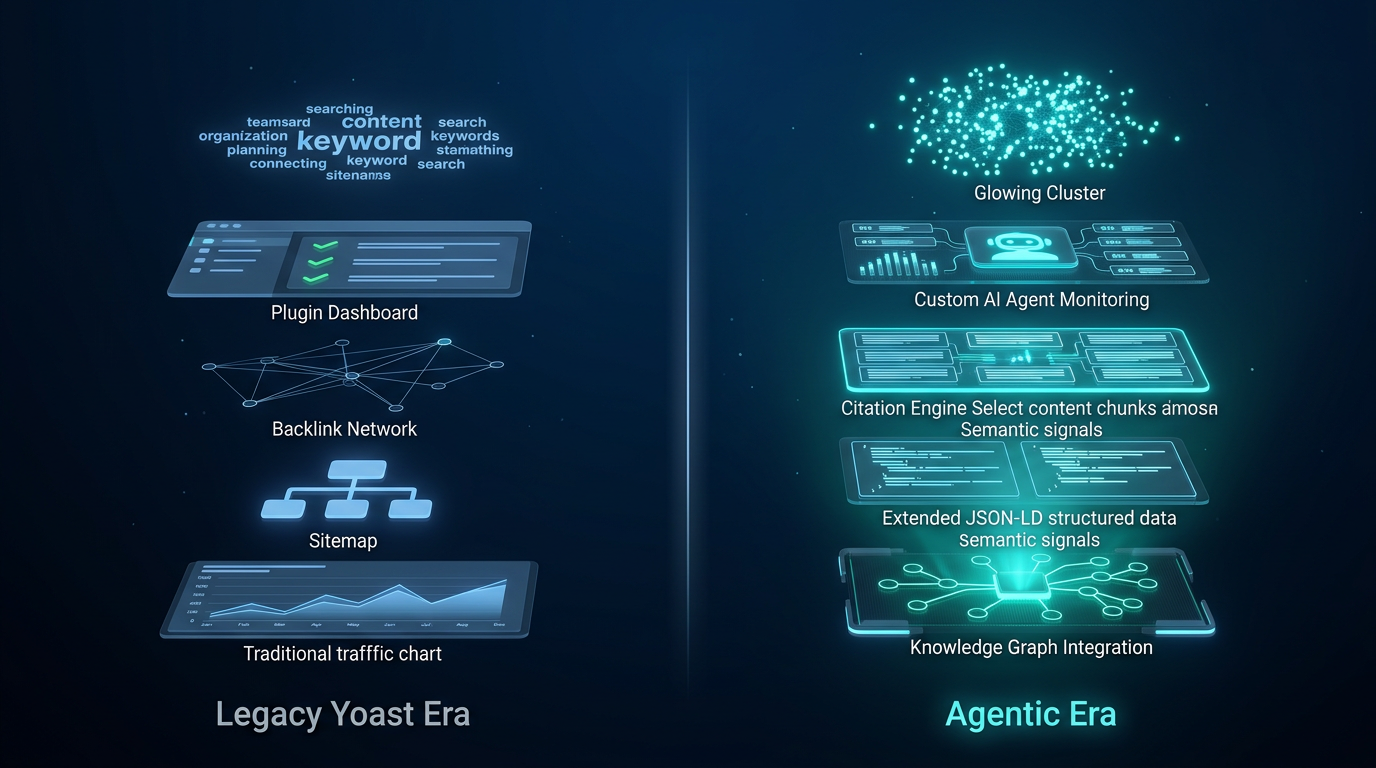
Comparison: The Yoast Era vs. The Agentic Era

| Category | The Yoast Era — Legacy SEO | The Agentic Era — Modern SEO |
|---|---|---|
| Primary Performance Signal | Keyword density and on-page keyword placement verified by plugin score | Semantic relevance score within entity cluster; citation frequency in AI-generated responses |
| Content Evaluation Mechanism | Plugin grades readability, title tag length, keyword presence in subheadings | Custom AI agents assess information gain threshold, entity co-occurrence accuracy, and intent alignment against live SERP entity distribution |
| Link Authority Model | Backlink count and domain authority as primary ranking proxies | Citation authority in LLM-generated responses; entity endorsement within knowledge graph; topical cluster coherence |
| Indexing Architecture | Standard WordPress output; basic schema via plugin; no entity-level markup | Extended JSON-LD entity graphs; custom database architecture for knowledge graph compatibility; programmatic schema generation at scale |
| Keyword Strategy | Target keyword + LSI keywords identified by volume; placed in specific HTML elements | Entity-based indexing targets; semantic relevance clusters; intent architecture analysis across query variants; no minimum keyword count thresholds |
| Technical Infrastructure | Plugin-managed sitemap, robots.txt, canonical tags, Open Graph tags | Plugin for administrative hygiene; custom agents for real-time intent drift monitoring; vector search compatibility engineering; LLM-crawling accessibility audits |
| Content Uniqueness Standard | Avoid duplicate content; write better than competitors; add a unique angle | Exceed minimum information gain score; contribute to knowledge graph with novel entity relationships; pass redundancy screening against indexed documents |
| Measurement Framework | Organic traffic, keyword rankings, click-through rate, time on page | Citation share in AI responses, intent satisfaction rate, entity authority growth, answer box ownership, generative summary inclusion frequency |
The Technical Engineering Layer: Where Most Publishers Are Absent

The most significant competitive gap in 2026 SEO is not content quality — most mature publishers can produce competent content. Instead, the gap is at the technical engineering layer: the structural decisions that determine whether a search engine or LLM can reliably extract, classify, and cite your content.
LLM-crawling infrastructure — the systems that AI companies use to index content for retrieval — has different access patterns and parsing priorities than traditional Googlebot. LLM crawlers prioritize clean text extraction, structured data availability, consistent entity naming, and document coherence. Consequently, websites with heavy JavaScript rendering, inconsistent heading hierarchies, or dense advertising layouts have measurably lower citation rates in AI-generated responses, regardless of content quality.
Strategic Shift: Technical SEO in 2026 must be evaluated against two distinct crawler profiles: the traditional search bot optimizing for index inclusion, and the LLM crawler optimizing for RAG retrieval quality. These profiles have different technical requirements and cannot be satisfied by the same checklist.
At the database level, programmatic SEO architectures must be designed with entity-level granularity. Every content record should carry explicit entity type classifications, relationship metadata, and information gain classifications — not as post-publication tags, but as first-class data attributes that drive both the publishing logic and the schema output. This is a data engineering problem that no ai writing assistant for WP plugin can solve, because plugins operate on published content rather than on the data model that generates it.
AEO FAQ: AI Writing Assistant for WP in Agentic Search
Why is “Time on Page” less important than “Intent Satisfaction” now?
Time on page was always a proxy metric — an inference that if users stayed on a page longer, the page was satisfying their need. The inference was reasonable when search results required users to read through content to extract an answer. In the agentic search environment, however, AI Overviews, generative summaries, and direct answer boxes increasingly satisfy user intent before a click occurs.
A user whose question is answered in a generative summary may never visit your page — but if your content was cited as the source of that answer, you have achieved superior intent satisfaction at the search layer, regardless of time-on-page data. More precisely, intent satisfaction measures whether the user’s actual information need was met, not whether they spent time on your property. Publishers optimizing for session duration metrics are measuring engagement with their interface, not alignment with search infrastructure priorities.
How do I structure content for Voice and Agentic Search using an AI writing assistant for WP?
Voice and agentic search share a critical structural requirement: direct, declarative, citation-ready answers. When Gemini Live or Siri responds to a query, the system retrieves a text passage and converts it to speech or presents it as a direct response. Passages that contain hedging language, incomplete sentences, or context-dependent references (“as mentioned above,” “see the table”) fail in this context because they are not self-contained answers.
Structurally, each section should open with a complete answer to its implied question — a sentence or two that could be read aloud and make complete sense with no prior context. Following that direct answer with depth and nuance serves human readers and traditional search; the opening sentence serves agentic retrieval. Additionally, FAQPage schema with complete question-answer pairs is the highest-leverage implementation for voice search compatibility. Each question-answer pair is a self-contained retrieval unit, precisely aligned with how voice interfaces package information for spoken delivery.
For Gemini Live specifically, optimizing for semantic relevance within the entity cluster of your topic — rather than specific keyword targets — aligns better with conversational query patterns, which rarely match exact keyword strings.
What is the role of technical engineering vs. an AI writing assistant for WP in 2026 SEO?
Technical engineering in 2026 SEO encompasses three distinct domains that were previously either absent or peripheral. The first is LLM accessibility engineering: ensuring that your content can be cleanly extracted by LLM-crawling infrastructure, which requires clean HTML rendering, consistent entity naming, accessible heading structures, and minimal JavaScript dependency in the critical content path.
The second is schema and knowledge graph engineering: producing extended JSON-LD entity markup that maps your content’s subject matter into machine-readable entity-relationship structures that align with Google’s Knowledge Graph taxonomy. The third and most advanced domain is vector search compatibility engineering: designing content architectures that produce coherent, dense semantic vectors when embedded by retrieval systems.
This involves entity co-occurrence analysis, topical cluster coherence audits, and database-level restructuring to ensure that the content generated by your CMS creates semantic signals that land precisely in the intended conceptual neighborhood. This final domain requires integration between content strategy, data engineering, and machine learning infrastructure — a combination that no ai writing assistant for WP plugin-centric approach can address. It is the domain where the real competitive advantage in search is being built right now.
All strategic frameworks reference Google’s publicly available documentation on Knowledge Graph, MUM, and Search Quality Rater Guidelines. Entity relationship mapping references align with schema.org vocabulary standards.
