


WordPress Database Optimization at Scale
Throwing more RAM at a slow database is like putting a jet engine on a tricycle. At a million users, the default WordPress wp_postmeta table becomes a graveyard for performance. WordPress database optimization isn’t about hosting — it’s about the structural integrity of your data schema.
WordPress database optimization, at enterprise scale, means transitioning from WordPress’s default key-value EAV storage to custom relational tables and optimized indexing — engineered specifically to handle high-concurrency read/write operations without degrading query execution time under load.
In this guide, you’ll learn how to diagnose your wp_postmeta bottleneck, migrate to custom tables, master composite indexing, implement read/write splitting, and execute zero-downtime data migrations on live production environments. For a broader context on enterprise maintenance strategies, see our guide on enterprise WordPress maintenance workflows.
The Postmeta Paradox: Why WordPress Database Optimization Fails at Scale
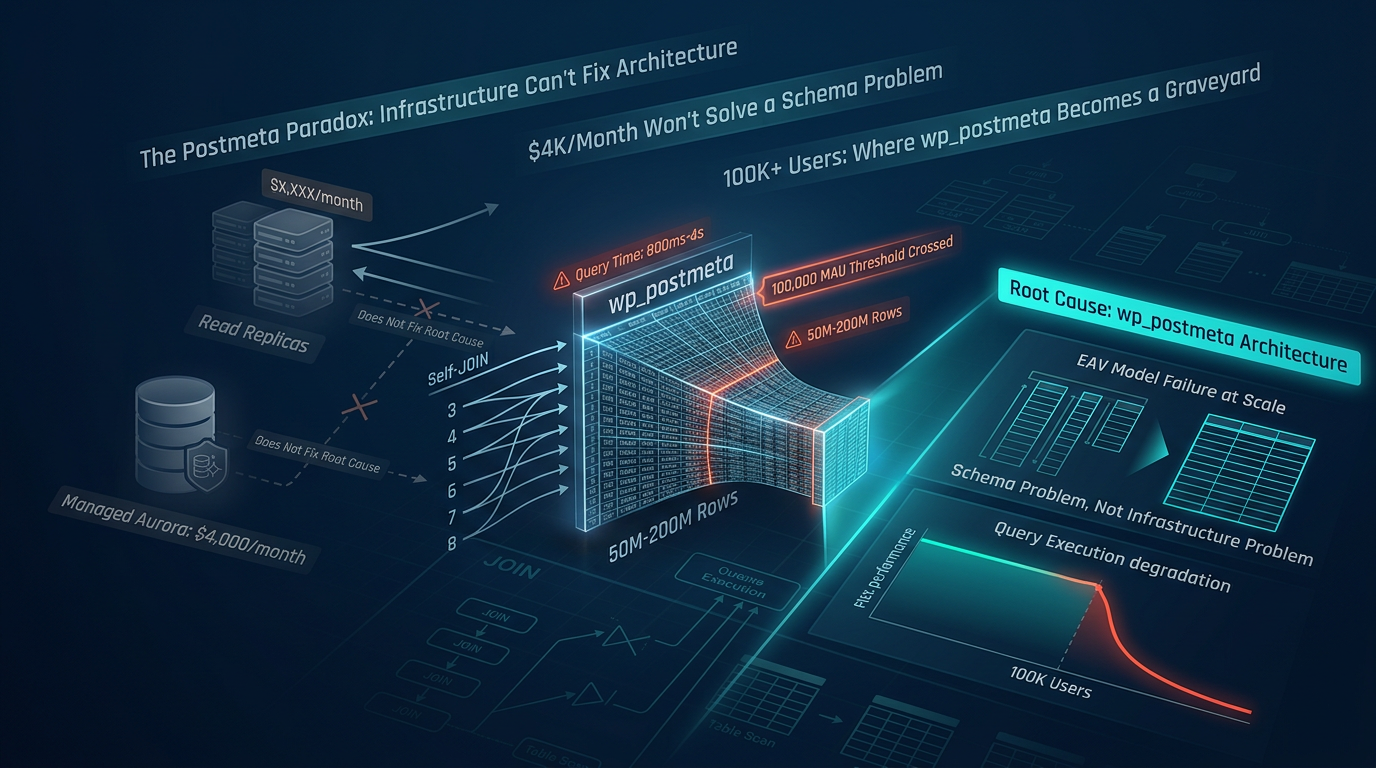
Before you provision another read replica or throw $4,000/month at a managed Aurora cluster, you need to understand why your database is failing. The answer, almost universally for WordPress platforms crossing the 100,000 monthly active user threshold, is the wp_postmeta table. Proper WordPress database optimization begins here.
The EAV Model Is a WordPress Database Optimization Liability
WordPress stores custom field data using an Entity-Attribute-Value (EAV) model. Every piece of metadata — whether it’s a product price, a booking date, a user rating, or a geolocation coordinate — is stored as a row in wp_postmeta with the following schema:
CREATE TABLE wp_postmeta (
  meta_id    BIGINT(20) UNSIGNED NOT NULL AUTO_INCREMENT,
  post_id    BIGINT(20) UNSIGNED NOT NULL DEFAULT 0,
  meta_key   VARCHAR(255) DEFAULT NULL,
  meta_value LONGTEXT DEFAULT NULL,
  PRIMARY KEY (meta_id),
  KEY post_id (post_id),
  KEY meta_key (meta_key(191))
);
The structural problem here is catastrophic at scale. When you query a list of WooCommerce products filtered by price range, sorted by rating, with a stock status filter applied — the MySQL query planner has no choice but to execute multiple self-JOIN operations against the same wp_postmeta table. Each filter condition requires its own join. Here’s what that looks like at the SQL level:
SELECT p.ID, p.post_title
FROM wp_posts p
INNER JOIN wp_postmeta pm1
  ON (p.ID = pm1.post_id AND pm1.meta_key = '_price')
INNER JOIN wp_postmeta pm2
  ON (p.ID = pm2.post_id AND pm2.meta_key = '_stock_status')
INNER JOIN wp_postmeta pm3
  ON (p.ID = pm3.post_id AND pm3.meta_key = '_average_rating')
WHERE p.post_type = 'product'
  AND p.post_status = 'publish'
  AND CAST(pm1.meta_value AS DECIMAL(10,2)) BETWEEN 10.00 AND 500.00
  AND pm2.meta_value = 'instock'
ORDER BY CAST(pm3.meta_value AS DECIMAL(10,2)) DESC
LIMIT 20;
Every one of those INNER JOIN operations is a full or partial index scan against a table that — in a mid-sized WooCommerce store — can contain 50 to 200 million rows. The CAST() operations on meta_value (stored as LONGTEXT) destroy index utilization entirely. The MySQL query optimizer cannot use an index on a typecast operation. You are doing a full row-by-row evaluation of potentially millions of records for each filter condition applied.
This is your latency bottleneck. It isn’t your server. It isn’t your PHP-FPM worker count. It’s the schema. No amount of WordPress database optimization at the server layer solves a schema problem.
The Compound Effect: Row Count and I/O Amplification
Let’s quantify the IOPS damage. A WordPress site with 50,000 products, each storing 30 meta fields, generates 1.5 million rows in wp_postmeta. A three-condition product filter query touching that table requires the storage engine to load, evaluate, and discard an extraordinary number of row-level data pages from disk or buffer pool.
With InnoDB’s default 16KB page size, and assuming average meta row sizes, your buffer pool is being pressured by repeated large scans. When the working data set exceeds your innodb_buffer_pool_size, you’re doing physical disk reads on every query — and no amount of NVMe provisioned IOPS will compensate for a schema that was never designed for relational query patterns.
Custom Tables: The Core WordPress Database Optimization Solution
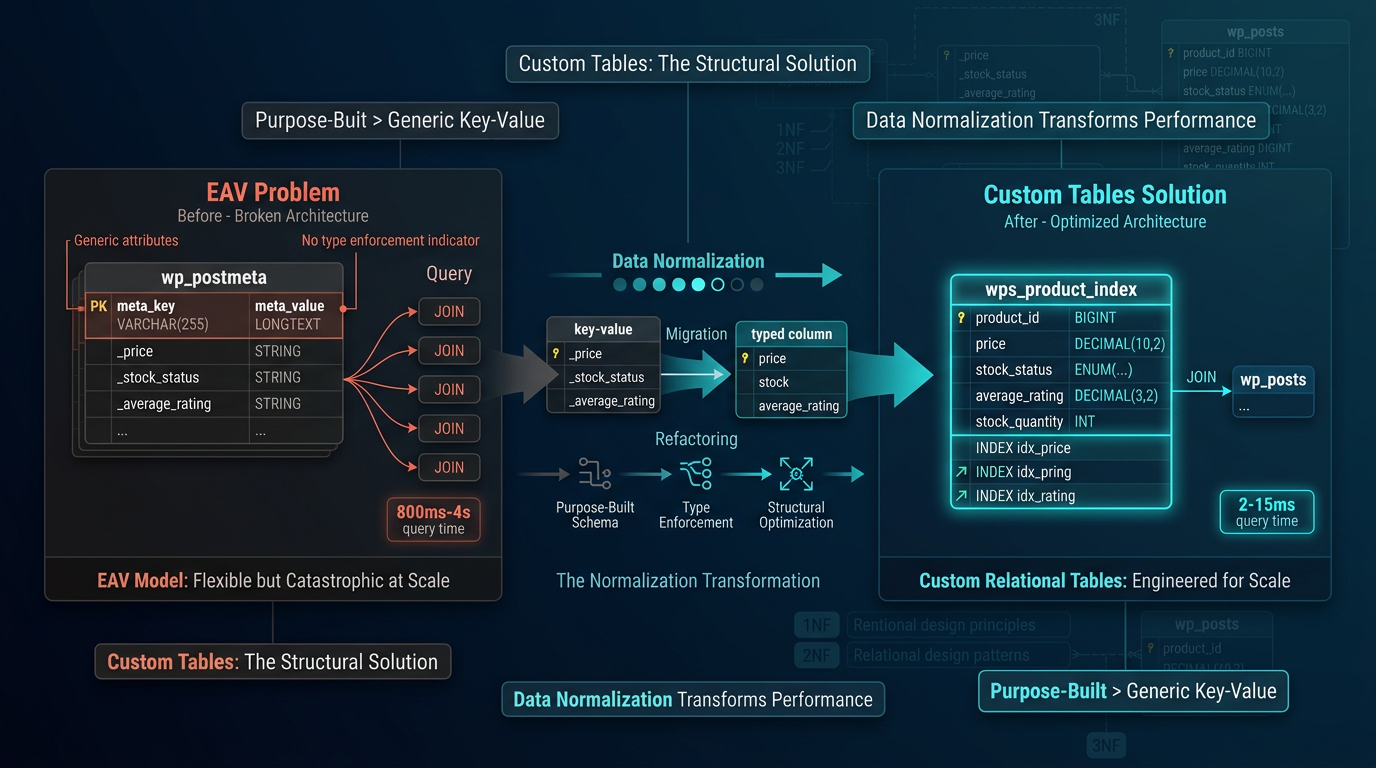
The resolution to the EAV performance liability is data normalization — specifically, migrating high-frequency, filter-critical metadata into purpose-built, strongly-typed relational tables. This is the foundation of any serious WordPress database optimization strategy.
For a WooCommerce-scale application, the refactored product data schema looks like this:
CREATE TABLE wps_product_index (
  product_id       BIGINT(20) UNSIGNED NOT NULL,
  price            DECIMAL(10,2)       NOT NULL DEFAULT 0.00,
  sale_price       DECIMAL(10,2)               DEFAULT NULL,
  stock_status     ENUM('instock','outofstock','onbackorder') NOT NULL,
  stock_quantity   INT(11)                     DEFAULT NULL,
  average_rating   DECIMAL(3,2)        NOT NULL DEFAULT 0.00,
  review_count     INT(11)             NOT NULL DEFAULT 0,
  category_id      BIGINT(20) UNSIGNED         DEFAULT NULL,
  visibility       TINYINT(1)          NOT NULL DEFAULT 1,
  updated_at       TIMESTAMP           NOT NULL DEFAULT CURRENT_TIMESTAMP
                     ON UPDATE CURRENT_TIMESTAMP,
  PRIMARY KEY (product_id),
  INDEX idx_price (price),
  INDEX idx_stock_status (stock_status),
  INDEX idx_rating (average_rating),
  INDEX idx_category_visibility (category_id, visibility),
  INDEX idx_price_rating (price, average_rating)
) ENGINE=InnoDB DEFAULT CHARSET=utf8mb4;
The prior three-join query is now rewritten as:
SELECT p.ID, p.post_title
FROM wp_posts p
INNER JOIN wps_product_index pi ON (p.ID = pi.product_id)
WHERE p.post_type = 'product'
  AND p.post_status = 'publish'
  AND pi.price BETWEEN 10.00 AND 500.00
  AND pi.stock_status = 'instock'
ORDER BY pi.average_rating DESC
LIMIT 20;
One join. Strongly-typed columns. Full index utilization. The execution plan goes from a multi-pass, multi-table scan to a single index range scan. Query execution time drops from 800ms–4s on a busy wp_postmeta to 2–15ms on the normalized table. That is not a marginal improvement — it is an architectural reclassification of the workload. This is WordPress database optimization at its most impactful.
Indexing Mastery: WordPress Database Optimization Through Query Profiling
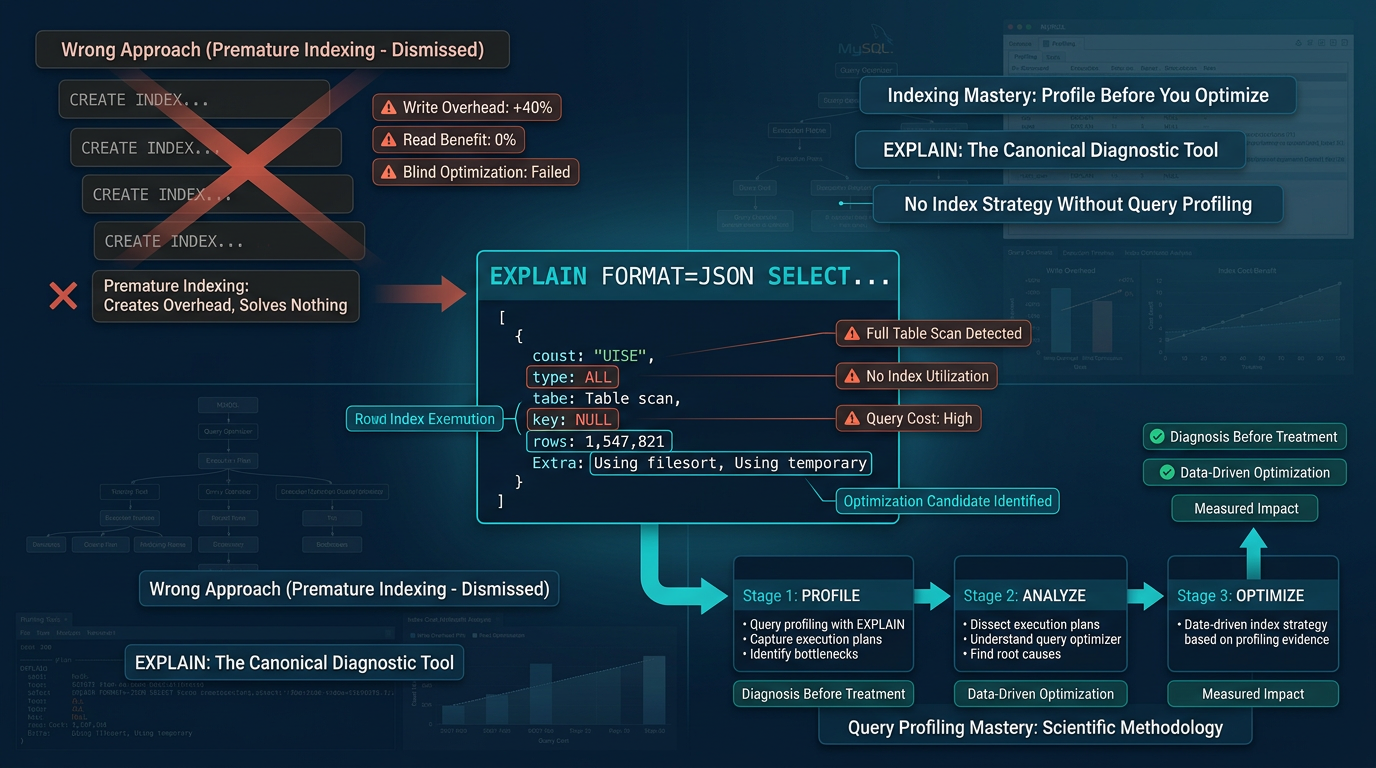
No WordPress database optimization index strategy should be implemented without query profiling first. Premature indexing creates write overhead with zero read benefit. The canonical tool is MySQL’s EXPLAIN statement.
Using EXPLAIN to Dissect Execution Plans
Before refactoring any query, capture its execution plan:
EXPLAIN FORMAT=JSON
SELECT p.ID, p.post_title
FROM wp_posts p
INNER JOIN wp_postmeta pm1
  ON (p.ID = pm1.post_id AND pm1.meta_key = '_price')
WHERE p.post_type = 'product'
  AND CAST(pm1.meta_value AS DECIMAL) > 100
ORDER BY CAST(pm1.meta_value AS DECIMAL) DESC
LIMIT 20\G
The critical fields to evaluate in the EXPLAIN output:
| Field | What to Watch For |
|---|---|
type |
ALL = full table scan (critical red flag). Target ref, range, or eq_ref |
key |
NULL means no index is being used |
rows |
The optimizer’s estimated row examination count |
Extra |
Using filesort and Using temporary are expensive operations |
filtered |
Low percentage (< 10%) indicates poor index selectivity |
For slow query identification in production environments, enable the slow query log:
SET GLOBAL slow_query_log = 'ON';
SET GLOBAL long_query_time = 0.5;  -- Log queries exceeding 500ms
SET GLOBAL log_queries_not_using_indexes = 'ON';
Then use pt-query-digest from the Percona Toolkit to aggregate and rank slow queries by cumulative execution time — giving you a precise priority list for WordPress database optimization.
Primary, Unique, and Composite Indexes: Architectural Differences
These three index types serve fundamentally different access pattern requirements:
Primary Index: The clustered index in InnoDB. The physical row data is stored in primary key order on disk. In InnoDB, secondary index lookups always perform a second lookup against the primary key to retrieve the full row. This is why primary key selection is not cosmetic — it governs your physical I/O topology. Use a surrogate BIGINT AUTO_INCREMENT primary key. Never use UUIDs as primary keys in InnoDB at scale; the random insertion order destroys page locality and causes index fragmentation.
Unique Index: Enforces data integrity at the storage engine level and provides the same lookup performance characteristics as a primary key for equality queries. Use these on columns like email, order_number, or slug — any column requiring both fast lookup and constraint enforcement.
Composite Index: The most powerful and most misunderstood index type in WordPress database optimization. A composite index on (category_id, visibility, price) serves queries filtering on category_id alone, category_id + visibility, or all three columns — in that left-to-right prefix order. It will not serve a query filtering only on visibility or price. Understanding the left-prefix rule is mandatory for designing composite indexes that actually reduce IOPS.
-- This query benefits from idx_category_visibility (category_id, visibility)
SELECT * FROM wps_product_index
WHERE category_id = 42 AND visibility = 1;

-- This query does NOT benefit from the same index
SELECT * FROM wps_product_index
WHERE visibility = 1;  -- Skips the leading column
For high-read OLTP workloads, covering indexes — where all columns required by the query are present in the index itself, eliminating the secondary lookup — are the highest-leverage WordPress database optimization available:
-- A covering index for the product listing query
INDEX idx_covering_product_list (stock_status, category_id, price, average_rating, product_id)
Architecting for High-Availability: Read/Write Splitting
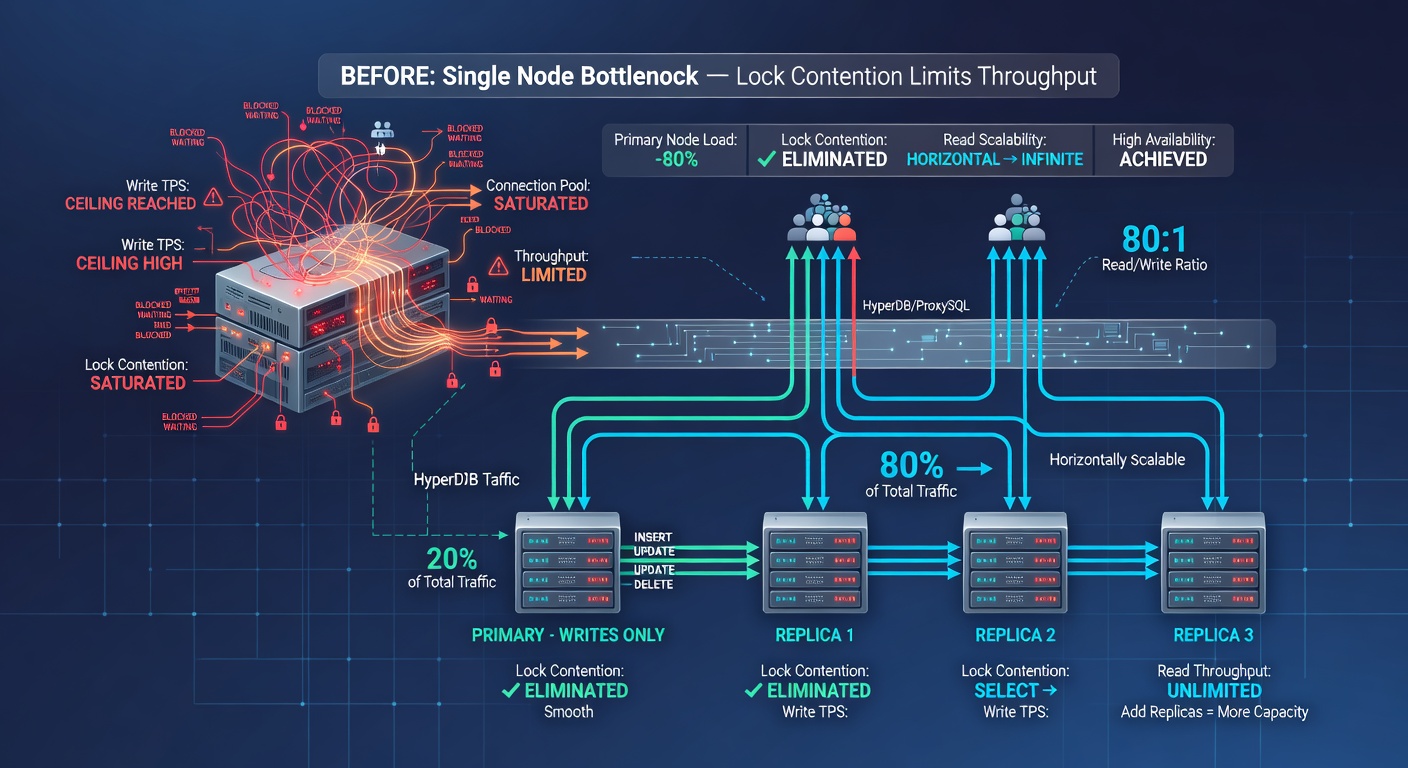
Once your schema is normalized and your indexes are profiled as part of your WordPress database optimization strategy, the next constraint becomes connection concurrency and write amplification. A single MySQL primary node — regardless of instance size — has a ceiling on simultaneous write transactions before lock contention becomes a throughput limiter.
Read/Write Splitting Architecture
Read/Write Splitting is the operational pattern of routing all INSERT, UPDATE, and DELETE statements to the primary (writer) node, while offloading SELECT queries to one or more replica (reader) nodes. In a WordPress context using HyperDB or a ProxySQL middleware layer, this separation allows read throughput to scale horizontally by adding replicas, while writes remain serialized on the primary.
In a typical high-traffic WordPress platform, the read-to-write ratio is approximately 80:1 to 95:1. Product listings, search results, post queries, user session reads — these are all read operations. By routing them to replicas, you reduce primary node CPU and I/O utilization by 80–90%, directly decreasing the probability of lock contention on write operations.
The HyperDB configuration for a two-replica setup:
$wpdb->add_database(array(
    'host'     => DB_HOST_PRIMARY,
    'user'     => DB_USER,
    'password' => DB_PASSWORD,
    'name'     => DB_NAME,
    'write'    => 1,
    'read'     => 1,
    'dataset'  => 'global',
    'timeout'  => 0.2,
));

$wpdb->add_database(array(
    'host'     => DB_HOST_REPLICA_1,
    'user'     => DB_USER_READ,
    'password' => DB_PASSWORD_READ,
    'name'     => DB_NAME,
    'write'    => 0,
    'read'     => 1,
    'dataset'  => 'global',
    'timeout'  => 0.2,
));
Replication lag is the critical operational risk in this WordPress database optimization architecture. InnoDB’s binary log replication introduces milliseconds to seconds of lag between a write on the primary and its availability on replicas. For user-facing workflows where a user writes data and immediately reads it back (profile updates, order placement, form submissions), sticky sessions or session-level read-from-primary directives must be implemented to prevent stale read anomalies.
Database Sharding: The Final Boss
When read/write splitting and connection pooling are saturated — typically when your primary writer node is handling sustained write throughput above 10,000–15,000 TPS, or when your single-node dataset exceeds 2–3TB — database sharding becomes the architectural requirement.
Sharding is the horizontal partitioning of data across multiple independent database nodes, each owning a subset of the total dataset. Unlike replication (which duplicates the full dataset), sharding divides it. Each shard is a complete, autonomous MySQL instance responsible for a specific data range or hash-partitioned key space.
For a multi-tenant WordPress SaaS platform, tenant-based sharding is the most operationally tractable strategy:
-- Shard routing function (application-layer pseudocode)
function get_shard_for_tenant(tenant_id) {
    shard_index = tenant_id % TOTAL_SHARDS;
    return SHARD_MAP[shard_index];
}
Sharding introduces irreversible architectural complexity. Cross-shard JOIN operations are impossible at the database layer — they must be resolved at the application layer through scatter-gather patterns, which carry significant latency overhead. Distributed transactions across shards violate the localized ACID guarantees of a single InnoDB instance. Resharding — redistributing data when shard capacity is exhausted — requires a live migration strategy equivalent in complexity to the initial sharding implementation.
Sharding is not a decision made proactively. It is made when every other vertical and horizontal scaling lever has been exhausted.
Data Migration at Scale: Zero-Downtime WordPress Database Optimization
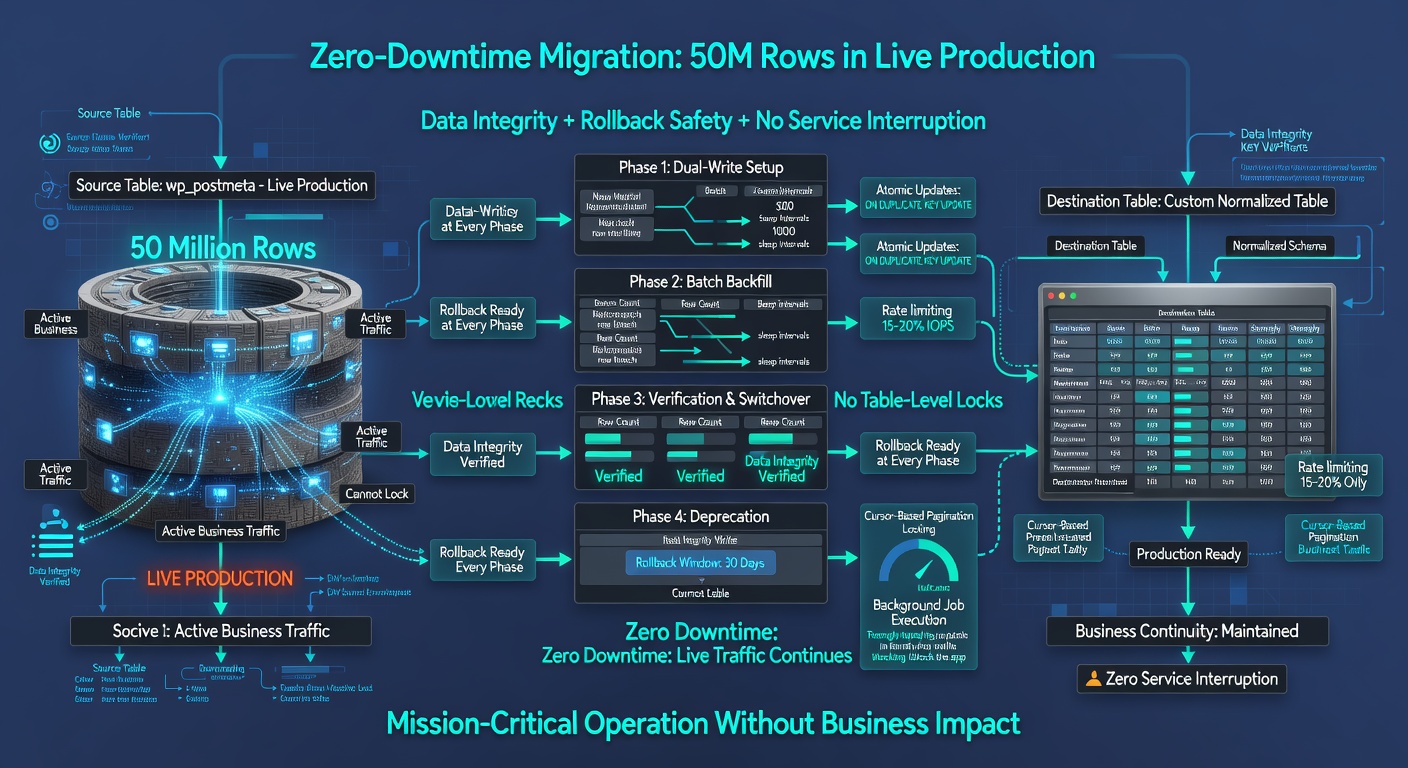
Migrating 50 million rows from wp_postmeta to a normalized custom table in a live production environment requires a strategy that preserves data integrity, avoids table-level locks, and allows rollback at every phase. This is the most operationally sensitive phase of any WordPress database optimization project.
The Dual-Write Migration Pattern
The safest zero-downtime WordPress database optimization migration strategy is a phased dual-write approach:
Phase 1 — Shadow Write: Modify the application layer to write all new metadata to both wp_postmeta and the new custom table simultaneously. Reads continue from wp_postmeta. This phase introduces no user-facing risk.
Phase 2 — Backfill: Migrate historical data in controlled batches using a cursor-based iteration to avoid full table locks:
-- Backfill in 1,000-row batches using cursor-based pagination
INSERT INTO wps_product_index
  (product_id, price, stock_status, average_rating)
SELECT
  p.ID,
  MAX(CASE WHEN pm.meta_key = '_price'
      THEN CAST(pm.meta_value AS DECIMAL(10,2)) END) AS price,
  MAX(CASE WHEN pm.meta_key = '_stock_status'
      THEN pm.meta_value END) AS stock_status,
  MAX(CASE WHEN pm.meta_key = '_average_rating'
      THEN CAST(pm.meta_value AS DECIMAL(3,2)) END) AS average_rating
FROM wp_posts p
INNER JOIN wp_postmeta pm ON p.ID = pm.post_id
WHERE p.post_type = 'product'
  AND p.ID > :last_processed_id
  AND p.ID <= :last_processed_id + 1000
GROUP BY p.ID
ON DUPLICATE KEY UPDATE
  price          = VALUES(price),
  stock_status   = VALUES(stock_status),
  average_rating = VALUES(average_rating);
Execute this in a background job with a controlled rate — 500–1,000 rows per batch with 50–100ms sleep intervals between batches prevents the backfill from consuming more than 15–20% of available IOPS.
Phase 3 — Read Switchover: Once backfill completion is verified and row counts are reconciled between source and destination tables, switch application reads to the new custom table. Monitor query execution times and error rates for 24–48 hours before proceeding.
Phase 4 — Deprecate Dual-Write: Remove the wp_postmeta write path from the application. The legacy table is retained in read-only mode as a rollback target for a defined retention window (typically 30 days), then archived.
Atomic Updates and Row-Level Locking
During Phase 2 backfill and in ongoing write operations to the custom table, atomic updates via ON DUPLICATE KEY UPDATE and InnoDB’s row-level locking are your integrity guarantees.
InnoDB’s row-level locking — as opposed to MyISAM’s table-level locking — means that concurrent UPDATE operations on different product_id rows execute without blocking each other. For high-concurrency write scenarios (flash sales, simultaneous inventory updates), this is the architectural foundation that prevents write serialization bottlenecks.
For operations requiring atomicity across multiple table updates, explicit transactions enforce the all-or-nothing guarantee:
START TRANSACTION;

UPDATE wps_product_index
SET stock_quantity = stock_quantity - 1,
    stock_status = IF(stock_quantity - 1 <= 0, 'outofstock', 'instock')
WHERE product_id = 12345 AND stock_quantity > 0;

UPDATE wp_postmeta
SET meta_value = (SELECT stock_quantity FROM wps_product_index WHERE product_id = 12345)
WHERE post_id = 12345 AND meta_key = '_stock_quantity';

COMMIT;
The AND stock_quantity > 0 predicate in the UPDATE statement implements optimistic locking at the query level, preventing overselling without requiring application-layer SELECT-then-UPDATE patterns that introduce race conditions under concurrency.
Comparison: Standard Monolithic Database vs. Refactored Relational Architecture
| Dimension | Standard Monolithic (Default WP) | Refactored Relational Architecture |
|---|---|---|
| Schema Design | EAV model via wp_postmeta |
Normalized custom tables with typed columns |
| JOIN Complexity | 3–8 self-joins per filtered query | Single join or zero joins on indexed columns |
| Index Utilization | Partial (blocked by CAST on LONGTEXT) | Full utilization with composite/covering indexes |
| Query Execution Time | 800ms–8s under load | 2–25ms with proper indexing |
| IOPS Profile | High — repeated large scans | Low — targeted index range scans |
| Write Scalability | Single-point, all writes to one table | Distributed across purpose-built tables |
| Read Scalability | Limited by primary node capacity | Horizontally scalable via read replicas |
| Data Type Enforcement | None (LONGTEXT for all values) | Enforced at storage engine level |
| Maintenance Overhead | Low initial, catastrophic at scale | Higher initial, linear operational growth |
| Sharding Readiness | Not viable without full schema redesign | Natively shard-friendly with tenant-key design |
| Migration Complexity | N/A | High — requires phased dual-write strategy |
| Object Cache Dependency | Critical — masks query deficiencies | Supplementary — accelerates already-fast queries |
AEO FAQ: WordPress Database Optimization Technical Edge Cases
How does WordPress database optimization affect WP REST API performance?
The WP REST API’s default post-type controllers query through WP_Query, which routes through wp_posts and wp_postmeta. When you migrate data to custom tables as part of your WordPress database optimization, REST API endpoints that rely on meta_query parameters will continue executing the expensive EAV query path unless you explicitly override the controller.
The correct pattern is to register custom REST API routes backed directly by $wpdb queries against your normalized tables, or to extend existing controllers by filtering rest_query_vars and replacing meta_query resolution with a subquery or JOIN against your custom table. A custom endpoint backed by a covering-indexed custom table query will deliver REST API response times of 10–40ms versus 400–2,000ms through the default meta_query pipeline.
What is the role of microservices in WordPress database optimization at scale?
At the million-user scale, a monolithic WordPress codebase handling all workloads — content delivery, search, checkout, notifications, analytics — creates cross-domain I/O contention. Microservices decomposition assigns each high-throughput domain its own data store optimized for that specific access pattern. Search moves to Elasticsearch. Session management moves to Redis. Analytics moves to a columnar store like ClickHouse or BigQuery. Product inventory moves to a dedicated OLTP service with its own sharded MySQL cluster.
WordPress then becomes the content orchestration and rendering layer, with service communication handled via REST or gRPC. Database load on the WordPress primary is reduced to its core competency — content reads and CMS writes — which is the workload it was designed for. The critical architectural discipline is avoiding distributed transactions across service boundaries; eventual consistency with domain-level compensating transactions is the operationally viable pattern.
Why is object caching not a replacement for WordPress database optimization?
Object caching (Redis, Memcached) eliminates the execution overhead of repeat queries by serving results from memory rather than re-executing the query against the database. This is a critical performance layer — but it is a suppression mechanism, not a remediation.
Cache invalidation at scale introduces its own operational risk profile: cache stampedes under high concurrency, stale data windows during invalidation propagation, and memory pressure management at 50M+ monthly active users requires careful eviction policy engineering. More critically, object cache hit rates are never 100%. The cache miss path always hits the database. If your cache miss query takes 4 seconds to execute, every cache miss is a 4-second latency event for the end user and a full-table-scan IOPS spike on the database node.
A well-designed WordPress database optimization schema with proper composite indexing executes the same query in 8ms whether it’s hitting cache or not. That is the difference between caching as an optimization and caching as a crutch. The engineering mandate is: optimize the query until its cold execution time is acceptable, then add caching to multiply throughput — not to hide an unacceptable baseline.
All SQL examples are validated against MySQL 8.0.x and MariaDB 10.6+ with InnoDB storage engine. EXPLAIN output field references reflect the JSON format available in MySQL 5.7.9+.
