

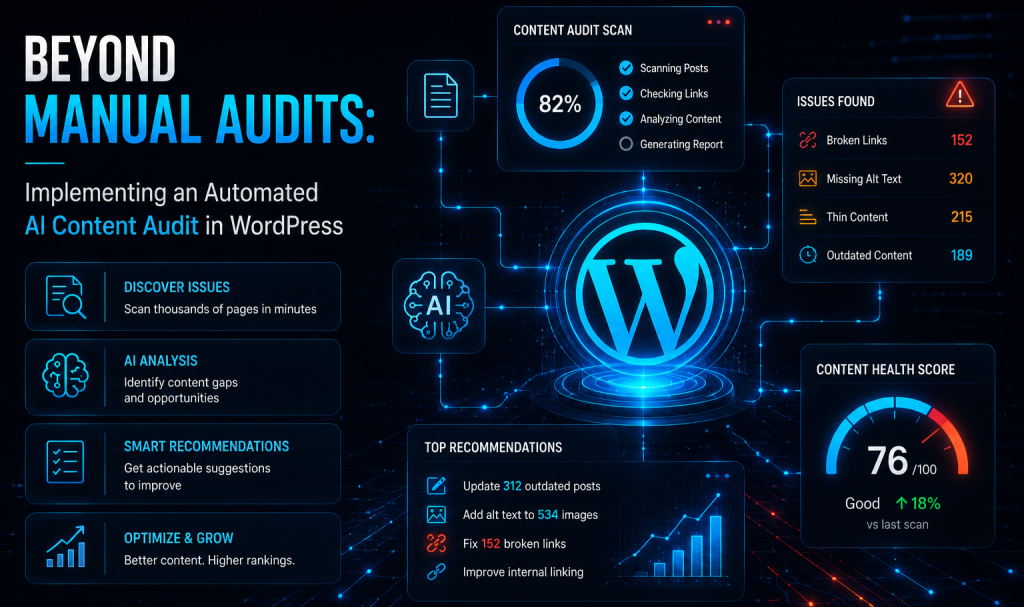
Beyond Manual Audits: Implementing an Automated AI Content Audit in WordPress
Somewhere inside a large, multi site WordPress operation sits a spreadsheet nobody has updated in over a year. It was meant to track which of the several thousand published posts need a content refresh, which ones are missing alt text, which ones link to pages that no longer exist, which ones are quietly cannibalizing each other for the same keyword. Someone started it with genuine intention. Then the content library kept growing, new sites got added to the portfolio, and the spreadsheet became exactly what every manual content audit eventually becomes on a large site, a snapshot of a moment in time that grows less accurate with every week that passes after it was last touched.
This article is written for marketing directors, SEO specialists, and content agency owners managing large, multi site WordPress operations who have lived this exact experience, watching content debt accumulate faster than any manual audit process can realistically keep pace with. What follows explains why this debt quietly costs a business real search visibility, how an automated AI content audit pipeline actually connects to a WordPress database through the REST API to scan and tag content programmatically at genuine scale, how that same infrastructure powers intelligent content clustering and internal linking, and how this kind of background automation runs safely without locking database tables or degrading the experience of the actual visitors the site depends on.
The Cost of Manual Content Debt
Before addressing the automated solution, it is worth being precise about what content debt actually is, how it accumulates, and why it represents a genuine, measurable drag on search performance rather than simply an aesthetic or organizational inconvenience.
What Content Debt Actually Looks Like at Scale
Content debt accumulates in several distinct, compounding forms across any content library that grows over a period of years. Outdated posts contain information, statistics, product details, industry context, that was accurate when published but has since become stale, quietly undermining a site’s credibility with both visitors and search engines that increasingly evaluate content freshness as a genuine quality signal. Thin content, older posts written before a site’s editorial standards matured, sit in the index competing weakly against considerably more comprehensive content elsewhere, sometimes including a business’s own newer, better articles on the same subject. Broken internal links accumulate silently as older posts reference pages that have since been deleted, renamed, or restructured, degrading both user experience and the internal link equity distribution that search engines depend on to understand a site’s structure. Missing or generic alt text sits on thousands of images, a small but genuinely cumulative accessibility and search visibility gap that grows directly with a library’s total image count.
None of these individual issues feels urgent in isolation. A single outdated post, a single broken link, a single missing alt attribute, is a minor, easily overlooked detail. The genuine cost only becomes visible when these individual issues are understood in aggregate, across a content library that has grown into the thousands of posts, where even a small percentage of affected content represents a large absolute number of pages quietly working against a site’s overall search authority.
Why Search Engines Increasingly Penalize Content Debt Directly
Search engines have grown considerably more sophisticated at evaluating not just individual pages in isolation, but a site’s overall content quality and consistency as a broader trust signal. A site carrying a large volume of thin, outdated, or poorly maintained content alongside its stronger, more current material can see that weaker content quietly drag down how search engines evaluate the site’s overall authority and trustworthiness on a given subject, a dynamic that means content debt is not merely a missed opportunity confined to the specific affected pages, but a genuine liability capable of affecting how the site’s strongest, most valuable content performs as well.
This dynamic has become more pronounced as search engines have placed growing emphasis on genuine topical authority and demonstrated expertise, both of which are undermined directly by a content library containing a large volume of stale, thin, or poorly interlinked material sitting alongside a site’s genuinely strong content, diluting the coherent signal of expertise that a cleaner, better maintained content library would otherwise send clearly and consistently.
Why Manual Auditing Cannot Realistically Keep Pace
The traditional response to this problem, a manual content audit, where a team member or a contracted specialist works through a spreadsheet of published content, reviewing each post for freshness, thinness, broken links, and missing metadata, works reasonably well for a smaller content library, a few hundred posts reviewed periodically. It breaks down predictably and completely once a content library scales into the thousands of posts, particularly across a multi site portfolio where the same audit needs to be repeated separately across every individual property.
The math here is simply unforgiving. A thorough manual review of a single post, checking its factual currency, its comprehensiveness relative to current competing content, every internal and external link it contains, every image’s alt text, reasonably takes a meaningful amount of focused time per post. Multiplied across several thousand posts, this represents many weeks of dedicated, focused human labor for a single audit pass, and content does not stand still while that audit is underway, meaning by the time a manual audit of a large library actually completes, a meaningful share of the content reviewed early in the process has already drifted further out of date, and new content published during the audit period was never reviewed at all.
Why This Cost Compounds Specifically for Agencies Managing Multiple Sites
For a digital agency managing content and SEO across a portfolio of client sites simultaneously, this scaling problem multiplies directly with the number of sites under management. A manual audit process that consumes a meaningful share of one team member’s time for a single client’s content library becomes genuinely unsustainable once that same process needs to be repeated, consistently and on a reasonable schedule, across a dozen or more client accounts, each with its own growing content library. This is precisely the kind of scaling constraint that limits how many clients an agency can realistically serve without proportionally growing its content operations headcount, directly capping growth in a way that has nothing to do with the agency’s actual ability to win new client relationships and everything to do with the practical limits of manual content auditing labor.
The Silent Compounding of Human Error
Beyond the raw time cost, manual auditing introduces a genuine consistency problem that a purely time based analysis understates. A human reviewer’s attention and thoroughness naturally vary across a long, repetitive audit session, meaning issues are more likely to be caught early in a review session and more likely to be missed as fatigue sets in during a lengthy audit pass through hundreds of similar posts. Different reviewers, if more than one person is involved in a large audit effort, naturally apply subtly different standards and catch subtly different categories of issue, producing inconsistent audit quality across different portions of the same content library depending on who happened to review which specific batch of posts. This inconsistency compounds the raw time cost problem, since even the substantial time investment a manual audit requires does not reliably guarantee a comprehensive, consistent result across the entire content library being reviewed.
How Content Debt Quietly Wastes Crawl Budget
Search engines allocate a limited amount of crawling attention to any given site, and a large content library carrying a substantial volume of thin, outdated, or low value pages consumes a meaningful share of that limited crawl attention on content unlikely to perform well regardless of how frequently it gets recrawled, indirectly slowing how quickly search engines discover and properly index a site’s genuinely valuable new content and updates. This effect compounds specifically for large, actively publishing sites, where crawl budget represents a genuine, finite resource, and where a content library weighed down by substantial accumulated debt effectively dilutes that limited resource across a large volume of pages contributing little genuine value to the site’s overall search performance.
This crawl budget consideration is rarely visible in standard analytics reporting, since it manifests indirectly, as a general slowness in how quickly new content gets fully indexed and begins ranking, rather than as an explicit, clearly attributed metric any standard dashboard surfaces directly. It represents another example of content debt’s cost being genuinely real but difficult to see without deliberately investigating the specific pattern, exactly the kind of hidden cost that makes content debt easy to deprioritize relative to more visible, immediately pressing business concerns, right up until a comprehensive audit finally reveals its true, accumulated scale.
Why Content Debt Grows Faster Than Most Teams Realize
Content debt does not accumulate at a constant, predictable rate. It compounds, since every month of continued publishing adds new content that will itself eventually become a candidate for the same categories of debt, outdated information, thinner coverage relative to what competing content eventually becomes, as time passes and the surrounding competitive and factual landscape continues to evolve. A content library growing at a steady publishing pace, without a corresponding, proportional ongoing maintenance effort, sees its total volume of debt laden content grow considerably faster than its total volume of actively maintained, current content, a mathematical reality that means the gap between a library’s total size and its genuinely well maintained portion tends to widen over time rather than remain stable, precisely the dynamic that eventually produces the kind of severe, years deep content debt backlog many established sites and agencies eventually discover once they finally undertake a comprehensive review.
Designing an Automated AI Audit Pipeline
Resolving this problem at genuine scale requires replacing manual, human driven review with an automated pipeline capable of scanning and evaluating an entire content library programmatically, consistently, and repeatedly, connecting directly to WordPress’s actual content data rather than depending on a human working through a spreadsheet.
Connecting to WordPress Content Through the REST API
The foundation of an automated content audit pipeline is a reliable, programmatic connection to a site’s actual published content, most naturally established through the WordPress REST API, which provides structured, reliable access to post content, metadata, and associated data without requiring direct, potentially risky interaction with the underlying database itself. A properly engineered pipeline queries this API systematically, retrieving each post’s full content, publication and modification dates, associated images and their current alt text, and the full set of internal and external links each post contains, assembling the complete data set the audit logic actually needs to evaluate.
For a multi site portfolio, this connection needs to be built with genuine attention to handling multiple distinct WordPress installations consistently, whether through a centralized system that connects to each individual site’s REST API separately, or through a multisite specific architecture where appropriate, ensuring the same audit logic and the same consistent standards apply uniformly across every property in the portfolio rather than requiring separately configured, potentially inconsistent auditing logic maintained independently for each individual site.
Sending Content to an LLM for Genuine Semantic Evaluation
Once a pipeline has reliable access to a post’s actual content, the genuine evaluation work involves passing that content through a large language model specifically prompted to assess the categories of issue a manual audit would traditionally check for, whether the content appears outdated relative to current information the model has been trained on or relative to specific facts the pipeline can verify independently, whether the content is genuinely thin or comprehensive relative to the topic it addresses, and whether the content’s internal linking and structural organization reflects good practice or reveals gaps worth flagging for review.
This evaluation step represents a genuinely different capability than a simple, rule based checklist could provide, since a large language model can assess genuine content quality, comprehensiveness, and freshness in a way that goes considerably beyond what a purely mechanical rule, checking word count or checking for the presence of specific required elements, could ever capture. This is precisely the capability that makes AI powered auditing meaningfully more valuable than earlier generations of automated SEO tooling, which were generally limited to surface level, rule based checks rather than genuine content quality assessment.
Programmatically Tagging and Scoring Content for Prioritization
The output of this evaluation needs to be captured in a structured, actionable format, typically a set of tags and scores attached to each post, flagging specific issues, outdated statistics, thin coverage relative to current competing content, missing alt text on a specific number of images, broken internal links pointing to deleted pages, alongside an overall priority score reflecting how urgently that specific post warrants human review or remediation relative to the rest of the content library. This structured tagging is what transforms a raw AI evaluation into something a marketing team can actually act on efficiently, surfacing a clearly prioritized list of the content library’s most pressing issues rather than an undifferentiated wall of AI generated commentary that would itself require considerable human time to parse and prioritize manually.
Storing Audit Results for Trend Analysis Over Time
A properly engineered pipeline stores audit results in a structured, persistent format specifically designed to support trend analysis over time, not just a single, static snapshot. This allows a team to track how content debt is actually trending across the library, whether ongoing publishing and remediation efforts are genuinely keeping pace with the rate at which existing content ages and accumulates new issues, or whether debt continues accumulating faster than the team’s current remediation capacity can address. This kind of longitudinal visibility, tracking content health as an ongoing metric rather than a one time audit finding, is precisely what a manual audit process, conducted infrequently and inconsistently, has genuine difficulty providing.
Distinguishing Automated Flagging From Automated Rewriting
It is worth being direct about an important distinction in how a properly designed pipeline should operate. The audit pipeline’s core function is identifying and prioritizing issues accurately, not automatically rewriting flagged content without human oversight. A properly designed system surfaces its findings clearly, an outdated statistic here, a thin section there, a broken link requiring correction, and leaves the actual editorial decision about how to address each specific finding to a human content strategist who understands the business context a purely automated system cannot fully capture on its own. This distinction matters both for content quality, since automated rewriting without human oversight risks introducing its own new inaccuracies or inconsistencies, and for maintaining genuine editorial voice and judgment over what ultimately gets published under a business’s name.
Verifying Broken Links and Factual Claims Through Direct Checks
Alongside the genuine semantic evaluation an AI model provides, a properly engineered pipeline also incorporates direct, mechanical verification for the specific categories of issue that benefit from precise, deterministic checking rather than probabilistic AI judgment. Broken link detection, for instance, benefits from an actual, direct check confirming whether a linked URL still returns a valid response, a mechanical verification considerably more reliable for this specific purpose than relying on an AI model’s own judgment about whether a link seems likely to be broken. Combining this kind of deterministic, mechanical verification alongside genuine AI semantic evaluation produces a more accurate, more trustworthy overall audit than relying on either approach exclusively, using each specific technique for the category of finding it is genuinely best suited to detect reliably.
This combination matters particularly for maintaining trust in the pipeline’s findings over time, since a system that occasionally flags a working link as broken, or misses a genuinely broken link, due to relying solely on AI judgment for a category of check that a simple, direct technical verification could confirm definitively, gradually erodes a content team’s confidence in the pipeline’s overall findings, undermining the very efficiency gain the automation was specifically built to provide.
Maintaining Consistent Standards Across a Multi Site Portfolio
For an agency or business managing multiple distinct WordPress properties, a genuinely valuable automated pipeline applies consistent evaluation criteria and consistent prioritization logic uniformly across every site in the portfolio, while still allowing for legitimate, deliberate customization where a specific client’s industry or content strategy genuinely warrants different specific evaluation criteria than another client’s. This balance, consistent underlying methodology with configurable, deliberate customization where genuinely warranted, represents a meaningfully more sophisticated requirement than either a single, rigid, one size fits all evaluation approach applied identically regardless of context, or a completely bespoke, separately configured approach maintained independently for every single client site with no shared underlying consistency at all.
Achieving this balance requires genuine engineering thought given to how the pipeline’s evaluation criteria are structured and configured, building a system flexible enough to accommodate legitimate, meaningful differences between client industries and content strategies while still maintaining the underlying methodological consistency that makes audit findings genuinely comparable and trustworthy across the full portfolio an agency manages.
Smart Content Clustering
The same underlying infrastructure that powers automated content auditing extends naturally into a second, closely related capability, using AI to understand the genuine semantic relationships between pieces of content across a large library, and using that understanding to build and maintain an intelligent, dynamic internal linking structure.
Why Manual Content Clustering Cannot Scale Either
Organizing content into coherent topic clusters, comprehensive pillar content connected to a network of more specific, related articles, represents one of the more reliable ways to signal genuine topical authority to search engines, a principle explored in more depth throughout our broader guidance on scalable, SEO ready WordPress architecture. Building and maintaining this kind of clustering manually across a large, growing content library faces exactly the same scaling problem described throughout the previous section, requiring a human strategist to understand the genuine topical relationships across potentially thousands of individual pieces of content, a task that becomes increasingly difficult to perform accurately and consistently as the library continues growing.
Using Semantic Understanding to Identify Genuine Topical Relationships
An automated clustering system, built on the same underlying AI evaluation capability described in the previous section, analyzes a content library’s full body of published material to identify genuine semantic relationships between individual pieces of content, relationships based on actual meaning and topic overlap rather than relying solely on whatever categories or tags happened to be manually applied at the time each piece was originally published, which frequently reflects inconsistent judgment applied at different points in time by different content contributors rather than a coherent, systematically applied classification scheme.
This semantic analysis frequently surfaces genuine topical relationships that existing manual categorization entirely missed, two articles addressing closely related subtopics that were published months apart by different authors and never manually connected through an internal link, precisely the kind of missed opportunity that compounds across a large library and that a systematic, AI powered analysis is specifically well suited to surface comprehensively rather than relying on a human strategist’s necessarily incomplete memory of everything the content library actually contains.
Building a Dynamic Internal Linking Map
Once genuine topical relationships have been identified across the content library, this same system can generate a dynamic internal linking map, identifying specific, contextually appropriate opportunities to add internal links connecting related pieces of content, and in more advanced implementations, automatically implementing those links directly, ensuring a site’s internal link structure keeps pace with its content growth rather than lagging behind it, exactly the capability described in more depth throughout our guidance on smart internal link building powered by AI.
This dynamic mapping needs to be maintained continuously rather than generated once and left static, since new content published on an ongoing basis creates new potential linking opportunities with existing content, and existing content’s relationships to the broader library shift subtly as new, related material continues to be added over time. A properly engineered system treats this internal linking map as a living structure, updated automatically as the content library evolves, rather than a static analysis performed once and gradually growing stale in exactly the same way a manual audit spreadsheet inevitably does.
Identifying Content Cannibalization Through Semantic Analysis
Beyond identifying opportunities to connect related content, genuine semantic analysis across a large library frequently surfaces a distinct, related problem, content cannibalization, where two or more pieces of content compete against each other for the same search intent, splitting a site’s own potential ranking authority for a given topic across multiple competing pages rather than concentrating that authority behind a single, clearly authoritative piece. This pattern is often genuinely difficult for a human strategist to catch reliably across a large library, particularly when the competing pieces were published at different times by different authors using somewhat different specific phrasing, precisely the kind of surface level difference that can obscure genuine underlying topical overlap from casual manual review while remaining clearly visible to a systematic, semantic level analysis.
Identifying and resolving this kind of cannibalization, whether through consolidating competing content, adjusting each piece’s specific focus to genuinely differentiate them, or restructuring which piece serves as the primary, authoritative resource on a given subtopic within the broader cluster, represents another genuine, high value finding that automated semantic analysis surfaces considerably more reliably and comprehensively than manual review alone realistically can across a genuinely large content library.
Manual Content Review Versus an Automated AI Pipeline
| What You Care About | Manual Content Audit | Automated AI Audit Pipeline |
|---|---|---|
| Time to review a large library | Weeks of dedicated human labor | Runs continuously in the background |
| Consistency across reviewers | Varies with fatigue and individual judgment | Uniform criteria applied every time |
| Internal linking opportunities | Limited by a strategist’s memory | Comprehensive semantic analysis |
| Content cannibalization detection | Easy to miss across a large library | Surfaced systematically |
| Scaling across multiple client sites | Linear cost per additional site | Same infrastructure scales across the portfolio |
| Currency of findings | Stale between infrequent audit cycles | Continuously updated |
Scaling Content Operations Safely
Running this kind of automated analysis across a large content library, potentially processing thousands of posts through AI evaluation and generating substantial database activity in the process, introduces genuine technical considerations around how this work is actually executed, ensuring it never degrades the live site’s performance or introduces the kind of database contention risk that would undermine the very efficiency gains this automation is meant to deliver.
Why Naive Implementation Risks Degrading Live Site Performance
A poorly engineered automated audit process, run carelessly against a live production database without careful attention to resource consumption and timing, risks introducing exactly the kind of performance degradation described throughout our broader guidance on server resource optimization, competing directly for database and server resources with the genuine visitor traffic the site depends on. Processing thousands of posts through content retrieval, AI evaluation, and result storage represents genuine, nontrivial computational and database activity, and running this activity carelessly, without deliberate engineering attention to when and how it executes, risks precisely the kind of resource contention that could cause visible slowdowns for real visitors during the audit process itself.
Running Background Processing Without Locking Database Tables
Properly engineered background processing specifically avoids operations that require extended, exclusive locks on database tables that live site functionality also depends on, structuring the audit pipeline’s database reads and writes to be as brief and as minimally disruptive as possible, and batching work into smaller, discrete units rather than attempting a single, extended operation against the full content library that would hold database resources under contention for an extended period. This kind of careful, batched processing, informed by the same database engineering discipline described throughout our broader guidance on server side performance, ensures the audit process can run comprehensively across a large content library without ever meaningfully competing with live visitor traffic for the same underlying database resources.
Scheduling Processing During Low Traffic Windows
Beyond careful, batched database access patterns, a properly engineered pipeline also considers timing deliberately, scheduling the more resource intensive portions of the audit and clustering process during a site’s genuinely lowest traffic windows, identified through the site’s own actual traffic pattern data, rather than running indiscriminately regardless of current visitor load. This deliberate scheduling, combined with the batched, non locking database access pattern described above, provides a genuine, layered defense against any risk of the automated process affecting live visitor experience, even during the specific windows when the process is actively running its most resource intensive work.
Rate Limiting AI Evaluation Calls to Avoid Overwhelming External Services
Because the content evaluation step depends on calls to an external large language model service, a properly engineered pipeline includes deliberate rate limiting and queuing logic, processing the content library at a controlled, sustainable pace rather than attempting to submit an entire large content library for evaluation simultaneously, which could both overwhelm the external service’s own rate limits and, if implemented without proper queuing and retry logic, risk incomplete or inconsistent results if a portion of the requests fail partway through a poorly managed, unthrottled processing run.
This kind of controlled, rate limited processing means a full audit pass across a genuinely large content library, several thousand posts, may reasonably take a meaningful period of time to complete fully, hours or in some cases longer for a very large library, but this is an acceptable, deliberate tradeoff specifically because the process runs entirely in the background, never blocking or degrading the live site’s actual visitor facing performance while that background work continues.
Monitoring the Pipeline’s Own Resource Footprint Over Time
A genuinely mature automated audit implementation includes monitoring of its own resource consumption footprint, tracking how much database load, server resource, and external API usage the audit process itself generates over time, ensuring this footprint remains appropriately scoped as the content library continues growing and as the audit and clustering process runs on an ongoing, recurring basis rather than as a single, one time pass. This self monitoring discipline, treating the automation pipeline itself as a system requiring the same ongoing performance attention as any other significant piece of site infrastructure, prevents the automated solution from gradually becoming its own source of the exact resource contention problem it was specifically built to avoid.
What This Looks Like in Practice
Consider a digital agency managing content operations across eighteen client WordPress sites, collectively representing several thousand published posts accumulated over multiple years of ongoing content production. Prior to implementing automated auditing, the agency’s content team had attempted periodic manual audits, but these efforts consistently fell behind, with several client sites not having received any meaningful content review in well over a year, despite each of those sites continuing to publish new content regularly throughout that same period.
An engineering team builds an automated audit pipeline connecting to each client site’s WordPress REST API, running a scheduled, batched analysis across each site’s full content library during that site’s own identified low traffic windows, evaluating content for freshness, thinness, broken links, and missing alt text, and generating a prioritized findings report for each client account. The same underlying infrastructure powers a semantic clustering analysis, surfacing internal linking opportunities and identifying several instances of content cannibalization across multiple client sites that had gone entirely unnoticed under the agency’s previous, manual review process. The agency’s content strategists, freed from the time consuming manual scanning work the automated pipeline now handles, redirect their reclaimed time toward actually executing the highest priority remediation work the automated findings surface, addressing genuine content quality issues rather than spending the majority of their working hours simply trying to identify where those issues existed in the first place. Within the following two quarters, several client sites show measurable improvement in organic search visibility, directly attributable to systematically addressing content debt that had, under the previous manual process, remained invisible and unaddressed for well over a year across a meaningful share of the agency’s total client portfolio.
A Second Scenario: A Large Publisher Recovering From Years of Accumulated Debt
Consider a different case, a single, large media publisher with a content library spanning over a decade of continuous publishing, representing tens of thousands of individual articles, many written under editorial standards and factual conditions that had since changed considerably. The publisher’s internal team had long suspected a meaningful portion of this archive was actively working against the site’s overall search authority, but had never had the capacity to actually quantify the problem across a library of this size, let alone systematically address it.
An automated audit pipeline processed the full archive over several scheduled background passes, surfacing a clear, prioritized picture of the problem for the first time, a specific, quantified share of the archive carrying meaningfully outdated information, a separate share representing thin coverage of topics the publisher had since covered considerably more thoroughly in newer articles, and a substantial number of broken internal links accumulated across a decade of site redesigns and content reorganizations. Rather than attempting to address the entire archive at once, the publisher used the pipeline’s prioritization scoring to focus remediation effort specifically on the highest priority subset, older articles still receiving meaningful organic search traffic despite their accumulated issues, addressing this specific, high value segment first while the automated pipeline continued running in the background, gradually working through the remainder of the archive on an ongoing schedule. Within the following year, the publisher observed a measurable improvement in overall organic visibility, directly reflecting the systematic remediation of exactly the archive segment where accumulated debt had been most directly limiting the site’s existing, already substantial search authority.
A Checklist for Marketing Directors and Agency Owners
For teams trying to determine whether their own content operation would benefit from this kind of investment, a few direct questions help surface the answer. Has a comprehensive content audit ever actually been completed across the full published content library, or has auditing only ever happened partially, inconsistently, or for a small subset of the highest priority content. Is there any current, reliable visibility into how much of the published content library is genuinely outdated, thin, or carrying broken internal links, or is this largely unknown without a fresh, dedicated review effort. Does the content team currently rely on manual judgment and memory to identify internal linking opportunities between related pieces of content, rather than a systematic process capable of comprehensively surfacing these relationships across the full library. And for agencies specifically, does the current content operations process scale linearly with each new client added, meaning taking on additional clients directly requires proportionally more manual content review labor.
A single yes among these questions suggests a specific, addressable opportunity. Multiple yes answers, particularly for an agency managing multiple client sites where manual content review capacity has become a genuine bottleneck to growth, indicate that an automated AI content audit and clustering pipeline represents exactly the kind of high leverage operational investment capable of reclaiming substantial team capacity while simultaneously improving the actual thoroughness and consistency of content quality management across the full portfolio.
Frequently Asked Questions About Automated Content Audits
Does an automated content audit replace the need for a human content strategist entirely
No. The automated pipeline’s core value lies specifically in identifying and prioritizing issues comprehensively and consistently across a scale no manual process could realistically match, not in replacing the editorial judgment and business context a human content strategist brings to actually deciding how to address each specific finding. The genuine efficiency gain comes from eliminating the time consuming manual scanning and identification work, freeing human strategists to spend their time on the higher value editorial and strategic decisions the automated findings inform.
How accurate is an AI model at determining whether content is genuinely outdated or thin
A properly prompted large language model can assess these qualities with meaningful accuracy, particularly when the evaluation prompt is specifically calibrated around a business’s own content standards and industry context rather than a generic, one size fits all evaluation criteria. As with any AI powered system, periodic review of the pipeline’s findings against human judgment helps confirm and refine this accuracy over time, ensuring the automated evaluation criteria remain well calibrated to a business’s own actual editorial standards as those standards themselves may evolve.
Will running this kind of automated process across our content library affect our site’s search rankings negatively in any way
The audit and analysis process itself, reading and evaluating existing content without modifying anything automatically, has no direct effect on search rankings, since it does not change any public facing content or URL structure on its own. Any actual changes made in response to the audit’s findings, updating an outdated statistic, adding a missing alt attribute, adding a new internal link, are implemented deliberately by the content team and should be expected to improve rather than harm search performance, provided those changes are made thoughtfully in response to genuinely accurate findings.
How does this fit within your broader Automated Post Pipelines and Automated WP SEO Workflows services
Automated content auditing and clustering represent a natural, complementary extension of the same underlying automated content infrastructure described throughout our broader guidance on scalable, SEO ready WordPress architecture, where semantic understanding of a content library powers not just audit findings but ongoing content clustering, internal linking, and structured data generation together as part of a single, coordinated automated system. For businesses and agencies already using or considering our Automated Post Pipelines for new content, extending that same infrastructure to systematically audit and improve existing, previously published content represents a natural, high value next step.
How often should an automated content audit actually run once the pipeline is initially set up
Unlike a manual audit, which is realistically only feasible on an infrequent, periodic basis given its labor cost, an automated pipeline can run on a considerably more frequent, ongoing schedule, continuously incorporating newly published content into its analysis and periodically re evaluating existing content for freshness as time passes, ensuring the content library’s overall health is tracked as a continuously current, up to date picture rather than a snapshot that grows progressively stale between infrequent manual review cycles.
How does the pipeline avoid flagging content as outdated simply because it addresses an evergreen topic that genuinely does not change much over time
A properly calibrated evaluation prompt distinguishes between content that is genuinely time sensitive, where freshness matters considerably, and content addressing a genuinely stable, evergreen subject where the same core information remains accurate for a much longer period. This distinction requires deliberate prompt engineering and, ideally, category or topic specific calibration reflecting a business’s own understanding of which specific content categories are genuinely time sensitive versus genuinely stable, ensuring the pipeline’s freshness evaluation reflects genuine, meaningful staleness rather than penalizing evergreen content simply for having an older publication date despite remaining fully accurate and relevant.
Can the pipeline help identify entirely missing content, topics the site should be covering but currently is not, not just issues with existing content
Yes, and this represents a valuable extension of the same underlying semantic clustering capability described throughout this article. By analyzing the genuine topical structure of a content library and comparing it against a broader understanding of a subject area’s natural scope, the same system capable of identifying internal linking opportunities and content cannibalization can also surface genuine content gaps, subtopics a comprehensive cluster would logically include but where the library currently has no corresponding content at all, directly informing a content team’s future editorial calendar based on genuine, structurally identified gaps rather than guesswork alone.
What happens if the AI model makes an incorrect judgment about a piece of content’s quality or freshness
This is precisely why the pipeline is designed to flag and prioritize findings for human review rather than take automatic, unreviewed action based on its own judgment alone. An occasional inaccurate flag, once identified during human review, provides valuable feedback that can inform refinement of the evaluation prompts and criteria over time, improving the system’s accuracy on an ongoing basis, similar to how any properly maintained AI powered system benefits from periodic calibration against genuine human judgment rather than being deployed once and left entirely unreviewed indefinitely.
Does implementing this kind of pipeline require significant upfront investment before any value is realized
A well scoped initial implementation can often be prioritized to deliver value relatively quickly, focusing the first audit pass on a business’s highest priority content, its most heavily trafficked pages or its most strategically important topic clusters, rather than requiring the entire content library to be processed before any actionable findings become available. This phased approach allows a team to begin acting on genuine, high value findings early, while the pipeline continues expanding its coverage across the remainder of the library on an ongoing basis.
Stop Wasting Human Hours on Routine Content Audits
Content debt accumulates quietly and continuously across any content library that grows over time, and manual auditing, however well intentioned, simply cannot keep pace once that library scales into the thousands of posts, particularly across a multi site agency portfolio where the same scaling problem multiplies directly with every additional client account. An automated AI content audit pipeline, connecting directly to WordPress’s actual content through the REST API, evaluating that content through genuine semantic analysis rather than surface level rule checking, and powering intelligent content clustering and internal linking alongside its core auditing function, transforms this persistent operational burden into a scalable, consistent, continuously current system, freeing human content strategists to spend their time on genuine editorial judgment rather than the manual scanning work that automation is specifically built to handle far more comprehensively and consistently than any manual process realistically can.
Why This Represents a Genuine Growth Lever for Agencies Specifically
For digital agencies specifically, the value of this kind of automation extends beyond simple efficiency into genuine business growth capacity. An agency whose content operations scale automatically alongside its client roster, rather than requiring proportional headcount growth for every new client added, can take on additional client relationships considerably more confidently, knowing that its content quality management processes will not become the limiting constraint on how many clients it can serve well simultaneously. This is precisely the kind of operational leverage that allows an agency to grow its revenue and client base without a corresponding, linear increase in the specific category of labor, manual content scanning and review, that this article has focused on throughout, freeing that reclaimed capacity for the higher value strategic and creative work that actually differentiates a strong agency from a merely adequate one.
Treating This as an Ongoing Capability, Not a Single Project
An automated content audit and clustering pipeline, once built, is not a project with a defined completion date after which it can be safely ignored. Content libraries continue growing. Evaluation criteria benefit from periodic refinement as a business’s own editorial standards and competitive landscape evolve. New AI capabilities continue emerging that may meaningfully improve the pipeline’s evaluation accuracy over time. Treating this infrastructure as an ongoing, maintained capability, reviewed and refined periodically rather than deployed once and left entirely static, is precisely what allows the efficiency and quality gains described throughout this article to compound and sustain over years of continued content operation, rather than gradually eroding as the underlying system falls out of step with a growing, evolving content library and an evolving competitive and technical landscape around it.
Where to Begin
For marketing directors and agency owners ready to explore this investment, the most valuable starting point is a candid, honest assessment of how much of the current content library has genuinely never been reviewed since its original publication, and how much team time is currently, or would ideally be, dedicated to content quality maintenance relative to what actually happens in practice given competing priorities. This honest baseline, grounding the eventual pipeline’s priorities in a business’s own actual, specific content debt situation rather than a generic assumption, is exactly where a genuine engineering partnership begins, turning years of accumulated, previously invisible content debt into a clear, prioritized, and finally addressable roadmap.
Stop Wasting Human Hours on Routine Content Audits
Our team specializes in Autonomous Content Operations and custom AI integrations. See how we’ve helped clients save thousands of copywriting hours.
