

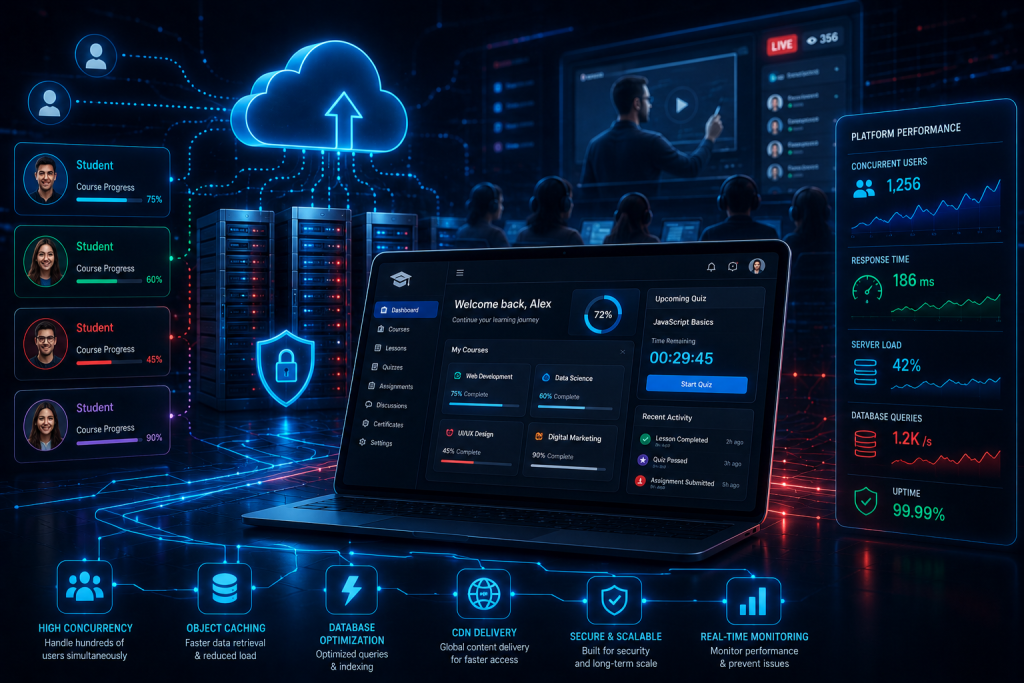
Scaling Virtual Classrooms: WordPress Performance Engineering for LMS and Membership Sites
Nine fifty nine in the morning, and everything looks fine. Then at ten o clock sharp, three hundred students log in at once for a scheduled quiz, and the platform grinds to a halt. Pages time out. The quiz submission spinner never stops spinning. Support tickets start pouring in from students worried their answers were not saved, from instructors unable to see who actually finished, and from a founder watching the one moment their platform absolutely needed to perform turn into the moment it failed most visibly, in front of the exact audience whose trust the business depends on.
This scenario is painfully familiar to anyone running a WordPress based LMS or membership platform at real scale, and it points to a specific, structural gap that generic WordPress hosting and generic caching advice were never built to close. Standard WordPress performance guidance assumes a largely anonymous, largely static audience, visitors browsing content who can be served the exact same cached page as every other visitor. LMS and membership platforms operate on the opposite assumption entirely. Every meaningful visitor is logged in. Every meaningful page is personalized. Every meaningful interaction, a quiz submission, a progress update, a course completion, writes to the database rather than simply reading from it. This article is written specifically for EdTech founders, LMS administrators, and high volume membership platform operators who need to understand why standard performance approaches fail them specifically, and what genuine, purpose built performance engineering for logged in, high concurrency platforms actually requires.
The Logged In User Performance Wall
The single most important fact to understand about performance engineering for LMS and membership platforms is that the entire, well established playbook for WordPress performance optimization was built around a fundamentally different kind of traffic than what these platforms actually serve.
Why Standard Page Caching Was Never Built for This
Standard WordPress page caching works by storing a fully rendered copy of a page and serving that identical, pre generated copy to every subsequent visitor who requests it, avoiding the cost of regenerating the page from scratch for every single request. This approach is extraordinarily effective for content that genuinely is identical for every visitor, a blog post, a marketing landing page, a product description page viewed by an anonymous shopper. It becomes fundamentally inapplicable the moment a page’s content depends on who is viewing it, which is precisely the defining characteristic of nearly every meaningful page on an LMS or membership platform.
A course dashboard shows a specific student’s specific progress, their specific completed lessons, their specific upcoming assignments. A quiz page needs to reflect that specific student’s specific attempt history and time remaining. A membership content page needs to check that specific user’s specific subscription tier before deciding what content to actually display. None of this can be served from a single, shared cached copy, because there is no single version of the page that is correct for more than one user at a time. Standard page caching plugins, when applied naively to this kind of platform, either fail to provide any meaningful benefit at all, since almost nothing on the site qualifies as genuinely cacheable static content, or worse, actively cause serious functional problems, serving one student’s cached dashboard to a different student who happens to request the same URL shortly afterward, a genuinely serious data exposure and trust problem for any platform handling student or member specific information.
Why Every Request Becomes a Full Database Hit
With page level caching effectively unavailable for the vast majority of meaningful platform activity, every single request from a logged in user typically requires WordPress to fully execute, checking session validity, retrieving that specific user’s data, running whatever custom logic determines what content and functionality that user is entitled to see, and querying the database repeatedly throughout this process. On a platform serving a modest number of concurrent users, this overhead, while real, remains manageable. The problem becomes severe specifically at the moment concurrency spikes, which for educational and training platforms tends to happen in a very particular, very predictable pattern, a large cohort of students all logging in and interacting with the platform within the same narrow window, precisely because a scheduled class, a live session, or a quiz deadline creates exactly this kind of synchronized demand.
This is a fundamentally different traffic pattern than what most WordPress performance guidance anticipates, which generally assumes traffic arrives relatively distributed across time, allowing server resources to handle requests in a more gradual, manageable stream. A scheduled quiz that opens at exactly ten o clock and closes at exactly ten thirty produces a traffic pattern that looks less like typical web traffic and more like a coordinated stress test, hundreds or thousands of database dependent requests arriving within the same narrow window, every single one of them requiring genuine, uncached database work rather than being served from a simple, pre generated cache.
Why This Traffic Pattern Breaks Generic Hosting Assumptions
Generic shared and even many managed WordPress hosting plans are provisioned and priced around typical, more evenly distributed traffic patterns, where average resource consumption across a billing period is the primary metric that matters. LMS and membership platforms, by contrast, experience extreme, predictable spikes concentrated into narrow windows, meaning the resource capacity actually required during a scheduled quiz or live session window vastly exceeds what the platform needs during the rest of the day, and often vastly exceeds what a hosting plan sized around average daily traffic can actually accommodate without severe degradation.
This mismatch between predictable spike traffic and hosting provisioned for average traffic is precisely what produces the database crashes, lockouts, and timeout errors that EdTech founders and LMS administrators encounter specifically during their platform’s most important moments, scheduled classes, live cohort sessions, graded assessment windows, rather than during quieter periods when the underlying infrastructure gap remains invisible simply because demand never rises high enough to expose it.
Why Generic WordPress Maintenance Misses This Entirely
A generic WordPress maintenance provider, focused on routine updates, basic security scanning, and general uptime monitoring, is simply not equipped to diagnose or address this specific class of problem, since the underlying issue is not a broken plugin or an outdated core version. It is an architectural mismatch between how the platform’s core functionality actually behaves under logged in, high concurrency conditions, and the assumptions baked into standard WordPress performance tooling and generic hosting plans. Solving this requires performance engineering specifically informed by an understanding of how LMS and membership platforms actually behave differently from typical WordPress sites, not a generic optimization checklist applied without regard for that fundamental difference.
Why a Content Delivery Network Alone Does Not Solve This
Many platform operators, aware that page caching does not work well for logged in traffic, turn to a content delivery network as a general performance solution, assuming that distributing content closer to users geographically will resolve the underlying slowness. A content delivery network genuinely helps with the delivery of static assets, images, stylesheets, JavaScript files, regardless of whether a visitor is logged in or not, and this remains a valuable, worthwhile layer of optimization for any platform. What it fundamentally cannot address is the actual dynamic content generation happening on the origin server itself, since a personalized dashboard, a specific student’s progress data, a specific quiz attempt, still has to be generated fresh by the WordPress application and database on every single request, regardless of how efficiently the surrounding static assets are being delivered from edge locations around the world.
This distinction matters considerably for platform operators evaluating where to invest performance engineering effort. A content delivery network improves the delivery speed of the parts of a page that genuinely are static and shared across every visitor, the platform’s logo, its core stylesheet, its shared JavaScript bundle. It does nothing to improve the speed at which the origin server can generate the actual personalized content that dominates an LMS or membership platform’s real functionality, which is precisely why the deeper architectural work described throughout the remainder of this article, restructuring membership logic, refactoring database schema, and implementing genuinely appropriate object caching, represents the actual solution to the core performance problem these platforms face, with a content delivery network serving as a valuable but ultimately secondary layer of optimization on top.
The Business Cost of Performance Failures at the Worst Possible Moment
It is worth being direct about why this specific category of performance failure carries outsized business risk compared to a typical WordPress site experiencing occasional slowness. A marketing site that loads slowly during a quiet traffic period causes some lost conversions, a real but relatively contained cost. An LMS platform that fails specifically during a scheduled, graded quiz window fails at the exact moment when trust matters most, in front of an audience of students whose academic outcomes, and whose confidence in the platform’s basic reliability, are directly on the line. A membership platform that locks out paying subscribers during a live, scheduled session fails in front of the exact audience whose continued subscription and word of mouth referral depend on believing the platform can reliably deliver what they are paying for.
This concentration of business risk into specific, predictable, high stakes moments is precisely why performance engineering for LMS and membership platforms deserves dedicated, specialized attention rather than being treated as a lower priority, general maintenance concern. The cost of an unaddressed performance gap on these platforms is not evenly distributed across ordinary traffic. It is concentrated entirely into the exact moments the business can least afford to fail, which is exactly the argument for proactive, purpose built engineering investment before those moments arrive, rather than reactive firefighting after a failure has already damaged student or member trust.
Optimizing Custom WP Membership Logic
Beyond the caching limitations described above, the specific custom logic that determines what content and functionality a given user is entitled to access, commonly referred to as membership or access restriction logic, is frequently a significant, independent source of performance problems under high concurrency, particularly when that logic was not originally designed with this kind of simultaneous load in mind.
Why Restriction Checks Are More Expensive Than They Appear
Membership and LMS platforms typically need to check, on nearly every meaningful page load, whether the current user is entitled to view the specific content being requested, based on their subscription tier, their enrollment status in a specific course, their progress through prerequisite material, or some combination of these factors. A restriction check that involves a single, simple database lookup is relatively cheap. A restriction check that involves multiple related queries, checking subscription status, then checking course enrollment, then checking prerequisite completion, then checking whether a specific piece of content has been individually unlocked, each as a separate query rather than a single, properly structured combined query, multiplies that cost considerably, and multiplies it again by however many concurrent users are triggering this same logic simultaneously during a high traffic window.
This kind of layered, multi query restriction logic is extremely common on platforms that have grown organically over time, with new access rules and new membership tiers added incrementally as business requirements evolved, each addition often implemented as its own separate check rather than being integrated into a single, efficient, unified restriction query. The cumulative cost of this accumulated complexity becomes most visible precisely during high concurrency windows, when the multiplied cost of inefficient restriction checking, repeated across hundreds of simultaneous users, becomes the dominant source of database load on the entire platform.
Why Table Locking Becomes a Serious Risk Under Concurrency
Database table locking occurs when a database operation needs exclusive access to a table or a portion of a table in order to safely complete, temporarily preventing other operations from reading or writing to that same locked section until the operation completes. Locking is a normal and necessary part of how databases maintain data integrity, but poorly structured queries and poorly designed database schemas can cause locking to become far more frequent and far more prolonged than genuinely necessary, and this problem becomes acute specifically under high concurrency, when many simultaneous operations are all competing for access to the same tables at the same time.
LMS platforms are particularly vulnerable to this specific problem because student progress tracking, quiz attempt recording, and completion status updates all typically involve writing to shared database tables, and if hundreds of students are submitting quiz answers within the same narrow window, poorly structured write operations against these shared tables can produce exactly the kind of lockout and timeout behavior described at the beginning of this article, where the database becomes a bottleneck not because it lacks raw processing capacity, but because poorly designed queries are forcing operations to wait in line for table access far more than a properly structured schema and properly structured queries would require.
Restructuring Restriction Logic for Concurrent Safety
Addressing this requires restructuring membership and access restriction logic specifically with concurrent access in mind, rather than simply optimizing for correctness in isolation. This typically involves consolidating multiple separate restriction checks into a single, efficient combined query wherever possible, reducing the total number of database round trips required to determine a given user’s access rights. It also involves reviewing exactly how and when restriction data gets written, ensuring that write operations affecting shared tables are structured to minimize lock duration and lock scope, so that one student’s quiz submission does not unnecessarily block or delay another student’s simultaneous submission through an avoidable, overly broad table lock that a more carefully structured query would have avoided entirely.
This restructuring work requires genuine database design expertise applied specifically to the platform’s actual custom logic, not a generic plugin configuration adjustment, since the specific restriction rules, the specific database schema, and the specific patterns of concurrent access are all unique to each platform’s particular business logic and cannot be addressed through a one size fits all optimization applied without understanding the platform’s actual custom implementation in detail.
Caching Restriction Results Without Sacrificing Accuracy
A meaningful share of restriction check overhead can be eliminated through carefully calibrated caching of restriction results themselves, storing a specific user’s computed access rights for a short period rather than recalculating them from scratch on every single page load. This requires careful attention to correctness, since a student whose enrollment status changes, whether through a new course purchase, a subscription upgrade, or an instructor granted exception, needs to see that change reflected promptly rather than continuing to be served a stale, cached restriction result from before the change occurred. Properly implemented restriction caching uses a short cache lifetime combined with explicit cache invalidation triggered immediately whenever a user’s underlying access rights actually change, ensuring the performance benefit of caching is realized without introducing the kind of access control errors that would represent a genuinely serious problem for a platform responsible for gating paid content correctly.
Preventing Race Conditions During Simultaneous Enrollment and Payment Events
High concurrency creates a specific risk beyond simple performance degradation, namely race conditions, where two or more operations attempting to modify the same underlying data simultaneously can produce an incorrect final result if the underlying code was not specifically written to handle this kind of simultaneous access safely. This risk becomes particularly relevant during enrollment events, course launches, limited capacity cohort signups, flash sale style membership promotions, where a large number of students or members may be attempting to enroll or purchase access within the same narrow window, sometimes competing for a genuinely limited number of available seats in a capacity constrained cohort.
Custom enrollment logic that was not specifically designed with this kind of simultaneous access in mind can produce serious, business impacting errors under these conditions, overselling a capacity limited cohort beyond its actual available seats, or in worse cases, incorrectly processing or duplicating a payment during a moment of database contention. Properly engineered enrollment logic uses appropriate database level safeguards, transactions and locking mechanisms specifically designed to handle this kind of simultaneous access correctly, ensuring that even under the exact high concurrency conditions this article has focused on throughout, enrollment and payment processing remain accurate and reliable rather than becoming an additional source of risk precisely when platform popularity and demand are at their highest.
Refactoring LMS Databases
Beyond the membership and restriction logic described above, the underlying database schema and query patterns used specifically for progress tracking, quiz attempts, and completion status represent another major category of performance risk for custom developed LMS portals, one that deserves focused, dedicated attention separate from general membership logic.
Why Progress Tracking Tables Grow Into a Liability
LMS platforms typically record granular progress data, which specific lessons a student has viewed, how far into a video they progressed, which quiz questions they answered and how, timestamps for every meaningful interaction. This granularity is valuable for instructors and for the platform’s own analytics, but it also means progress tracking tables grow extremely large extremely quickly, particularly on platforms with meaningful student volume and meaningful course length. A table that performed acceptably when it contained a few thousand rows during initial development and testing can become a serious performance bottleneck once it has grown to contain millions of rows across a mature platform’s full student and course history, particularly if that table was never properly indexed with this eventual scale in mind.
This growth pattern means progress tracking performance problems frequently emerge gradually, performing acceptably for months or years before crossing a threshold where query performance degrades noticeably, precisely the kind of slow, creeping problem that is easy to miss until it becomes severe enough to cause the visible crashes and timeouts described at the start of this article, often coinciding with exactly the high concurrency windows, live quizzes, scheduled deadlines, where the underlying table’s degraded query performance finally becomes impossible to ignore.
Proper Indexing for High Volume Progress Data
The single most impactful fix for degraded progress tracking performance is typically proper database indexing, ensuring that the specific columns actually used to filter and retrieve progress data, student identifier, course identifier, lesson identifier, completion timestamp, are properly indexed so the database can locate relevant rows efficiently rather than scanning through a rapidly growing table’s full contents on every single query. Many custom developed LMS implementations, particularly those built incrementally without dedicated database design review, accumulate progress tracking tables that lack this proper indexing entirely, relying on the database’s default behavior rather than deliberately structured indexes matched to the platform’s actual, real world query patterns.
Adding proper indexing to an already large, actively used progress tracking table requires careful planning, since the index creation process itself can be resource intensive and needs to be executed in a way that does not disrupt the live platform during the process. This is precisely the kind of database refactoring work that benefits from being performed by engineers with genuine database administration expertise, planning the index creation carefully around the platform’s actual traffic patterns to minimize disruption while still delivering the underlying performance improvement as quickly as safely possible.
Archiving and Partitioning Historical Progress Data
For platforms with a long operating history and substantial accumulated student volume, proper indexing alone sometimes is not enough to fully resolve progress tracking performance, particularly if the vast majority of active queries only genuinely need recent or currently relevant data, while the table itself continues to carry the full historical weight of every student interaction ever recorded since the platform’s earliest days. Archiving older, no longer actively queried progress data into a separate table, or implementing database partitioning to logically separate historical data from actively queried current data, can meaningfully reduce the effective size of the data the database needs to search through for the vast majority of real time queries, without requiring the historical data itself to be deleted or made inaccessible for reporting and analytics purposes when it is genuinely needed.
This kind of archiving strategy requires careful design specific to the platform’s actual reporting and compliance requirements, ensuring that historical data remains accessible when genuinely needed, whether for instructor reporting, student transcript requests, or regulatory retention requirements, while still achieving the performance benefit of keeping actively queried tables focused on the data that real time platform functionality actually needs to search through on every request.
Optimizing Quiz Submission and Grading Logic Specifically
Quiz submission represents a particularly concentrated form of the high concurrency database write problem described throughout this article, since a scheduled quiz deadline creates a genuinely synchronized burst of write operations, potentially hundreds of students submitting final answers within the same narrow closing window. Quiz submission logic needs specific attention to ensure that the actual database write operations involved, recording each answer, calculating a score, updating completion status, are structured as efficiently as possible, minimizing the number of separate database operations required per submission and ensuring that automatic grading logic, when applicable, does not introduce unnecessary additional database round trips beyond what is genuinely required to process and confirm the submission correctly.
For platforms using automatic grading, particular attention should be paid to whether grading calculations are being performed efficiently, since a poorly optimized grading algorithm executed synchronously as part of the submission process, blocking the student’s confirmation until every calculation completes, can meaningfully extend perceived submission time during exactly the moment students are most anxious about confirming their work has actually been recorded successfully. Restructuring grading to complete asynchronously where the platform’s functionality allows for it, providing an immediate submission confirmation while grading calculations complete in the background, can meaningfully improve the perceived reliability and responsiveness of the platform during its most stressful, highest stakes moments.
Why Backup Strategy Needs to Account for Large, Actively Written Tables
Large, rapidly growing progress tracking and quiz attempt tables introduce a consideration that is easy to overlook until it becomes a real operational problem, namely how these tables affect backup strategy and backup reliability. A backup process not specifically designed to handle very large, actively written tables efficiently can itself become a source of performance degradation, consuming database resources during the backup window in a way that competes directly with genuine student traffic if that backup happens to run during or near a scheduled high concurrency window. Worse, a poorly designed backup process attempting to capture a consistent snapshot of a table receiving heavy concurrent writes risks producing a backup that is itself inconsistent or incomplete, undermining the very reliability the backup was meant to provide.
Properly engineered backup strategy for LMS platforms accounts for this directly, scheduling resource intensive backup operations specifically outside of known high concurrency windows wherever possible, and using backup approaches specifically designed to handle large, actively written tables consistently without requiring the kind of extended table locking that would itself degrade platform performance during the backup process. This is a genuinely specialized consideration that a generic WordPress backup plugin, configured with default settings and no awareness of the platform’s specific traffic patterns, is unlikely to handle correctly without deliberate, informed configuration.
Advanced Caching Setup
While standard page caching cannot meaningfully address the logged in, personalized traffic that dominates LMS and membership platforms, object caching, operating at a fundamentally different, more granular level, provides genuine, substantial performance benefit specifically for this kind of dynamic, database dependent traffic.
Why Object Caching Is the Correct Tool for This Problem
Object caching, implemented through dedicated systems like Redis, stores the results of specific, expensive database queries and computations in fast access memory, allowing that stored result to be retrieved quickly for subsequent requests that need the same data, without requiring the underlying expensive query to be executed again from scratch. Critically, this caching operates at a granular level, below the level of an entire page, which means it works effectively even for pages that are fully personalized and cannot be cached as a complete, static unit through standard page caching. A student’s course progress data, once retrieved and computed, can be cached specifically for that student, served quickly on subsequent page loads within the cache’s lifetime, without requiring every single page view to trigger the full underlying database computation from scratch.
This is precisely why object caching represents the correct architectural tool for LMS and membership platforms specifically, addressing the exact category of dynamic, per user, database dependent overhead that standard page caching was never able to touch, while still delivering genuine, substantial performance improvement for exactly the kind of repeated, expensive computations, membership restriction checks, progress calculations, enrollment verification, that dominate a logged in platform’s actual resource consumption.
Implementing Redis for Membership and Progress Data Specifically
A properly configured Redis object caching implementation for an LMS or membership platform requires deliberate configuration specific to the platform’s actual data patterns, rather than a generic, default installation. This means identifying specifically which categories of data genuinely benefit from caching, membership status, course enrollment, computed progress summaries, and configuring appropriate cache lifetimes for each category based on how frequently that specific data actually changes and how critical immediate accuracy is for that specific use case. Membership status, which changes relatively infrequently and where a brief delay in reflecting a change is generally acceptable, can typically be cached for a longer duration than live quiz attempt data, where accuracy during an active session matters considerably more and shorter cache lifetimes, or explicit cache invalidation tied directly to specific student actions, become correspondingly more important.
This kind of granular, data aware caching configuration is precisely what separates a genuinely effective Redis implementation from a generic caching plugin installation applied without specific consideration of an LMS platform’s particular data sensitivity and update patterns. A poorly configured implementation risks either providing minimal genuine performance benefit, through overly conservative, short cache lifetimes applied uniformly regardless of actual data volatility, or risks serving meaningfully stale data to students and instructors, through overly aggressive caching applied to data that genuinely needs to reflect real time accuracy.
Handling Session Data and Real Time Interaction Correctly
LMS and membership platforms frequently include genuinely real time or near real time functionality, live session attendance tracking, in progress quiz timers, real time discussion or chat features associated with a live class session, that requires particular care within a caching architecture, since this kind of data is specifically not a good candidate for the kind of caching applied to more stable data like membership status or completed course progress. Properly designed caching architecture explicitly identifies and excludes this category of genuinely real time data from standard object caching, instead relying on appropriately fast, direct database access or, where the platform’s scale genuinely warrants it, a dedicated real time data layer specifically suited to this kind of low latency, frequently changing information.
Getting this distinction correct, caching what genuinely benefits from caching while ensuring genuinely real time functionality remains fast and accurate without inappropriate caching interfering with its correctness, requires engineers who understand both the caching technology itself and the specific functional requirements of each different category of data an LMS platform actually handles, rather than applying a single, uniform caching strategy across every type of data indiscriminately.
Combining Object Caching With Database Level Optimization
It is worth being direct that object caching, however well configured, works best as a complement to the database level optimization described earlier in this article, not as a substitute for it. A well configured Redis cache reduces how often expensive queries need to run, but the underlying queries still need to run efficiently on every cache miss and every cache expiration, meaning poorly indexed tables and inefficient restriction logic continue to represent a real performance risk even with caching in place, particularly during the specific moment a cache expires or is invalidated during a high concurrency window, precisely when the underlying database’s raw efficiency matters most. Genuine, comprehensive performance engineering for LMS and membership platforms addresses both layers together, efficient underlying database queries and schema design, combined with properly configured object caching layered on top, rather than treating either one as sufficient on its own to fully solve the performance challenges these platforms specifically face.
Generic WordPress Performance Stack Versus LMS Specific Engineering
| What You Need | Generic WordPress Performance Stack | LMS Specific Performance Engineering |
|---|---|---|
| Page caching for logged in users | Minimal or no real benefit | Bypassed intentionally, addressed at the object level |
| Membership and restriction checks | Unreviewed, often multiple queries per load | Consolidated into efficient combined queries |
| Progress and quiz tracking tables | Default indexing, degrades with volume | Indexed and structured for real scale |
| Concurrent write safety | Not specifically addressed | Transactions and locking designed for concurrency |
| Object caching configuration | Generic or absent | Calibrated per data type and volatility |
| Behavior during scheduled quiz windows | Prone to lockouts and timeouts | Tested and engineered for peak concurrency |
What This Looks Like in Practice
Consider a growing EdTech company running a custom developed LMS built on WordPress, serving several thousand active students across dozens of cohort based courses, each with scheduled live sessions and timed quizzes. The platform has experienced repeated database lockouts specifically during quiz windows, with the founder growing increasingly concerned about reputational damage as students, understandably, lose trust in a platform that cannot reliably process their submitted work during exactly the moments that matter most for their grades and progress.
A thorough performance engineering engagement begins with profiling the platform’s actual behavior during a real, representative quiz window, revealing that a significant share of database load traces back to an unindexed progress tracking table that has grown to contain millions of rows across the platform’s several years of operating history, combined with a membership restriction check that performs four separate database queries on every single page load to verify a student’s course enrollment and prerequisite completion, a pattern that had never been consolidated as new access rules were added incrementally over the platform’s development history.
Remediation involves adding proper indexing to the progress tracking table, carefully scheduled to avoid disrupting the live platform during the index creation process, consolidating the four separate restriction queries into a single, efficient combined query, and implementing Redis object caching specifically configured around the platform’s actual data patterns, caching membership and enrollment status with a moderate lifetime while ensuring live quiz attempt data bypasses caching entirely to preserve real time accuracy during active sessions. Quiz submission logic is also restructured to confirm submission to the student immediately while grading calculations complete asynchronously in the background, reducing perceived submission time during exactly the high anxiety moment when a quiz deadline is closing. The following quiz window, running the same student volume that had previously caused a database lockout, completes without incident, and the founder is able to confidently communicate to instructors and students alike that the platform’s most critical, highest stakes moments are now genuinely reliable.
A Second Scenario: A Membership Platform Surviving a Viral Growth Spike
Consider a different case, a subscription based professional development membership platform that experienced a sudden surge in signups after being featured prominently in a well known industry newsletter, driving several thousand new signups within a single day, followed immediately by a scheduled live cohort session for existing members that many of these new signups were eager to join. Prior to this spike, the platform had never experienced concurrency anywhere near this level, and the founder was reasonably concerned that the sudden surge, combined with the already scheduled live session, would overwhelm a platform that had never been specifically engineered for this kind of simultaneous load.
A performance engineering review conducted proactively, immediately after the initial signup surge began and before the scheduled live session, identified that membership tier verification logic was running four separate, uncached queries on every single page load across the entire platform, and that Redis object caching, while nominally installed, had never actually been configured to cache this specific membership data, running with an effectively default configuration that provided minimal real benefit for the platform’s actual bottleneck. Rapid remediation consolidated the membership verification into a single efficient query and properly configured object caching specifically around membership tier data with an appropriately calibrated cache lifetime. The scheduled live session, run just days after this remediation, comfortably handled several times the platform’s previous peak concurrency without incident, allowing the founder to convert what could have been a damaging, viral moment of platform failure into a successful, high visibility session that reinforced exactly the kind of reliability a newly enlarged membership base needed to see to justify staying subscribed past their trial period.
A Checklist for EdTech Founders and LMS Administrators
For technical leaders and founders trying to determine whether their own platform carries this specific kind of unaddressed risk, a few direct questions help surface the answer. Has the platform ever experienced a database lockout, timeout, or severe slowdown specifically during a scheduled quiz, live session, or enrollment deadline, rather than during ordinary, evenly distributed traffic. Does the current caching setup consist primarily of a standard page caching plugin, without any dedicated object caching layer specifically configured for logged in, dynamic content. Has the platform’s progress tracking or quiz attempt database table ever been reviewed specifically for proper indexing as the platform’s student volume and history have grown over time. Does membership or course access restriction logic involve multiple, separately executed database queries rather than a single, consolidated check. And has the platform’s actual behavior under genuine, simultaneous high concurrency load, hundreds of students interacting within the same narrow window, ever been specifically profiled and tested, or has performance only ever been evaluated under more typical, lower concurrency conditions.
A single yes among these questions indicates a specific, addressable performance risk. Multiple yes answers, particularly a documented history of incidents during exactly the platform’s highest stakes moments, indicate that the platform’s underlying architecture has already outgrown generic WordPress hosting and generic maintenance, and would benefit substantially from a performance engineering engagement specifically informed by how LMS and membership platforms actually behave differently under load.
Frequently Asked Questions About Scaling LMS and Membership Platforms
Can a standard managed WordPress hosting plan handle high concurrency quiz traffic if we simply upgrade to a larger tier
A larger hosting tier provides more raw capacity, which can provide some genuine relief, but it does not address the underlying inefficiency in unindexed database tables, unconsolidated restriction queries, or missing object caching described throughout this article. Without addressing these underlying architectural issues directly, a larger hosting tier tends to simply raise the threshold at which the same underlying problems become visible again as student volume continues to grow, following the same pattern described in our guidance on server resource optimization more broadly.
Does implementing Redis object caching risk showing students stale or incorrect progress data
This risk is real if caching is implemented without careful, data specific configuration, which is precisely why properly implemented caching for LMS platforms uses different cache lifetimes and invalidation strategies for different categories of data, caching relatively stable data like membership status more aggressively while ensuring genuinely real time data like active quiz attempts either bypasses caching entirely or uses very short, carefully managed cache lifetimes specifically designed to preserve accuracy during active sessions.
How do we know if our progress tracking database tables actually need reindexing without a full technical audit
The clearest practical signal is whether performance degradation correlates with data volume rather than simply traffic volume, meaning the platform performs noticeably worse for established courses with a long history of accumulated student data compared to newer courses with less accumulated data, even under otherwise similar traffic conditions. This pattern strongly suggests a table scaling problem tied to indexing rather than a purely traffic driven capacity issue, though a proper technical audit remains the reliable way to confirm this with certainty and identify exactly which tables and queries are involved.
Is this level of performance engineering only necessary for very large platforms, or does it matter for smaller, growing LMS businesses too
The underlying architectural risks described throughout this article, unindexed tables, unconsolidated restriction logic, missing object caching, exist regardless of a platform’s current size, though their consequences become visible specifically once concurrency during peak moments crosses a certain threshold. Addressing these risks proactively, while a platform is still relatively small and growing, is considerably less disruptive and less costly than waiting until a platform has scaled to the point where a serious incident, like a database lockout during a high stakes quiz window, forces the issue reactively.
How does this kind of performance engineering fit within your Professional or Enterprise support plans
LMS and membership specific performance engineering, database schema review, restriction logic restructuring, Redis configuration tailored to the platform’s actual data patterns, represents exactly the kind of complex, specialized technical work that our resolution based Professional and Enterprise plans are built to absorb, giving platforms ongoing access to this level of specialized engineering expertise as their student volume and course catalog continue to grow, rather than treating it as a single, isolated project with no ongoing support once the initial engagement concludes.
How do we know if our platform’s traffic pattern actually qualifies as high concurrency, or if this level of engineering is overkill for our current scale
A useful, practical test is whether any meaningful portion of your student or member base logs in and interacts with the platform within the same relatively narrow time window, a scheduled quiz, a live cohort session, a synchronized course launch, rather than accessing the platform in a more gradually distributed pattern throughout the day. Even a platform with a relatively modest total user base can experience genuine high concurrency risk if its usage pattern is concentrated into scheduled windows, since the relevant metric is simultaneous demand within a narrow window, not total registered users or even total daily active users measured across an entire day.
Can we test whether our platform will hold up under high concurrency before it happens for real
Yes, and this is a genuinely valuable proactive step rather than waiting to discover problems during an actual live event. Load testing, simulating a realistic number of simultaneous logged in users performing representative actions, quiz submissions, progress updates, content access checks, against a staging environment configured to closely mirror production, can reveal exactly where a platform’s architecture breaks down under concurrency before that breakdown happens in front of real students or members during an actual scheduled event.
Do LearnDash specific performance issues differ from issues on other LMS plugins built on WordPress
The specific database schema and query patterns vary somewhat between different LMS plugins, LearnDash, LifterLMS, and various membership plugin combinations each implement their own particular approach to progress tracking and access restriction. The underlying architectural principles described throughout this article, the need for proper indexing on progress tables, the need to consolidate restriction checks, the need for object caching calibrated to data volatility, apply broadly across this category of platform regardless of the specific plugin foundation, though the precise technical implementation of each fix needs to be tailored to the specific plugin and any custom modifications layered on top of it.
How disruptive is this kind of performance engineering work to a platform that is already actively serving students
Properly executed performance engineering work follows the same disciplined, staged deployment process used for any other significant site change, testing database changes and code modifications in a staging environment first, scheduling higher risk operations like large table indexing during lower traffic windows, and deploying verified changes to production through a controlled process specifically designed to avoid disrupting the live platform during the improvement process itself.
LMS and Membership Platforms Demand High End Engineering, Not Basic Support
Standard WordPress performance advice, standard caching plugins, and standard maintenance providers were built around a fundamentally different traffic pattern than what LMS and membership platforms actually experience. Every meaningful page is personalized. Every meaningful interaction writes to the database. And the platform’s most important traffic, scheduled classes, live sessions, timed assessments, arrives in exactly the kind of sudden, synchronized concentration that standard hosting and standard caching were never designed to absorb gracefully. Genuinely solving this requires performance engineering specifically informed by how these platforms actually behave under real, logged in, high concurrency conditions, restructuring custom membership logic, refactoring database schema and indexing for genuine scale, and implementing object caching configured deliberately around the platform’s actual data sensitivity, not a generic checklist applied without regard for what makes an LMS or membership platform fundamentally different from a typical WordPress site.
Matching Plan Tiers to Platform Complexity and Scale
For EdTech founders and platform administrators evaluating which level of ongoing support genuinely fits their platform, it helps to think concretely about the specific risk factors described throughout this article. A newer platform with a smaller, growing student base, still validating its course model and not yet running frequent, large scale synchronized events, may find a Starter level of support sufficient for now, while still benefiting from the underlying engineering discipline described throughout this article being applied as the platform’s architecture is first established. A platform running regular cohort based courses with scheduled live sessions and timed assessments, exactly the kind of concentrated, high stakes traffic pattern this article has focused on throughout, is a much stronger fit for a Professional plan, where complex, specialized issues, restriction logic tuning, progress table optimization, ongoing caching calibration, are absorbed as predictable, resolution based support rather than unpredictable, individually priced emergency engagements.
For platforms operating at genuine enterprise scale, large student populations, multiple concurrent cohorts, business critical reliability requirements tied directly to institutional or corporate training contracts, an Enterprise plan provides the depth of ongoing engineering attention that this level of business criticality genuinely warrants, treating performance engineering not as an occasional project but as a continuously maintained discipline matched to the platform’s actual, ongoing operational stakes.
Why Proactive Investment Beats Reactive Firefighting
The founders and administrators who get the most value from this kind of engineering investment are consistently the ones who address it proactively, before a serious incident during a genuinely high stakes moment forces the issue. The scenario described at the very beginning of this article, three hundred students hitting a wall at exactly ten o clock, is entirely avoidable, but only when the underlying architectural gaps, unoptimized restriction logic, unindexed progress tables, absent or poorly configured object caching, are identified and addressed before that moment arrives, rather than diagnosed reactively in the aftermath of a failure that has already damaged student or member trust. Choosing the right maintenance plan today, matched honestly to your platform’s actual traffic patterns and actual business stakes, is what ensures your platform’s most important moments become the moments it performs best, rather than the moments it fails most visibly.
LMS and Membership Platforms Demand High End Engineering
Choose the right maintenance plan, Starter, Professional, or Enterprise, to keep your platform fast, secure, and ready to scale.
