

Unlocking Semantic Intelligence: A Guide to Vector Database Integration in WordPress
A visitor lands on a knowledge base and types a genuine, natural question into the search bar, something like how do I recover a payment that failed midway through checkout. The search returns nothing useful, or worse, returns nothing at all, because the article that actually answers this exact question uses the phrase declined transaction rather than failed payment, and standard WordPress search has no way of understanding that these two phrases mean essentially the same thing. The visitor tries a second, slightly different phrasing. Still nothing. Within moments, they abandon the search entirely and either leave the site or, worse for a support heavy knowledge base, open a support ticket asking a question the content already answered, if only the search had been capable of understanding what they actually meant rather than only what they literally typed.
This article is written for CTOs, technical leads, and the people responsible for large content hubs, knowledge bases, and ecommerce catalogs who have run into exactly this wall, watching search abandonment quietly undermine what should be one of a site’s most valuable features. What follows is a genuinely technical explanation of why standard WordPress search fails at this specific kind of natural language query, what vector embeddings actually are and how they capture semantic meaning in a way keyword matching structurally cannot, how a real engineering pipeline connects WordPress to an external vector database through the REST API, and what actually changes for real users once semantic search replaces exact text matching as the mechanism powering a site’s core search experience.
Why Standard Keyword Search Fails
To understand why vector based semantic search represents such a meaningful upgrade, it helps to be precise about exactly how WordPress’s default search actually works under the hood, and why that specific mechanism is fundamentally mismatched to how real visitors actually search.
How WordPress Search Actually Queries the Database
Default WordPress search operates through a relatively straightforward relational database query, searching post titles and content for rows containing the literal text a visitor typed into the search box, using standard SQL text matching against the wp posts table. This approach is functionally simple and reasonably fast for small sites, but it depends entirely on literal string matching, meaning the search query and the target content need to share actual, matching words or word fragments for a result to be returned at all. If a visitor searches using different vocabulary than the content itself uses, synonyms, related concepts, or a differently phrased description of the same underlying need, standard keyword search has no built in mechanism for recognizing that connection, because it was never designed to understand meaning. It was designed to match literal characters.
The Vocabulary Mismatch Problem
This limitation produces what is commonly called the vocabulary mismatch problem, where a visitor’s actual search terms and the content that would genuinely satisfy their need use different words to describe the same underlying concept. A visitor searching for cancel my subscription will not find an article titled ending your membership through standard keyword matching, even though the two phrases describe precisely the same action, because the two phrases share no common words at all. A visitor searching how do I make my checkout faster will not surface an article about reducing cart abandonment through streamlined payment flows, despite that article being exactly what the visitor needs, simply because none of the visitor’s specific words appear literally within the article’s text.
This problem compounds considerably for any site with genuinely broad, varied content, since the number of different ways a real person might phrase a given question grows quickly, while a keyword based search system can only ever match the specific phrasings that happen to overlap literally with the content’s own specific wording. No amount of manually adding synonyms or alternate phrasings to individual articles can realistically keep pace with the genuine diversity of natural language a real, varied visitor base actually uses when searching.
Why Natural, Conversational Queries Make This Worse
As visitors increasingly search using natural, conversational phrasing, full questions rather than terse keyword fragments, influenced heavily by how comfortable people have become typing genuine questions into AI chat interfaces and voice assistants, the gap between how people actually search and what keyword matching can actually handle widens further. A conversational query like why does my invoice show a different amount than what I was quoted contains almost none of the specific terminology a billing discrepancy article might use, pricing variance, quoted rate adjustment, prorated charges, even though the underlying need is identical. Keyword search, built around matching literal terms, structurally cannot bridge this gap, regardless of how much additional tuning or configuration is applied to the underlying search query logic.
The Business Cost of Search Abandonment
Search abandonment, a visitor searching, receiving unsatisfying or empty results, and leaving without finding what they needed, carries a real, measurable business cost that varies depending on the specific site involved but is consistently significant. For a knowledge base or documentation site, failed search frequently translates directly into an avoidable support ticket, since the visitor’s underlying question likely already had an answer within the existing content, if only search had been capable of surfacing it. For an ecommerce catalog, failed product search translates directly into lost revenue, a visitor with genuine purchase intent, actively searching for a specific product using their own natural description of what they want, leaving empty handed simply because their phrasing did not happen to match the product listing’s own specific wording.
This cost is frequently underestimated precisely because it is difficult to measure directly through standard analytics, since a visitor who abandons a failed search simply leaves, generating a bounce or an exit rather than any explicit signal clearly attributing that departure to search failure specifically. Reviewing internal search query logs against actual result click through rates, however, frequently reveals this pattern clearly once a team specifically looks for it, a significant share of search queries returning zero results or results the visitor never engaged with, exactly the signature of a vocabulary mismatch problem that keyword search alone has no mechanism for solving.
Why Adding More Keywords or Tags Does Not Solve the Underlying Problem
A common but ultimately limited response to this problem involves manually adding additional tags, alternate keywords, or synonym lists to content, attempting to bridge the vocabulary gap through more comprehensive manual metadata. This approach provides some genuine, incremental improvement but does not scale to solve the underlying problem comprehensively, since it depends entirely on someone anticipating in advance every meaningful way a real visitor might phrase a given question, a task that becomes increasingly impractical as content volume grows and as the genuine diversity of natural language phrasing continues to exceed whatever finite list of synonyms and tags any team could realistically maintain by hand. This is precisely the structural limitation that vector based semantic search is specifically designed to overcome, not through more exhaustive manual tagging, but through a fundamentally different underlying mechanism for understanding what content and queries actually mean.
Why Basic Stemming and Fuzzy Matching Only Partially Help
Some search implementations attempt to narrow the vocabulary gap through basic linguistic techniques, stemming, which reduces words to their root form so that searching and searched might both match against search, and fuzzy matching, which tolerates minor spelling variations or typos. These techniques provide genuine, real value for the specific, narrow category of problem they address, minor word form variation and simple typos, but they do nothing to address genuine vocabulary mismatch, where a visitor uses an entirely different word or phrase to describe the same underlying concept. Stemming can connect searching to searched, but it has no mechanism whatsoever for connecting cancel my subscription to ending your membership, since these phrases do not share a common word root to reduce down to in the first place. This is precisely the gap that requires genuine semantic understanding rather than any further refinement of literal text matching techniques, however sophisticated those specific literal matching techniques become.
Why This Problem Is Particularly Acute for Technical and Specialized Content
Sites covering technical, specialized, or industry specific subject matter experience a particularly severe version of this vocabulary mismatch problem, since content authors, often subject matter experts themselves, naturally tend to write using precise, technical terminology, while visitors, particularly those newer to the specific domain, tend to search using considerably more general, layperson phrasing describing their actual underlying problem rather than the specific technical term an expert would use to describe it. A visitor experiencing a specific technical issue might search using a plain language description of the symptom they are observing, while the documentation addressing that exact issue is titled using the precise technical term for the underlying root cause, a gap that keyword search has no way of bridging, since the visitor’s plain language description and the documentation’s precise technical terminology share essentially no common vocabulary despite addressing exactly the same underlying problem.
Understanding Vector Embeddings
Semantic search works on an entirely different principle than keyword matching, representing meaning itself in a mathematical form that allows genuinely related concepts to be recognized as related, even when they share no common words at all.
What a Vector Embedding Actually Is, in Plain English
A vector embedding is a way of representing a piece of text, a sentence, a paragraph, an entire article, as a list of numbers, typically hundreds or even thousands of individual numeric values, generated by a machine learning model specifically trained to capture the underlying meaning of that text within this numeric representation. The specific numbers themselves are not meaningful to a human reading them directly, but the mathematical relationships between different pieces of text’s numeric representations are precisely where the actual semantic understanding lives. Two pieces of text that mean similar things, even if phrased completely differently, produce embedding vectors that are mathematically close to each other, while two pieces of text about entirely different topics produce vectors that are mathematically distant from each other, regardless of whether they happen to share any literal words in common.
This is the fundamental mechanism that solves the vocabulary mismatch problem described in the previous section. Cancel my subscription and ending your membership share no common words, but because they mean essentially the same thing, a properly trained embedding model produces numerically similar vectors for both phrases, allowing a search system built on this foundation to recognize their genuine semantic relationship even though a keyword based system, looking only at literal text, would never make that connection.
How Multi Dimensional Space Captures Meaning
It helps to think of this numeric representation as coordinates within a vast, multi dimensional space, considerably more dimensions than the three spatial dimensions we experience physically, but conceptually similar to how two points close together in physical space represent two locations that are genuinely near each other. In this multi dimensional semantic space, pieces of text with similar meaning end up positioned close together, while pieces of text with different meaning end up positioned further apart, and a search system can measure this distance mathematically to determine how semantically related any two pieces of text actually are, a query and a piece of content, regardless of their specific literal wording.
The specific machine learning models capable of generating these embeddings have been trained on enormous volumes of text, learning through this training process to recognize genuine semantic relationships, synonyms, related concepts, paraphrased ideas, and to position their corresponding embeddings appropriately close together within this multi dimensional space as a direct result of that training. This is fundamentally different from a rule based synonym list, since the model has genuinely learned semantic relationships from vast amounts of real language usage, rather than following a manually curated, inherently limited list of predefined equivalent terms.
Why This Captures Search Intent, Not Just Related Words
A particularly important property of properly generated embeddings is that they capture something closer to genuine intent and meaning rather than simply recognizing related vocabulary. A query and a piece of content can be semantically related even when they share almost no vocabulary overlap at all, and conversely, two pieces of text can share considerable vocabulary while actually addressing quite different underlying needs, a distinction a well trained embedding model is able to recognize precisely because it has learned to represent genuine meaning rather than simply tracking word overlap statistics.
This is precisely why semantic search, built on this foundation, can return contextually accurate results even in the genuinely challenging cases where zero literal keyword overlap exists between a visitor’s actual query and the content that best answers their underlying need, exactly the scenario described at the very beginning of this article, where a visitor’s natural, conversational phrasing shares no words at all with the specific terminology the answering content happens to use.
Generating Embeddings for Real Content at Scale
Producing these embeddings for a real WordPress site’s actual content involves passing that content, typically broken into appropriately sized chunks rather than processed as entire, lengthy articles all at once, through a properly selected embedding generation model, producing a corresponding vector for each chunk of content. This chunking decision matters considerably for search quality, since embedding an entire lengthy article as a single vector tends to blur together multiple distinct subtopics the article might cover into one averaged, less precise representation, while breaking content into more focused, appropriately sized chunks, individual sections or paragraphs addressing a more specific subtopic, produces embeddings that more precisely capture each specific piece of meaning, improving the eventual search system’s ability to surface the genuinely most relevant specific section of content rather than only the most relevant article as an undifferentiated whole.
This chunking strategy requires genuine engineering judgment specific to a given site’s actual content structure, since the appropriate chunk size and boundary logic varies depending on how a site’s content is actually organized, long form articles with clear internal section headings benefiting from a different chunking approach than a product catalog with relatively short, self contained individual product descriptions.
How Similarity Is Actually Measured Between Vectors
Once a query and a piece of content have both been converted into their corresponding embedding vectors, determining how semantically similar they actually are involves a specific mathematical calculation, most commonly a measurement called cosine similarity, which evaluates the angle between two vectors within the multi dimensional space described earlier, rather than simply their raw distance. Two vectors pointing in a very similar direction within this space, even if one happens to have a somewhat different overall magnitude, are considered highly similar under this measurement, a property that turns out to correspond well with genuine semantic similarity in practice, since it captures the underlying direction and pattern of meaning a piece of text represents rather than being unduly influenced by factors like overall text length that might otherwise distort a simpler distance based measurement.
A vector database platform’s core technical function is performing this kind of similarity calculation efficiently across potentially millions of stored vectors, quickly identifying which stored content vectors are most similar to a given query vector, a computational task that becomes genuinely challenging to perform quickly at scale without the kind of specialized indexing and search algorithms these purpose built vector database platforms are specifically engineered to provide, considerably more efficiently than attempting the equivalent calculation through a standard relational database never designed for this specific kind of high dimensional similarity search workload.
Why the Choice of Embedding Model Genuinely Matters
Not every embedding model produces equally accurate semantic representations, and the specific model selected for a given implementation genuinely affects the quality of the resulting search experience. Different models vary in the specific volume and nature of the text they were trained on, the number of dimensions they use to represent meaning, and their particular strengths and weaknesses across different types of content and language, technical documentation, conversational text, multilingual content, each of which may be better served by a model specifically strong in that particular area. Selecting an embedding model appropriate to a specific site’s actual content and expected query patterns represents a genuine technical decision requiring evaluation, rather than a default choice that performs equally well regardless of the specific use case involved.
Integrating the Pipeline
Understanding vector embeddings conceptually is one thing. Actually building a reliable, production ready pipeline that connects a live WordPress site to a vector database and keeps that connection accurately synchronized as content continues to be published and updated requires genuine backend engineering.
The Overall Architecture
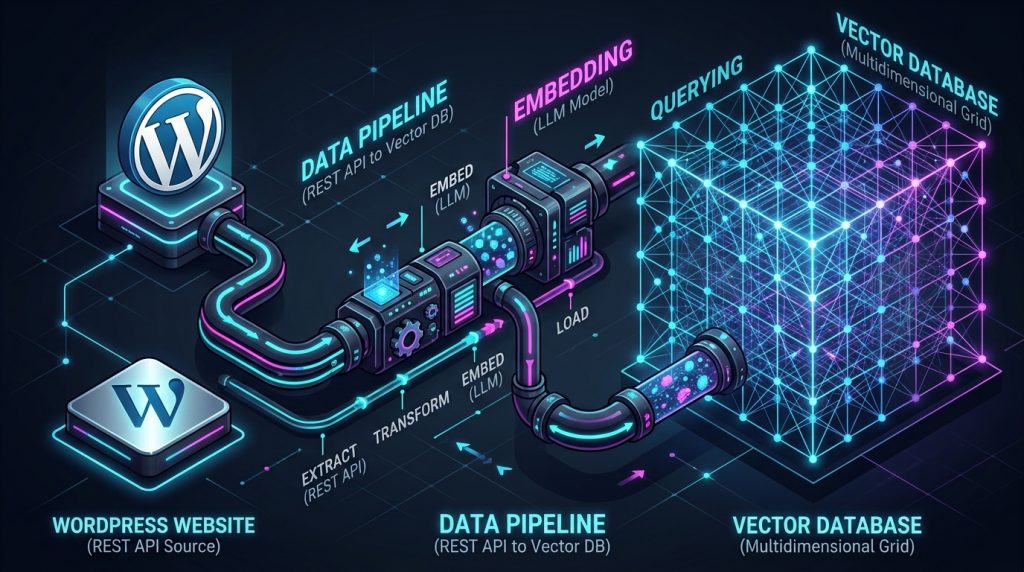
A properly engineered vector search pipeline for WordPress generally involves several distinct components working together, a synchronization process that identifies when WordPress content has been created or updated, a chunking and embedding generation step that processes that content into appropriately sized pieces and converts each piece into its corresponding vector representation, a vector database, commonly a specialized platform like Pinecone or Weaviate, purpose built specifically for storing and efficiently searching this kind of high dimensional vector data, and a query time process that converts a visitor’s actual search query into its own corresponding embedding vector and queries the vector database to find the most semantically similar stored content vectors, returning the corresponding WordPress content as the visitor’s search results.
Each of these components requires deliberate engineering attention, and the overall system’s reliability depends on all of them working together correctly and efficiently, rather than any single component in isolation.
Syncing WordPress Content Through the REST API
The WordPress REST API serves as the natural integration point for extracting content reliably and programmatically, allowing an external synchronization process to query WordPress for new and updated content in a structured, reliable format rather than needing to interact directly with the underlying database. A properly engineered synchronization process typically hooks into WordPress’s native content lifecycle, triggering an update to the vector database specifically when a post is published, updated, or deleted, rather than relying on an inefficient, resource intensive process that periodically re processes a site’s entire content library from scratch regardless of whether anything has actually changed since the previous synchronization cycle.
This event driven synchronization approach, updating the vector database incrementally in response to actual content changes rather than through full, periodic reprocessing, matters considerably for both efficiency and search accuracy, ensuring that newly published or recently updated content becomes searchable promptly rather than remaining invisible to the semantic search system until whatever periodic batch process eventually gets around to including it.
Choosing and Connecting to an External Vector Database
Vector databases like Pinecone and Weaviate are purpose built specifically for the kind of high dimensional similarity search that semantic search depends on, offering considerably better performance and scalability for this specific workload than attempting to implement equivalent similarity search functionality directly within a standard relational database like the MySQL database WordPress itself runs on. Connecting WordPress to one of these external vector databases requires building a reliable integration layer, handling authentication, managing the specific data format each vector database platform expects, and implementing appropriate error handling so that a temporary connectivity issue with the external vector database does not silently break either the synchronization process or, more critically, the live search functionality visitors actually depend on.
Selecting the specific vector database platform best suited to a given project involves genuine technical evaluation, considering factors like the platform’s specific performance characteristics at the project’s expected scale, its pricing structure relative to the project’s expected content volume and query traffic, and how well its specific API and feature set align with the broader pipeline’s architectural requirements, a decision that benefits from genuine engineering evaluation rather than a default, arbitrary choice made without considering the specific project’s actual needs.
Handling Content Updates and Deletions Reliably
A genuinely reliable pipeline needs to handle not just new content but updates and deletions correctly, ensuring that when an existing article is substantially revised, its corresponding vector representation in the external database gets updated to reflect the new content rather than continuing to reflect an outdated version indefinitely, and ensuring that when content is deleted or unpublished from WordPress, its corresponding vectors are correctly removed from the vector database as well, preventing a scenario where semantic search continues surfacing content that visitors, upon clicking through, discover no longer exists or is no longer publicly accessible.
This kind of lifecycle management requires careful, deliberate engineering, since a pipeline that reliably handles content creation but fails to properly handle updates or deletions will gradually accumulate exactly this kind of stale, orphaned data within the vector database over time, degrading search accuracy and user trust in a way that becomes progressively worse the longer the underlying synchronization gap goes unaddressed.
Query Time Performance and Caching Considerations
Beyond the synchronization pipeline itself, the actual query time experience, converting a visitor’s live search query into an embedding and querying the vector database for similar content, needs to complete quickly enough to feel genuinely responsive, ideally within a similar timeframe to what visitors already expect from standard search functionality. This requires efficient implementation of the query time embedding generation step and efficient use of the vector database’s own query capabilities, along with appropriate caching for extremely common or repeated queries where genuinely beneficial, applying the same performance engineering discipline described throughout our broader guidance on server resource optimization specifically to this new, semantically driven search workload.
Maintaining This as a Living System, Not a One Time Integration
A vector search pipeline, once built and deployed, requires ongoing attention as a living system rather than a completed, static integration. Embedding models themselves continue to improve over time, and periodically evaluating whether a newer, more capable embedding model would improve search accuracy represents a genuine, ongoing consideration. Content volume and query patterns continue evolving as a site grows, potentially warranting adjustments to chunking strategy or vector database configuration to maintain optimal performance and accuracy at the site’s continually growing scale. This ongoing maintenance responsibility is precisely why a genuine vector search implementation benefits from an ongoing engineering relationship, capable of monitoring and refining the system’s performance over time, rather than treating the initial integration as a single, permanently finished project.
Keyword Search Versus Vector Based Semantic Search
| What You Care About | Standard Keyword Search | Vector Based Semantic Search |
|---|---|---|
| Matching mechanism | Literal text overlap | Mathematical similarity of meaning |
| Handles paraphrased or conversational queries | Fails without exact word overlap | Recognizes semantic equivalence |
| Requires manual synonym maintenance | Yes, and it never fully closes the gap | No, meaning is learned by the model |
| Performance at scale | Query cost grows with content volume | Purpose built indexing for high volume search |
| Zero result search rate | Often high for natural language queries | Meaningfully reduced |
| Enables recommendations and content gap analysis | Limited to shared tags or categories | Genuine semantic relationship detection |
The Semantic UX Revolution
The genuine value of everything described throughout this article ultimately shows up in how real visitors actually experience search, and understanding these concrete, measurable improvements helps ground the technical discussion in genuine business value.
Returning Genuinely Relevant Results With Zero Keyword Overlap
The most immediately visible improvement semantic search delivers is precisely the capability described throughout this article, returning genuinely relevant, contextually accurate results even when a visitor’s actual search query shares no literal words with the content that best answers their need. This directly resolves the vocabulary mismatch problem described at the beginning of this article, transforming search from a system that only works when a visitor happens to guess the exact terminology the content itself uses, into a system that understands what a visitor actually means regardless of how they happen to phrase their specific question.
Supporting Genuinely Natural, Conversational Queries
As visitor search behavior continues trending toward natural, conversational phrasing, full questions rather than terse keyword fragments, semantic search handles this kind of query naturally and effectively, since the underlying embedding model was specifically trained to understand genuine natural language meaning rather than requiring visitors to reformulate their genuine question into an artificial, keyword optimized fragment simply to accommodate a search system’s specific technical limitations. This alignment between how visitors naturally want to search and how the underlying search system actually processes that query represents a meaningful improvement in overall user experience, removing friction that keyword based search structurally imposes on every single conversational or naturally phrased query.
Measurable Improvement in Core Search Metrics
This improvement in search relevance translates directly into measurable metrics that matter to a business, a meaningful reduction in the rate of zero result searches, a meaningful increase in search result click through rate as visitors find genuinely relevant results more consistently, and for knowledge base and documentation sites specifically, a meaningful reduction in support tickets asking questions that existing content already answered, simply because search finally became capable of actually surfacing that existing answer when a visitor asked their genuine, naturally phrased question. For ecommerce catalogs, this same improvement frequently translates into measurably improved conversion rates from search specifically, as visitors with genuine purchase intent are able to actually find the product they were looking for rather than abandoning their search in frustration.
Reducing Support Burden Through Better Self Service
For knowledge base and documentation heavy sites specifically, the connection between search quality and support ticket volume deserves particular emphasis, since a support team’s time is genuinely valuable and every avoidable ticket, one where the visitor’s question already had a documented answer that failed keyword search simply prevented them from finding, represents both an unnecessary cost to the business and an unnecessarily frustrating experience for the visitor who had to wait for a human response to a question the existing content could have answered instantly. Semantic search directly attacks this specific inefficiency, improving genuine self service success rate and, as a direct consequence, reducing the volume of support tickets that never needed to become tickets in the first place had search simply been capable of connecting the visitor’s genuine question to the content that already answered it.
Enabling Genuinely New Product Experiences Beyond Search Alone
Beyond directly improving the search box itself, a properly built vector database integration opens up genuinely new product capabilities that keyword based systems have no realistic path toward, related content recommendations based on genuine semantic similarity rather than shared tags or categories alone, an AI powered assistant capable of drawing on a site’s actual content to answer visitor questions conversationally, and content gap analysis, identifying topics visitors are genuinely searching for where no sufficiently relevant existing content exists, directly informing a content team’s future editorial priorities based on genuine, demonstrated visitor need rather than guesswork alone. These capabilities all build on the same underlying vector infrastructure described throughout this article, representing genuine additional return on the engineering investment required to build the core semantic search capability in the first place.
What This Looks Like in Practice
Consider a growing SaaS company whose extensive knowledge base, built up over several years and containing several hundred detailed support articles, has been struggling with a search abandonment problem the support team had noticed anecdotally but never precisely measured. A review of internal search logs confirms the problem clearly, a significant share of searches returning zero results, and analysis of these specific failed queries reveals the exact vocabulary mismatch pattern described throughout this article, visitors searching using natural, conversational phrasing that shared little or no literal vocabulary with the specific, more technical terminology the knowledge base articles themselves happened to use.
An engineering team builds a vector search pipeline specifically for this knowledge base, chunking existing articles into appropriately sized sections, generating embeddings for each chunk, and syncing this data into a properly configured external vector database through a synchronization process integrated directly with the site’s WordPress REST API, triggering updates automatically whenever knowledge base content changes. The search interface itself is updated to route queries through this new semantic search pipeline rather than WordPress’s default keyword search. Within the following quarter, the knowledge base’s zero result search rate drops dramatically, and the support team observes a measurable reduction in tickets specifically asking questions that existing articles already answered, directly reflecting visitors now successfully finding those answers through search rather than needing to escalate to a human support agent for a question the knowledge base had already addressed all along.
A Second Scenario: An Ecommerce Catalog Recovering Lost Search Revenue
Consider a different case, a specialty ecommerce retailer with a genuinely large, detailed product catalog, where internal analysis revealed that a meaningful share of on site search queries were returning zero or poorly matched results, particularly for visitors describing what they wanted in natural, descriptive language rather than using the retailer’s own specific product naming conventions, a visitor searching for a warm jacket for cold hikes failing to surface a specific product technically named using a manufacturer style code and a set of technical fabric specifications rather than any of the visitor’s own natural descriptive language.
A vector search implementation, generating embeddings for each product’s full description, including its practical use cases and features described in natural language within the product copy itself, allowed the search system to correctly connect a visitor’s natural, descriptive query to the specific product that genuinely matched their underlying need, regardless of whether the visitor’s phrasing happened to overlap with the product’s own specific technical naming. Following deployment, the retailer observed a measurable increase in conversion rate specifically among visitors who used the on site search function, directly reflecting genuine purchase intent that had previously been lost to a search experience incapable of understanding what these visitors actually meant.
A Checklist for CTOs and Technical Leads
For technical leaders trying to determine whether their own site’s search experience would benefit from this kind of investment, a few direct questions help surface the answer. Has anyone reviewed internal search query logs specifically to measure the rate of zero result or low engagement searches, or has search quality only ever been evaluated anecdotally. Does the site’s content genuinely address a broad range of topics using specific, sometimes technical terminology that may not naturally match how a typical visitor would phrase their actual question. Is search abandonment a plausible contributor to support ticket volume, meaning visitors likely resort to filing a support ticket for questions that existing content may already answer, if only search were capable of surfacing that answer. And does the site’s content volume and growth trajectory justify investment in this kind of infrastructure, versus a smaller site where content volume remains modest enough that keyword search’s specific limitations rarely surface as a genuine, visible problem in practice.
A single yes among these questions suggests a specific, worthwhile area for further investigation. Multiple yes answers, particularly a documented pattern of zero result searches combined with a genuinely large, topically diverse content library, indicate that vector database integration represents a genuinely high value technical investment, one where the resulting improvement in search relevance and the corresponding reduction in support burden are both likely to be measurable and significant.
Frequently Asked Questions About Vector Search in WordPress
Does implementing semantic search mean completely replacing WordPress’s existing search functionality
Generally, yes for the specific search experience visitors interact with directly, since the underlying query handling logic is replaced with the vector based approach described throughout this article. WordPress’s native content management, publishing workflow, and general site functionality remain entirely unchanged, with the vector search pipeline operating as an additional, integrated layer specifically powering the search experience itself, rather than requiring any broader disruption to how content is actually created and managed within WordPress.
How much does connecting to an external vector database like Pinecone or Weaviate typically cost
Pricing for vector database platforms typically scales with the volume of stored vectors and query traffic, meaning cost depends considerably on a specific site’s actual content volume and search traffic. Many vector database platforms offer tiers appropriate for smaller scale projects at a relatively modest cost, with pricing scaling upward for genuinely large content libraries and high query volumes, making a careful evaluation of the specific platform’s pricing structure relative to a given project’s actual expected scale an important part of the initial technical evaluation process.
Can vector search work alongside traditional keyword search rather than fully replacing it
Yes, and a hybrid approach, combining semantic vector search with traditional keyword matching, represents a genuinely valuable architecture for some use cases, particularly where exact matching still carries specific value, a visitor searching for a specific product model number or a specific exact term benefiting from precise keyword matching working alongside the broader semantic understanding vector search provides for more naturally phrased, conversational queries. This kind of hybrid approach requires additional engineering complexity to properly combine and rank results from both approaches, but can deliver genuinely the best of both underlying search mechanisms for sites where both exact and semantic matching provide genuine value.
How does this connect to the AI powered content pipelines and automated SEO workflows described in your other guidance
The same embedding technology underlying semantic search also powers genuinely intelligent content clustering, identifying topical relationships between existing content based on actual semantic similarity rather than manual categorization alone, described in more depth throughout our broader guidance on scalable, SEO ready WordPress architecture. A business already investing in AI powered content clustering and automated internal linking has a natural, complementary next step in extending that same underlying vector infrastructure to power semantic search directly for site visitors, since much of the same embedding generation and vector storage infrastructure serves both purposes.
Is this kind of implementation only relevant for very large sites, or does a smaller content hub benefit as well
The underlying vocabulary mismatch problem described throughout this article affects sites of any size where content covers a genuinely broad range of topics using specific terminology visitors may not naturally guess. That said, the relative return on this engineering investment scales considerably with content volume and search traffic, meaning a smaller site with limited content and light search traffic may find the investment less immediately justified compared to a larger, more heavily searched content hub or knowledge base where the cumulative impact of improved search relevance affects a considerably larger volume of real visitor interactions.
Does semantic search require sending our proprietary content to a third party AI service, and what are the data privacy implications
Generating embeddings does typically involve processing content through an embedding generation model, which may be hosted by a third party provider depending on the specific model and infrastructure chosen for a given implementation. This is a genuine consideration worth evaluating carefully as part of the technical planning process, including reviewing the specific data handling and privacy practices of whichever embedding provider and vector database platform are selected, and considering self hosted or more tightly controlled alternatives for businesses with particularly sensitive content or strict data governance requirements that require content to remain within a specifically controlled environment throughout the entire processing pipeline.
How does the system handle a visitor’s query that genuinely has no good matching content anywhere on the site
A properly engineered semantic search implementation includes a relevance threshold, meaning results are only returned when their computed similarity to the query genuinely exceeds a meaningful bar, rather than always returning some result regardless of how weak the actual semantic match happens to be. For queries that genuinely have no strong matching content, the system should recognize this and respond appropriately, whether by returning no results, by returning the closest available matches with an appropriate confidence indication, or by surfacing this pattern as a genuine content gap worth the editorial team’s attention, precisely the content gap analysis capability described earlier in this article.
Can vector search be implemented incrementally, starting with a specific section of the site rather than the entire content library at once
Yes, and this is often a practical, sensible implementation approach, particularly for a genuinely large site where prioritizing the specific content section most affected by search abandonment, a knowledge base or a product catalog specifically, allows the initial engagement to demonstrate clear, measurable value before extending the same underlying pipeline architecture to additional content sections in subsequent phases, rather than requiring the entire site’s content to be processed and integrated simultaneously before any benefit can be realized.
How is search result quality actually measured and validated once semantic search is deployed
Genuine validation involves both quantitative metrics, tracking zero result search rate, click through rate on search results, and search to conversion or search to resolution rate over time compared against the previous keyword based baseline, and qualitative review, periodically sampling actual search queries and their corresponding results to confirm the semantic matches returned genuinely make sense to a human reviewer, catching any systematic pattern where the embedding model might be producing matches that are mathematically similar but not genuinely useful to a real visitor’s actual underlying need, a distinction that automated metrics alone do not always fully capture without this kind of periodic human review layered on top.
Upgrade Your Search Experience From Standard Matching to True Cognitive Intelligence
Standard WordPress search was built around literal text matching, a mechanism fundamentally incapable of understanding what a visitor actually means when their natural phrasing does not happen to overlap with a piece of content’s own specific wording. Vector database integration solves this at a genuinely architectural level, representing meaning itself in a mathematical form that allows semantically related content and queries to be recognized as related regardless of their literal vocabulary, built through a real engineering pipeline connecting WordPress to a purpose built vector database through the REST API, kept accurately synchronized as content continues to evolve. For CTOs and technical leads managing large content hubs, knowledge bases, or ecommerce catalogs where search quality directly affects user satisfaction, support burden, and conversion, this represents exactly the kind of foundational technical investment capable of transforming search from a persistent source of visitor frustration into a genuine competitive advantage.
Why This Is Headless and API Engineering Work, Not a Plugin Installation
It is worth being direct about the nature of this work. There is no plugin that reliably delivers genuine vector database integration, since this requires real backend engineering, connecting to an external, purpose built vector database through its own API, building reliable synchronization logic through the WordPress REST API, and implementing the query time logic that converts a visitor’s search into a properly formed similarity query. This is precisely the kind of headless and API integration work that sits well outside what any standard WordPress plugin, however well reviewed, is designed to provide, requiring engineers genuinely comfortable working across WordPress’s own architecture and the external vector database and embedding infrastructure this kind of implementation depends on.
An Ongoing Relationship, Not a Single Deployment
As described throughout the integration section of this article, a genuine vector search implementation is not a project with a single, permanent finish line. Embedding models improve. Content libraries grow and change. Query patterns shift as visitor behavior evolves, particularly as natural, conversational search becomes an increasingly standard expectation across the broader web. A business that treats its vector search infrastructure as a living system, periodically reviewed and refined as these underlying conditions change, realizes considerably more sustained value from the investment than one that deploys the initial implementation and never revisits it again, precisely the kind of ongoing engineering discipline a genuine resolution based support relationship is specifically built to sustain over the long term, giving a growing content hub or knowledge base continuous access to the specialized expertise this kind of infrastructure requires as it continues to evolve alongside the business itself.
Where to Start
For technical leaders ready to explore this investment, the most valuable starting point is precisely the kind of internal search log analysis described earlier in this article, reviewing actual query data to measure the genuine scale of the zero result and low engagement search problem within your own specific site, before committing to a full scale implementation. This kind of grounded, evidence based starting point ensures the resulting engineering investment is scoped and prioritized around your site’s own actual, measured search behavior, rather than a generic assumption about what semantic search might theoretically improve, turning an abstract technical upgrade into a specific, measurable business case built on your own real visitor data.
Upgrade From Standard Matching to True Cognitive Intelligence
Contact our headless and API experts to integrate custom vector database integration today, and build search logic that matches how your customers actually think.
