
WordPress Redesign Services: Why Speed & SEO Must Come Before Aesthetics
Building a beautiful website without prioritizing Speed and SEO is like building a luxury showroom in the middle of a desert. It looks magnificent, but no one is ever going to find it. In 2026, the best WordPress redesign services treat design as a secondary function of performance.
A Performance-First WordPress Redesign ensures that technical SEO and Core Web Vitals are engineered into the codebase from day one—not bolted on afterward. This single strategic distinction is what separates a site that drives revenue from one that merely earns compliments. The business case is direct: aesthetic-only redesigns that ignore technical SEO foundations are a primary driver of the traffic losses that routinely follow a site launch, with businesses often seeing 30–40% of their organic visibility evaporate within weeks of going live.
Before you sign a contract with any WordPress redesign services agency, you need to understand exactly what you’re buying—and more importantly, what you may be losing if the brief starts with color palettes instead of crawl budgets. For context on how enterprise-level WordPress management works, see our guide on enterprise WordPress maintenance.
The “Designer vs. Engineer” Conflict: Where WordPress Redesign Services Fail
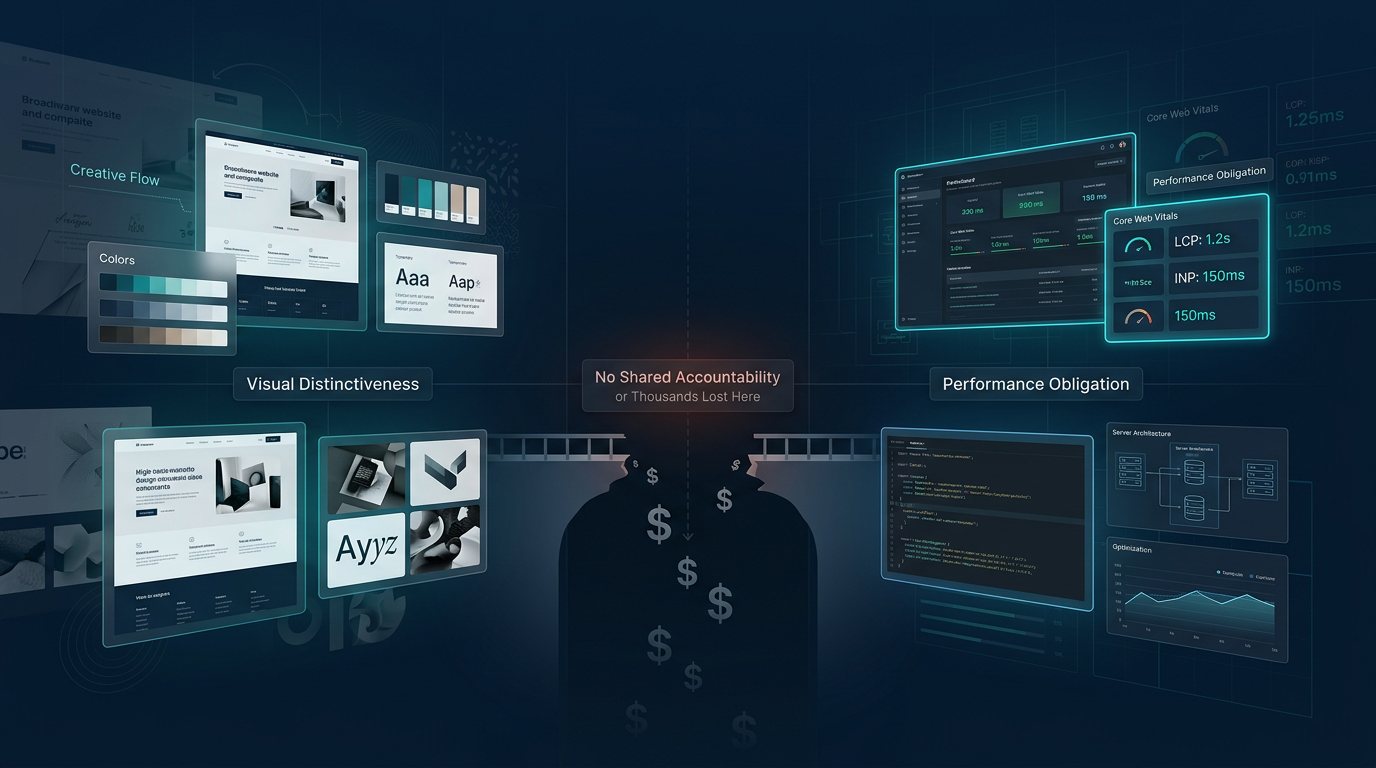
There is a structural tension inside almost every web design project, and most business owners never see it coming. A designer’s professional incentive is to produce something visually distinctive. An engineer’s professional obligation is to produce something that performs. When these two disciplines operate without shared accountability metrics, designers win—and business owners lose.
This is not an indictment of designers. It is an indictment of a process that has no performance budget built into it. It is the most common failure mode in WordPress redesign services across the industry.
Visual Flair Is Not Free—It Has a Millisecond Cost in WordPress Redesign Services
Every design decision carries a weight in render time. Autoplay video backgrounds, entrance animations powered by heavy JavaScript libraries, full-width image sliders, custom cursor effects—these are not just stylistic choices. They are direct attacks on your Largest Contentful Paint (LCP) score.
LCP measures the time between a page request and when the largest content element is displayed in the visible viewport. A good LCP score is under 2.5 seconds. When a designer places a looping MP4 video as a hero background, that video is almost certainly your LCP element. You have just made it nearly impossible to pass the single most consequential speed threshold Google measures.
The three Core Web Vitals—LCP, Interaction to Next Paint (INP), and Cumulative Layout Shift (CLS)—measure how fast your site loads, how responsive it feels, and how visually stable it is. Passing these metrics leads to better Google rankings, reduced bounce rates, and higher conversions. Failing them usually comes down to slow servers, unoptimized images, heavy JavaScript, or unstable layouts.
Business Risk: A single autoplay video background can push your LCP from 1.8 seconds to 5+ seconds. That is the difference between “Good” and “Poor” on Google’s own scale—and the difference between winning and losing in competitive search.
According to the 2025 Web Almanac, only 48% of mobile pages and 56% of desktop pages pass all three Core Web Vitals. That means more than half the web is failing on mobile. Your new “visually immersive” WordPress site is probably about to join that failing majority.
What a Performance Budget Actually Is—and Why WordPress Redesign Services Need One
A performance budget is a hard constraint placed on every design decision before a single line of code is written. It specifies the maximum allowable page weight in kilobytes, the maximum number of HTTP requests, the maximum JavaScript bundle size, and the LCP target in milliseconds. Every design element—every font, every animation, every third-party embed—must justify its weight against this budget before it is approved.
This is how WPscaleops operates. No mockup gets client approval without a corresponding performance impact estimate attached to it. If a design element cannot justify its millisecond cost in terms of conversion value, it does not ship.
Sector leaders like Amazon, Zalando, and ASOS invest in dedicated performance teams with real-time monitoring and performance budgets that block deployments when any metric exceeds a defined threshold. If the world’s most profitable e-commerce operations run their design process this way, there is no argument for any WordPress redesign services provider to operate differently.
The SEO Migration Strategy: Protecting Equity in WordPress Redesign Services
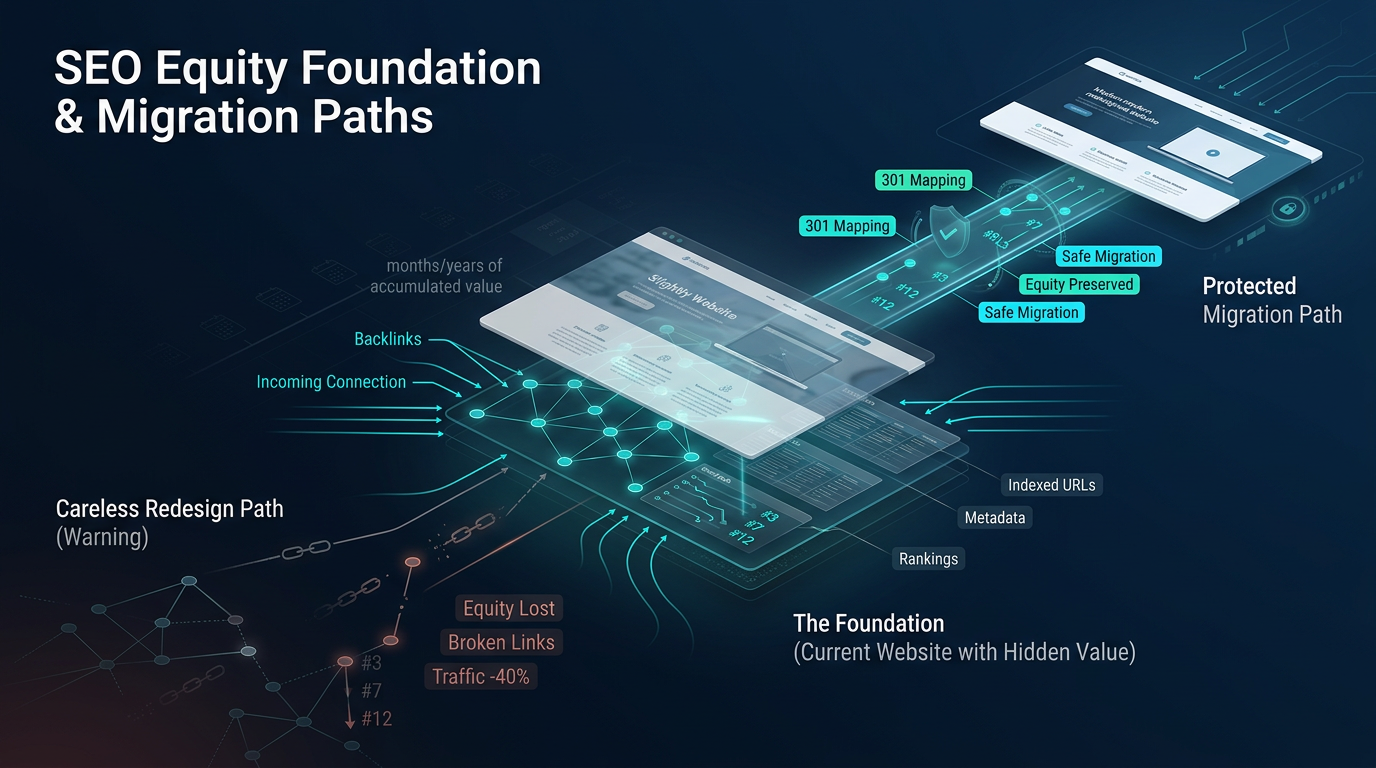
Here is a fact that most agencies presenting you with mood boards will never mention: your current website, however outdated it looks, has accumulated SEO equity over months or years. That equity lives in indexed URLs, established crawl paths, accumulated backlinks, metadata structures, and heading hierarchies that Google has already evaluated and assigned ranking value.
WordPress redesign services are supposed to improve your website, not damage your traffic. Yet many businesses experience an unexpected drop in visibility, rankings, and organic sessions shortly after launching a new site. This often happens because crucial SEO structures, technical settings, or content foundations were changed or removed during the redesign process.
The Silent Killers of Poorly Managed WordPress Redesign Services
There are three categories of technical SEO debt that are routinely created—not inherited—during an aesthetic-only redesign:
1. Broken Internal Links and Missing 301 Mapping
When URL structures change during a redesign without a comprehensive 301 mapping document in place, every old URL becomes a 404. Every backlink pointing to that URL—regardless of how authoritative the referring domain—now resolves to a dead page. Google demotes the referring link equity. Your rankings follow.
When a site is redesigned and a tool’s URL structure changes, even when 301 redirects are put in place for top-level pages, none may be created for sub-pages. And those sub-pages often hold all the links and traffic—so Google drops those pages from search results, and all that traffic disappears overnight.
2. Lost Metadata and Altered Heading Structures
Title tags and meta descriptions are not just text fields in a CMS. They are Google’s primary signal for understanding what a page is about and how to represent it in search results. In the rush to build out a new visual template, these get cleared, overwritten, or homogenized. Similarly, heading hierarchies—the H1, H2, H3 structure that communicates content architecture to crawlers—frequently get restructured to serve visual layout rather than semantic HTML logic. The result is technical SEO debt that takes months to reverse.
3. Page Speed Regression
Redesigns often introduce heavy themes, animations, large images, and unnecessary scripts. A slower website drastically reduces organic visibility because speed is a major ranking factor in Google’s Core Web Vitals. Slow pages also frustrate visitors, increasing bounce rates and lowering engagement.
Why WPscaleops Runs an SEO Audit Before the First Mockup in Our WordPress Redesign Services
This is non-negotiable. Before any wireframe is drawn, our process begins with a full technical and content audit of your existing site. This audit documents:
- Every URL currently indexed by Google, along with its traffic value
- The complete internal linking map and DOM depth of critical conversion pages
- All existing metadata, structured data markup, and canonical tag configurations
- Current Core Web Vitals field data from Google Search Console’s CrUX dataset
- A crawl of all backlink targets to identify high-value URLs that require 301 protection
This audit is the architectural blueprint that the entire redesign is built around. The design serves the data. Not the other way around. This is what distinguishes professional WordPress redesign services from aesthetic-only agencies.
Technical Aesthetics: Cinematic Design in WordPress Redesign Services Without the Performance Penalty
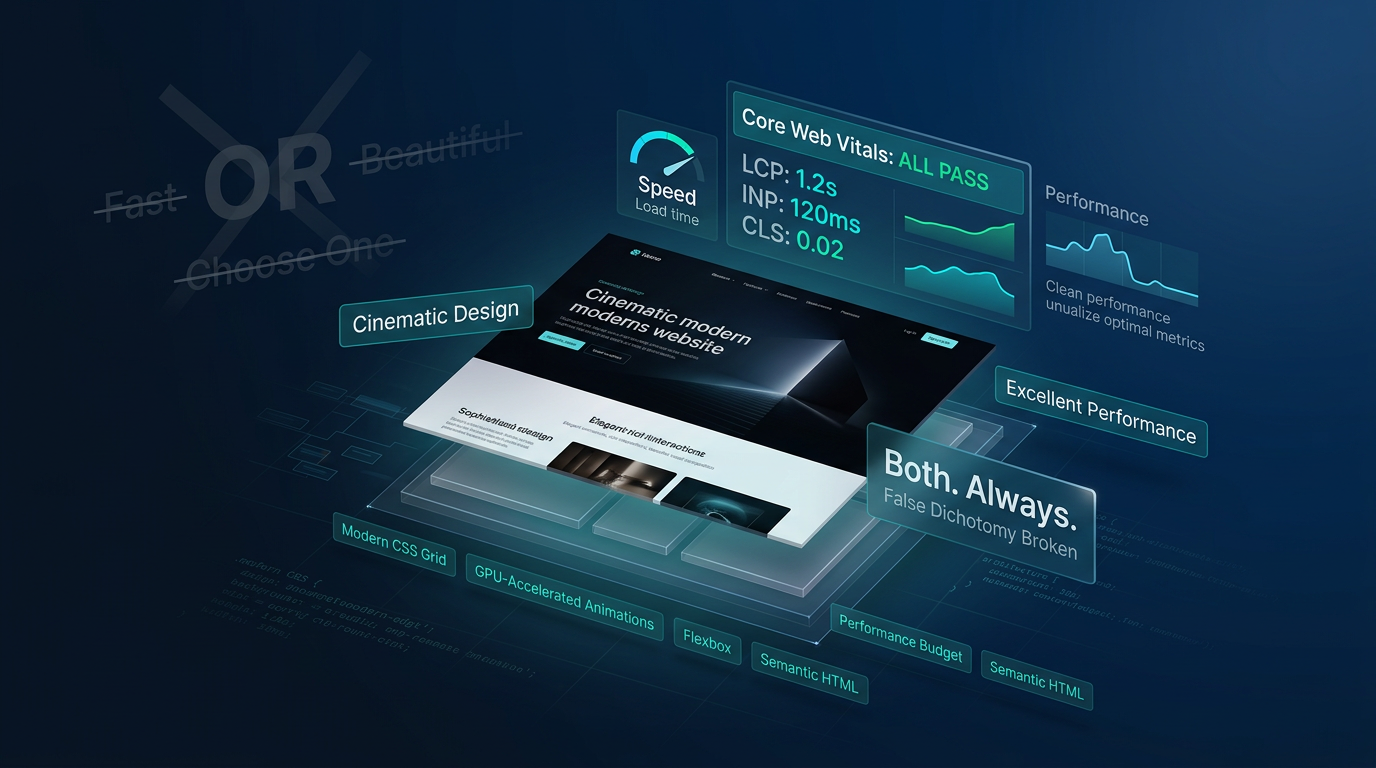
The false choice presented to most business owners is: “Do you want a fast site or a beautiful site?” This is a false dichotomy propagated by designers who have not kept pace with modern CSS capabilities and engineers who have not developed a visual sensibility. Professional WordPress redesign services eliminate this trade-off entirely.
A common objection is: “if I add animations and rich interactions, my Core Web Vitals will suffer.” This is a false dilemma. It is entirely possible to combine sophisticated interactions with excellent performance scores—by applying rigorous architecture principles.
Modern CSS Does the Heavy Lifting in Performance-First WordPress Redesign Services
CSS Grid and Flexbox have fundamentally changed what is achievable without JavaScript. Complex, visually layered layouts that previously required jQuery libraries and DOM-manipulating animation frameworks can now be built entirely in CSS. CSS Grid provides two-dimensional layout control with zero JavaScript overhead. CSS custom properties (variables) enable dynamic theming. CSS @keyframes delivers smooth, GPU-accelerated animations without touching the main thread.
Contrast this with the standard approach: a bloated page builder like Divi or WPBakery that generates 400+ DOM nodes per section, enqueues five to eight separate JavaScript files, and outputs inline styles that override every attempt at asset minification.
Business Risk: Deep DOM depth—the structural complexity of your page’s HTML tree—directly impacts how long a browser takes to render your page. A typical Elementor or Divi page can produce DOM depths that are 3–4x deeper than a custom-built Gutenberg block page. This is not a cosmetic problem. It is a Core Web Vitals problem.
SVG Icons vs. Icon Font Libraries in WordPress Redesign Services
Font Awesome is loaded on a significant percentage of WordPress sites. It is a 250KB+ font file loaded for what are, in most cases, a handful of icons. Every one of those icons can be replaced with an inline SVG element that weighs between 500 bytes and 2KB, scales perfectly at any resolution, and is fully accessible. This single swap can eliminate a render-blocking resource and reduce your total page weight by hundreds of kilobytes.
Custom Gutenberg Blocks: The WordPress Redesign Services Approach Over Bloated Page Builders
WPscaleops builds in Custom Gutenberg Blocks. Not Elementor widgets. Not Divi modules. Not WPBakery shortcodes that leave raw [vc_row] markup in your database when you eventually switch platforms.
Custom Gutenberg Blocks produce clean, semantic HTML output. They carry no external CSS framework dependencies. They do not enqueue scripts on pages where those scripts are not needed. They output exactly the markup your design requires—nothing more. This architecture is what makes asset minification meaningful: when your code is lean at the source, optimization tools actually have something worth optimizing.
The ROI of Speed: Why WordPress Redesign Services Must Prioritize Performance
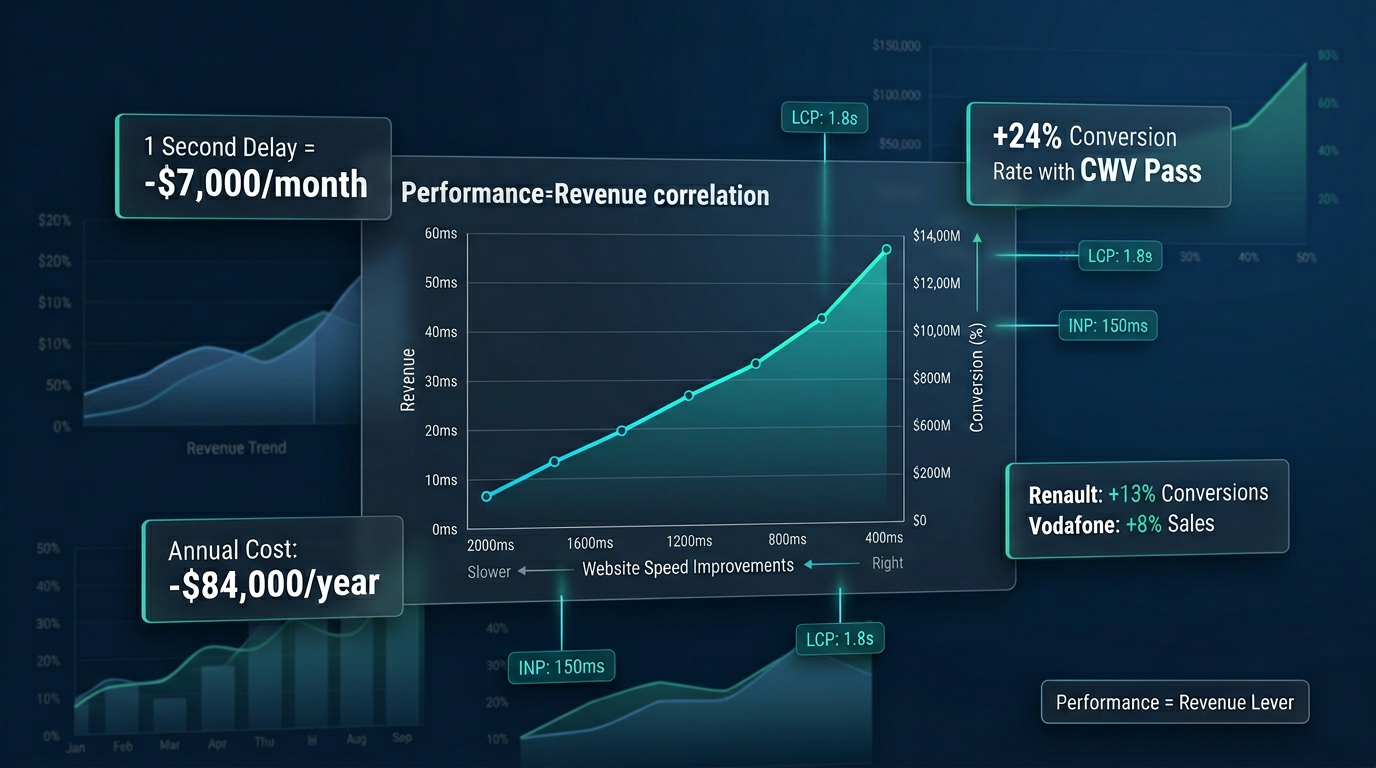
Performance optimization is not a technical vanity project. It is a direct revenue lever. The data from 2025 and 2026 is unambiguous.
A one-second delay in load time reduces conversions by 7%. For an e-commerce site generating $100,000 per month, that’s $7,000 in lost revenue every month. $84,000 per year. For one second.
A 0.1-second improvement in load time has been documented to lift e-commerce revenue by approximately 1 percent.
2025 data shows that e-commerce sites passing all three Core Web Vitals thresholds have a 24% higher conversion rate than those that do not. Sector leaders maintain a median LCP below 1.8 seconds, CLS below 0.04, and INP below 150ms.
Real-world data from the Chrome User Experience Report analyzing 10+ million sites shows measurable ROI: Renault improved LCP by 1 second, which resulted in a 14% bounce rate reduction and 13% conversion increase. Vodafone improved LCP by 31%, resulting in an 8% sales increase and a 15% cart-to-visit rate improvement. These are the outcomes that performance-first WordPress redesign services are engineered to deliver.
Google’s Page Experience Signal: The Tiebreaker in WordPress Redesign Services Strategy
Content relevancy is still the number one ranking factor when Google builds the SERP. However, for many queries, there is lots of helpful and relevant content available. In such cases, having a good page experience could be the main differentiator leading to success in search.
Core Web Vitals function as a tiebreaker signal, not a primary ranking factor. Strong Vitals remove a disqualifying signal but cannot overcome fundamentally weak content relevance or low authority. This is the precise strategic argument for getting your performance right during WordPress redesign services. In competitive niches—where multiple providers offer comparable services, where content quality is broadly similar—the technical performance of your site is the variable that determines which business appears on page one and which appears on page two.
In 2026, with AI-generated content flooding search results, the technical excellence of your site architecture has become a critical differentiator. As AI-powered search experiences evolve, user experience quality likely becomes even more important. AI systems generating answers from multiple sources must evaluate which sources provide the best experiences alongside content quality. Pages delivering poor experiences—slow loading, unresponsive interfaces, unstable layouts—might be deprioritized in AI-generated summaries even if their content quality is high.
Comparison Table: Standard Redesign vs. WPscaleops WordPress Redesign Services
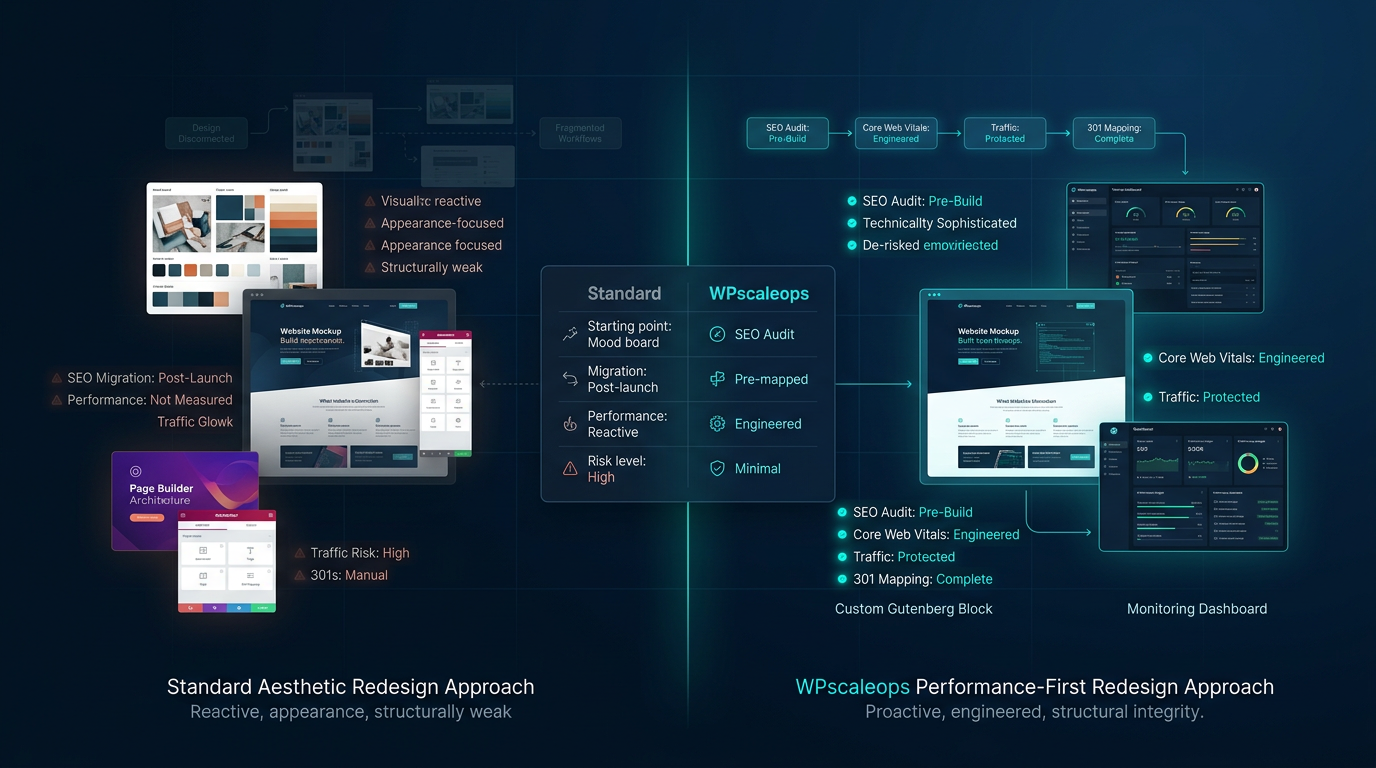
| Factor | Standard Aesthetic Redesign | WPscaleops WordPress Redesign Services |
|---|---|---|
| Starting Point | Brand mood board, color palette | Technical SEO audit + CWV baseline |
| SEO Migration | Redirects handled post-launch (if at all) | Full 301 mapping documented pre-build |
| Page Builder | Elementor, Divi, WPBakery | Custom Gutenberg Blocks |
| JavaScript Strategy | jQuery, animation libraries loaded globally | Code-split, deferred JS loaded per-component |
| Image Assets | JPEG/PNG, no srcset, lazy-loading on LCP element | WebP/AVIF, responsive srcset, LCP image preloaded |
| Icon System | Font Awesome or icon fonts (200–400KB) | Inline SVG (< 2KB per icon) |
| Performance Budget | None defined | Hard constraints set pre-wireframe |
| DOM Depth | 400–800 nodes per section | Lean, semantically structured HTML |
| Core Web Vitals | Assessed after launch | Engineered to pass before launch |
| Heading Structure | Determined by visual layout | Determined by semantic HTML and keyword hierarchy |
| Metadata Strategy | Migrated manually (inconsistently) | Audited, mapped, and migrated systematically |
| Post-Launch Monitoring | None included | CrUX field data tracking + Search Console alerts |
| Traffic Risk | High — 30–40% drop common | Minimal — SEO equity actively protected |
| Conversion Focus | Aesthetics-driven UX | Conversion-centric design with friction analysis |
AEO FAQ: WordPress Redesign Services — Questions Your Designer Hopes You Never Ask
How long do professional WordPress redesign services take compared to a visual redesign?
A purely aesthetic redesign—new theme, new layout, no structural analysis—can be completed in four to six weeks. It is fast precisely because it skips the foundational work. Performance-First WordPress redesign services typically run eight to fourteen weeks depending on site size. That additional time is spent on the SEO audit, 301 mapping, performance budget definition, custom block development, and Core Web Vitals validation before launch.
The question you should be asking is not “how fast can we launch?” It is “how much organic traffic can we afford to lose while we recover from a botched migration?” Recovery from a poorly executed redesign typically takes three to nine months—if it happens at all. Links from other sites play a factor in rankings, so when those links point to dead URLs, the site’s rankings may never fully recover—effectively handing the competition an entire page-one advantage. The additional six weeks upfront is categorically cheaper than the alternative.
Can you fix a slow WordPress site after it’s built, or do WordPress redesign services require a rebuild?
It depends on what “slow” means at the architectural level. Surface-level performance problems—unoptimized images, missing caching configuration, non-deferred scripts—can be addressed post-launch through optimization. These are legitimate quick wins and they matter.
Structural performance problems are a different category entirely. If your site was built on a bloated page builder with excessive DOM depth, globally enqueued JavaScript across all pages, render-blocking third-party embeds wired into the theme header, and no semantic HTML structure—you are not looking at an optimization job. You are looking at a rebuild. Putting a caching plugin on top of a structurally bloated build is the digital equivalent of painting over damp walls. The most frequent mistake is treating Core Web Vitals as a one-time project. The reality is that every new third-party script, every design change, every content update can introduce a regression. If the architecture is unsound, regressions will continue indefinitely regardless of how many optimization plugins you stack. This is precisely why WordPress redesign services must address architecture first.
What is “Frictionless UX” and how do WordPress redesign services engineer it?
Frictionless UX is a conversion-centric design philosophy that eliminates every unnecessary step, load delay, layout shift, or visual instability that stands between a user’s intent and a completed action—a purchase, a form submission, a phone call. It is not a visual style. It is a systems approach to removing the micro-frustrations that cause users to abandon pages before converting.
The relationship to server-side speed is direct and non-negotiable. A frictionless experience requires that pages respond instantly to user intent. Pages loading in under 2 seconds show a 9% bounce rate. Those exceeding 5 seconds see rates explode to 38%. For every second of delay beyond the 2.5-second LCP threshold, bounce rates increase by 32%.
Server-side speed—Time to First Byte (TTFB), server response time, hosting infrastructure quality—determines how quickly the browser even begins to receive your page. No amount of front-end optimization eliminates a slow server. A TTFB above 600ms will make passing LCP targets extremely difficult regardless of how well the front end is optimized. In 2026, over 60% of Google searches happen on mobile. Google now uses mobile scores as the primary ranking signal, including for desktop results. Even if your site is fast on a high-end laptop with fiber internet, it’s the performance on a mid-range Android smartphone on 4G that determines your position in search results. Professional WordPress redesign services engineer for this reality from day one.
What a Performance-First Brief Looks Like in Practice: WordPress Redesign Services by WPscaleops
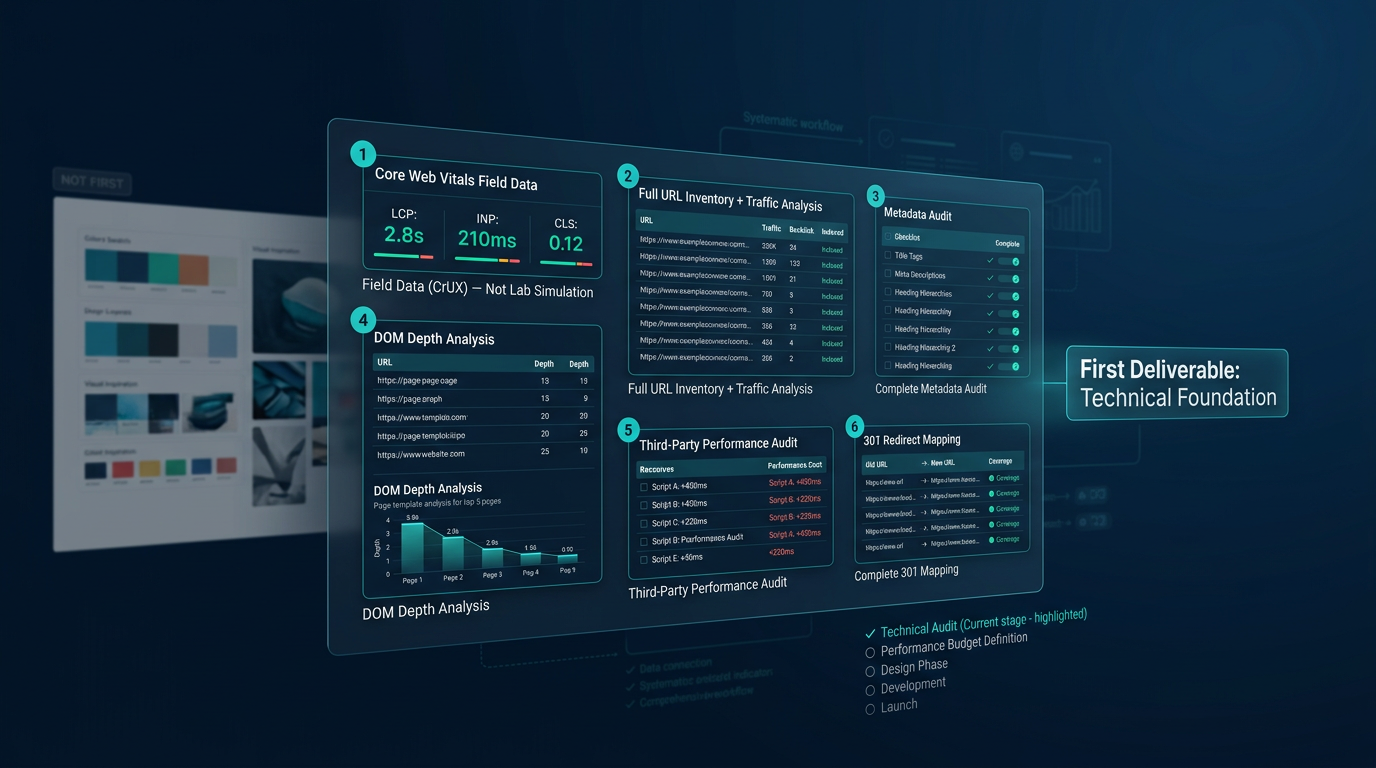
When a new client engages WPscaleops for WordPress redesign services, the first deliverable is not a mood board. It is a Technical SEO and Performance Baseline Report that documents:
- Current LCP, INP, and CLS scores from field data (not Lighthouse lab simulation)
- Full URL inventory with traffic values, backlink counts, and indexed status
- Complete metadata audit across all ranking pages
- DOM depth analysis of the five highest-traffic page templates
- Third-party script audit—every external resource loading on every page, with a documented performance cost for each
- 301 redirect mapping from every current URL to every intended new URL
Only after this document exists does the design process begin. Every wireframe is produced against a defined performance budget. Every component is evaluated for its millisecond cost before it is approved for development. Core Web Vitals testing runs in staging, not after launch.
Business Risk: Any agency that presents you with visual concepts before conducting an SEO audit is building your new site on sand. The investment you’re about to make has a high probability of destroying the organic traffic that is currently paying your bills.
The competitive reality of 2026 is this: when multiple pages offer similar content quality and authority, the site delivering superior user experience gains the decisive advantage. With AI-generated content flooding search results, the technical excellence of your site architecture has become a critical differentiator.
A WordPress redesign services engagement that starts with aesthetics and ends with performance is a liability. One that starts with performance and arrives at aesthetics through disciplined constraint—that is an asset. It is the difference between a showroom that people find and one that no one does.
WPscaleops.com specializes in Performance-First WordPress redesign services for businesses that need their investment to generate measurable ROI, not just a new coat of paint.